News

07 Jul 2026
The Hardest Part of Data Sharing Isn't the Data
Every state wants to make better decisions with data. Whether the goal is understanding workforce outcomes, improving education policy, evaluating health and human services programs, or measuring the long-term impact of public investments, administrative data has become one of the most valuable strategic assets any state or federal agency can leverage. Public agencies are structured to pass citizens from one milestone to the next. Early childhood programs prepare toddlers for kindergarten. High schools equip teens for college or trades. Higher education and training programs provide adults with the knowledge and skills to successfully enter careers. No single agency handles the entire pipeline; each operates as one piece of a large, often unaligned puzzle. Across the country, leaders increasingly recognize that linking these data across agencies can reveal important insights. Agencies deploy programs based on what they believe works, yet they frequently lose track of the individuals they serve the moment they cross an institutional boundary. This makes it difficult to know if their efforts had the desired outcomes. Without cross-agency and even cross-region data sharing, feedback is often inconsistent, nonexistent, or based on isolated and often dated anecdotes. Yet while nearly everyone agrees on the value of data sharing, many initiatives take years to launch or never move beyond the planning stage. The common assumption is that the biggest challenge is technical. Agencies expect the hard part will be integrating different systems, securely transferring data and classified information, or matching records across databases built decades apart. In our experience, those are rarely the barriers that determine success. In an environment that requires collaboration, the real challenge is building trust. We have seen this time and time again at Coleridge and we hear this firsthand from our partners who do similar work in the field. Successful data sharing is ultimately about creating an environment where agencies understand their legal authority, governance structures are clearly defined, privacy protections are well understood, and every participant has confidence that data will be used responsibly. Great technology enables collaboration, but trust is what makes collaboration possible. In other words, the barriers are organizational and not just technical Another primary challenge for agencies beginning a data-sharing journey is how quickly technical questions give way to larger structural and operational ones. Can we legally share this data? Who approves new research projects within secure data systems? Who remains responsible for the data after it's shared or placed in a secure platform? How are privacy risks managed and mitigated? What happens when multiple agencies have different interpretations of the law? These questions often become far more complex than selecting software or building secure infrastructure. The question is rarely whether agencies can or cannot link their data, but how they can do it in a way that provides actionable insights without sacrificing individual privacy. Building trust and operational questions are two of the primary challenges of sharing administrative data but there are a host of other matters to address in a data sharing partnership. Timely Legal Engagement Another hurdle that hampers progress is involving legal counsel too late in the process, after months of planning have already taken place. By that point, agency project teams may have developed technical solutions, defined research objectives, identified partners, and drafted governance models before attorneys are asked to review agreements. Legal teams are then asked to evaluate a nearly finished proposal instead of helping shape a framework that is legally sustainable from the beginning. General counsels and other legal support should be viewed as partners from the beginning. When several agencies participate, multiple legal departments may interpret the same statutes differently, creating additional rounds of reviews and negotiations. Early legal engagement changes the entire trajectory of a project and it allows agencies to identify statutory authority, clarify privacy obligations and requirements, define governance responsibilities, and resolve questions before they become barriers. Rather than acting as gatekeepers at the end of the process, legal and privacy professionals become partners in designing legal and governance frameworks that everyone can support. Modern Collaboration Bumps Against Outdated Legislation Many of the laws governing administrative data were written long before cloud computing, secure research environments, sophisticated matching processes, or multi-agency collaborations became commonplace. As a result, agencies may have clear authority to collect and use their own data but lack explicit statutory authority to share it through trusted third-party intermediaries or modern secure research environments. Even when appropriate privacy protections exist, uncertainty around legal authority can make agencies understandably cautious. This isn't necessarily a technology problem or even a policy disagreement. It's often a question of whether existing legislation has kept pace with how governments want to collaborate today. Governance makes responsible sharing possible Because of these realities, successful initiatives tend to focus on governance as much as technology. Across our work with states at Coleridge, we've seen the same ingredients appear again and again in successful models. Executive leadership establishes a shared vision across agencies. Legal and privacy stakeholders are involved from the outset. Governance processes clearly define who approves projects, who can access data, and how disclosure risks are managed. Standardized agreements reduce duplication, clarify expectations, and shorten the time needed to process agreements and provide access to needed data. Secure technical infrastructures allow agencies and other data stewards to house data in an environment that allows them to maintain control over approved uses without relying on repeated, time-consuming transfers of sensitive data to answer individual questions Perhaps most importantly, data owners retain confidence that they and not the technology platform remain in control of how their data is used. That confidence and assurance becomes the foundation upon which collaboration and trust can grow. Maryland provides a compelling example. In 2026, the state enacted legislation authorizing the Maryland Longitudinal Data System (MLDS) Center to securely share data through a qualified third-party research environment, enabling participation in Coleridge’s Democratizing Our Data Challenge with Washington, D.C., and Virginia. Our own Vice President of Data Enclave Operations, Jonathan Mills, provided formal testimony before the Maryland Senate Committee on Education, Energy, and Environment and the House Ways and Means Committee, highlighting the importance of secure, FedRAMP-authorized research environments. By establishing a modern legal framework for secure, cross-state collaboration, Maryland demonstrated that advancing data sharing often requires updating governance and legislative authority, not simply deploying new technology. More broadly, the organizations that move fastest are rarely those with the most sophisticated technical infrastructure. They are the organizations that invest early in relationships, governance, and alignment. They spend time building trust among legal counsel, privacy officers, agency leadership, researchers, and data owners before tackling technical implementation. That investment often pays dividends for years because it creates repeatable processes rather than one-time agreements. The Conversation is Changing The conversation around administrative data sharing has evolved considerably over the past several years. Not long ago, many discussions centered on a single question: Can we share data? Today, forward-looking states are asking a much more productive question: How do we share data responsibly, securely, and for the benefit of our communities?
16 Jun 2026
Spotlight: Ohio State IMPACT Collaborative Team
Motivation for Applying to the State IMPACT Collaborative The Ohio team applied to the State IMPACT Collaborative, a joint project of MDRC and Coleridge, to strengthen its culture of evidence and use data more systematically to guide program and policy decisions. The Ohio Department of Job and Family Services (ODJFS) is conducting a statewide Reemployment Services and Eligibility Assessment (RESEA) impact and implementation evaluation with The Ohio State University. Through this partnership, the research team has been exploring whether Supplemental Nutrition Assistance Program (SNAP) participants should be included or are better served within the RESEA program. When the team learned about the State IMPACT Collaborative, they recognized it as an opportunity to gain access to expert coaches, training, and support in refining research questions and applying advanced analytic methods, as well as additional grant funding. The Ohio team includes staff from ODJFS’s Office of Workforce Development and other internal offices who support data extraction and researchers from The Ohio State University. Applied Data Analytics Project: Design and Findings State IMPACT Collaborative participants complete an applied research project using Arkansas state data. For the Applied Data Analytics (ADA) project, the Ohio team examined whether RESEA services increase unemployment insurance (UI) claimants’ employment rate and wages at two, four, and six quarters after program exit compared with similar UI claimants who do not receive RESEA services. The Ohio team linked RESEA, reportable individual, UI claims, workforce program, and UI wage data. They used several statistical techniques to compare similar groups of people and make sure the groups were as alike as possible. They then estimated the program impact on participants’ employment and earnings. The team found modest positive employment impacts and little evidence of meaningful wage gains, which aligned with the RESEA intention of reducing UI duration by helping UI claimants return to work faster. Earnings effects were small and not statistically significant. They also highlighted a recurring training lesson, namely that cohort construction and data linkage are often more difficult than the final modeling stage. Sample size limitations, post COVID data complications, and missing claims history constrained the team’s ability to draw any inferences. Lessons Learned from Cross-State Collaboration The State IMPACT Collaborative has created a forum for the Ohio team to discuss shared challenges and approaches with other states. Hearing that others face similar hurdles—particularly the time and effort required to navigate data-sharing agreements and protect sensitive participant information—has helped reframe these delays as an expected feature of responsible bureaucracy rather than a uniquely Ohio problem. The team has become more aware of the safeguards needed to prevent data breaches and maintain public trust, even when that means involving many reviewers and moving more slowly than they might like. At the same time, conversations with peer states have expanded Ohio’s thinking about research questions and analytic priorities. Other teams have surfaced lines of inquiry that Ohio had not yet considered, prompting the team to ask whether those questions might also yield valuable insights in their own context. This cross-state exchange has not only validated Ohio’s existing efforts but also sparked new directions for evidence-building that the team can bring back home. ADA Training Benefits The ADA training brought together program, analytics, and academic partners and equipped the Ohio team, particularly non‑coders, to participate more effectively in data‑driven analysis and decision making. ● The ADA training broadened the Ohio team’s comfort with data, strengthened collaboration among program, research, and academic partners, and created a shared foundation for working with more complex analyses. ● For staff who do not expect to code, the ADA course demystified the technical side of data work, replacing the sense that analysis happens in a “black box” with a clearer understanding of what coders are doing and how to interpret results. ● The training helped non‑data staff learn how to frame more precise data requests, anticipate analysts’ follow‑up questions, and provide the detailed context needed upfront, improving collaboration between program and analytics staff. For data‑focused team members, it offered a structured way to connect their technical skills to real program and policy decisions, making it easier to align methods, measures, and research questions with on‑the‑ground needs. ● The course reinforced broader habits of evidence use, encouraging the team to continually ask questions, seek out available data even when it cannot fully answer an issue, and use those insights to inform program improvements, performance discussions, and communication with stakeholders. ● Beyond technical skills, the cohort model and cross‑state interactions helped build a community of practice in which states regularly compare challenges, share analytic approaches, and learn from one another’s experiences. Future Goals for Analytical Work Looking ahead, the Ohio team plans to use the State IMPACT project as a foundation for more systematic, data‑driven inquiry into whether SNAP recipients benefit from RESEA services and whether the program might be extended to include more people in that group. They also hope to keep building a community of practice with other states to continue comparing research questions, sharing data challenges and solutions, and adapting promising ideas from peers to the Ohio context.
09 Jun 2026
Spotlight: Pennsylvania State IMPACT Collaborative Team
Motivation for Applying to the State IMPACT Collaborative The Pennsylvania team applied to the State IMPACT Collaborative, a joint project of MDRC and Coleridge, to formalize and deepen emerging partnerships between agencies responsible for human services and workforce development. Leaders at the Department of Human Services and the Department of Labor & Industry had already begun breaking down silos, but much of this collaboration rested on informal relationships rather than a durable, cross‑agency structure. Participating in the State IMPACT Collaborative offered a way to institutionalize that cooperation through a formal, shared initiative. At the same time, there was a strong interest in using data more systematically for program improvement. Pennsylvania’s team included staff from the following organizations: ● Office of Administration (which houses the Pennsylvania Longitudinal Data System) ● Department of Human Services – Office of Income Maintenance ● Department of Labor & Industry – Pennsylvania Workforce Development Board ● Office, Bureau of Workforce Partnership and Operations, and Center for Workforce Information and Analysis ● The Governor’s Policy Office Applied Data Analytics Project: Design and Findings State IMPACT Collaborative participants complete an applied research project using Arkansas state data. For the Applied Data Analytics (ADA) project, the Pennsylvania team examined whether co-enrollment of Supplemental Nutrition Assistance Program (SNAP) recipients in Workforce Innovation and Opportunity Act (WIOA) Title I, Title II, and Title III programs was associated with positive employment and earnings outcomes. The team used propensity score matching and matched-sample regression models. They compared SNAP-only participants with SNAP participants co-enrolled in various WIOA titles and examined employment and quarterly earnings one year after SNAP exit. While the analysis was exploratory and the results were not necessarily causal, the team found statistically significant positive employment differences across all co-enrollment types. Earnings results were most positive for Title I and Title III, though the team expressed caution about whether the effect sizes could be fully attributed to program participation alone and could be related to the large sample sizes used in the analysis. They highlighted that the results might not be solely attributable to WIOA participants but might, rather, reflect unobservable differences between those who participated in the programs and those who did not. Lessons Learned from Cross-State Collaboration Through the State IMPACT Collaborative, the Pennsylvania team has experienced a blend of inspiration and validation as members engage with other participating states. Learning about Ohio’s partnership with The Ohio State University, for example, underscored how powerful it can be to tap into a deep bench of researchers and data analysts that state agencies often struggle to hire and retain over the long term. It also underscored that collaborating with public universities can be a smart, realistic strategy for building long-term analytical capacity, rather than trying to reinvent the state workforce. Pennsylvania currently relies on a small number of highly skilled staff within agency-based data and analytics teams, such as the Pennsylvania Longitudinal Data System, whose commitment to public service helps compensate for limited internal research capacity. At the same time, conversations with peer states have been reassuring: challenges like slow progress in data sharing across agencies appear to be common, not a sign that Pennsylvania is uniquely behind. While the team remains committed to improving the pace and quality of data integration, it has been helpful to recognize that these hurdles are widespread and systemic. ADA Training Benefits The ADA training deepened the Pennsylvania team’s technical fluency with data, strengthened collaboration between policy and analytics staff, and equipped them to design, interpret, and apply rigorous analysis more confidently. ● The ADA training substantially expanded the Pennsylvania team’s capacity to work with and understand how to use data, especially for staff from policy rather than research backgrounds. Hands-on experience with tools like SQL and R demystified the data analysis process, replacing a sense that data work happens in a “black box” with a clearer understanding of how analyses are conducted and how to interpret results. ● The training helped non-data staff learn how to ask the right technical questions and provide the fine-grained information analysts need, improving collaboration between “data” and “policy” staff. ● For data-focused team members, the project work and training offered a structured way to connect their technical expertise to real policy decisions, beginning to bridge two professional worlds that are often siloed in day-to-day government work. ● Lessons from the ADA project are being actively applied to their State IMPACT project, such as limiting sample sizes to avoid finding statistical significance purely due to large scale. ● Evidence from Arkansas reinforced that it is worthwhile examining employment and wage outcomes associated with WIOA co-enrollment and other program characteristics, such as co-location of services. ● Beyond technical skills, the broader ADA experience—including intensive cohort convenings and opportunities to present to other states—deepened professional growth and made it easier to have “the right conversations with the right people.” Future Goals for Analytical Work Looking ahead, the Pennsylvania team wants to widely share the results of their State IMPACT project with state agencies, local workforce boards, and state workforce board members to spark interest in new analytic projects among colleagues who were not part of the initial effort. It also hopes to build on the ADA experience by staying connected to a broader cross-state learning community and continuing to exchange feedback and ideas with future Collaborative cohorts.
02 Jun 2026
Spotlight: Mississippi State IMPACT Collaborative Team
Motivation for Applying to the State IMPACT Collaborative The Mississippi team’s focus when beginning the State IMPACT Collaborative was to evaluate prison industry workforce training programs amid ongoing concerns about the state's high recidivism rates. It applied to the State IMPACT Collaborative, a partnership between MDRC and Coleridge, to strengthen analytics capacity across departments and be part of a broader multistate group using data to address complex policy challenges. Its team had staff from Accelerate Mississippi, which funds or studies workforce training, the Mississippi Department of Employment Security, and MAGCOR, a Mississippi-based correctional industries and workforce development organization. For its final project, the Mississippi team plans to evaluate workforce training programs offered through the Department of Corrections to better understand their impact on employment outcomes and recidivism. Applied Data Analytics Project: Design and Findings State IMPACT Collaborative participants complete an applied research project using Arkansas state data. For the Applied Data Analytics (ADA) project, the Mississippi team examined whether participation in Wagner-Peyser services was associated with improved post-exit employment outcomes for unemployment insurance claimants in Mississippi. The team linked PROMIS UI claims data, WIOA PIRL data, and UI wage records. They used regression adjusted comparisons with covariates including age, gender, education, and prior wages, and evaluated outcomes at the second, fourth, and eighth quarters after exit. Their research showed Wagner Peyser participation was associated with improved employment outcomes for UI claimants. Wage gains, while positive, were modest and not statistically significant. In addition, they identified selection bias, missing data, and time constraints as major study limitations, and recommended future use of propensity score matching and improved data quality to build on these findings. Lessons Learned from Cross-State Collaboration Through the State IMPACT Collaborative, the Mississippi team recognized that states across the country are often confronting many of the same institutional, programmatic, and policy challenges. In Mississippi, recruiting and retaining staff with strong data analytics and research skills is difficult, particularly because universities and the private sector often offer more competitive opportunities. Through engagement with states such as Ohio, Pennsylvania, and Arkansas, the team learned that these staffing challenges are widespread. Even larger states frequently rely on partnerships with universities or external organizations to supplement technical capacity. For example, Ohio partners with The Ohio State University to support analytical work. The program also highlighted how states are grappling with many of the same programmatic and policy issues, but a community of learning established during the 2025 Coleridge Annual National Conference and ADA training sessions created opportunities for states to share approaches, compare experiences, and learn from one another in real time. For the Mississippi team, this collaborative “think tank” environment was one of the program’s most valuable aspects. ADA Training Benefits The ADA training strengthened the Mississippi team’s analytical skills, improved cross-stakeholder communication, and enhanced the credibility and practical application of its research and policy analysis work. ● The ADA training has influenced how the Mississippi team approaches research and policy analysis. It exposed them to more advanced concepts in coding, data structure, and methods such as propensity score matching. For some staff, the experience provided an introduction to the full research lifecycle, demystifying how rigorous analysis is conducted and how data can be used to inform policy decisions. ● The coaching support was a very valuable aspect of the training. The Mississippi team worked with coaches who each contributed different expertise. Early guidance from subject matter experts in corrections research was particularly helpful in grounding the project. ● The training has strengthened the team’s ability to communicate across technical and policy partners, resulting in more thoughtful engagement. Its conversations are now more detailed and focused on the broader analytical picture, including data completeness and methodological constraints, improving its engagement with the state longitudinal system. ● It has also improved their ability to explain complex analytical questions more clearly to legislators, helping set realistic expectations about what the analysis can and cannot show. ● Beyond technical skills, the credibility of producing work through a vetted, collaborative process has been particularly important. Findings carry more weight when they are supported by external partners and shared methodologies. Future Goals for Analytical Work Looking ahead, the Mississippi team sees significant opportunities to expand this work. Future projects will likely extend beyond short-term outcome windows to examine longer-term impacts on employment and recidivism. The team is also interested in exploring geographic and industry-specific differences in outcomes. For example, there is interest in understanding whether the effectiveness of specific training programs varies depending on where individuals return after release or the type of occupation they enter. More broadly, this experience has helped strengthen analytical approaches, build a network of experts across states, and generate interest from additional stakeholders. With strong legislative support and growing demand for evidence, there is a clear opportunity to continue building on this work and using data to inform meaningful policy change.
30 Apr 2026
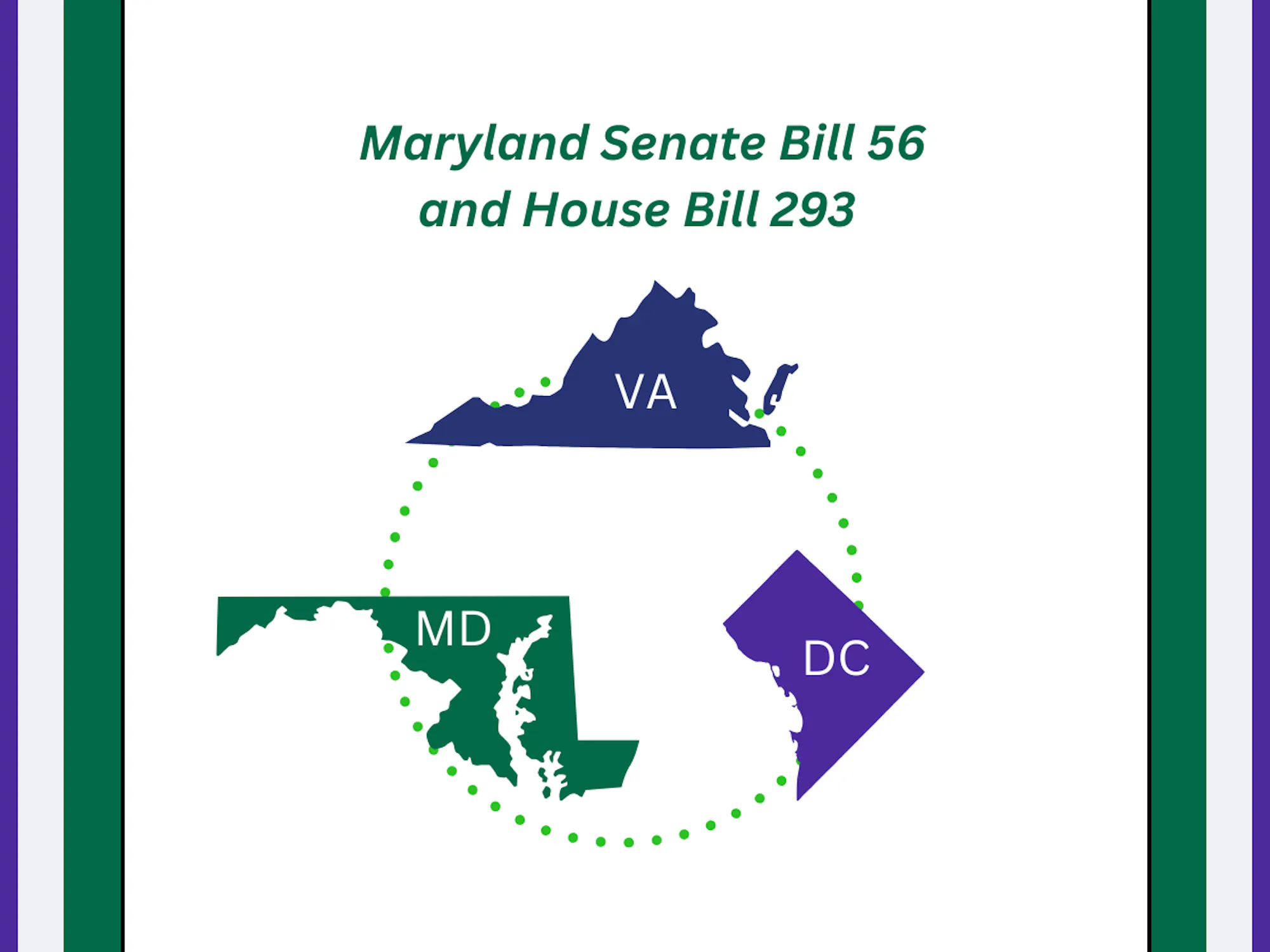
Maryland Enacts Legislation to Enable Secure, Cross-State Data Collaboration for Policy Impact
New law expands authority for external data sharing through trusted, privacy-preserving infrastructure WASHINGTON, DC, April 30, 2026 — Coleridge today announced that the Maryland General Assembly enacted legislation (SB 56/HB 293 - MLDSC - External Data Sharing with Third-Party Data Centers for Multistate Reporting - Authorization) that establishes a framework for secure data sharing between the Maryland Longitudinal Data System (MLDS) Center and an authorized third-party data center, like Coleridge’s Administrative Data Research Facility (ADRF). The bills were signed into law by Governor Wes Moore on April 14, 2026. SB 56 and HB 293 enable the MLDS Center to participate in Coleridge’s Democratizing our Data Challenge (DDC) program with Washington, D.C. and Virginia. Collectively, they will link education and workforce data across the Capital Region for the first time and help the jurisdictions better understand outcomes for residents who began in its K-12 schools, regardless of where they live or work in the region. Coleridge played an active role in supporting the advancement of the legislation. Vice President of Data Enclave Operations, Jonathan Mills, provided formal testimony to the Maryland Senate Committee on Education, Energy, and Environment and the House Ways and Means Committee, highlighting the importance of secure, FedRAMP-authorized environments. “Legislative leadership like Maryland’s is essential to building the infrastructure needed for modern, data-informed policymaking,” said Ahu Yildirmaz, President and CEO of Coleridge. “By establishing clear pathways for secure data sharing, SB 56 enables states to answer complex questions about education, workforce, and economic mobility and to understand the efficacy of policies, while maintaining the highest standards of privacy and trust.” At the core of the legislation is a recognition that administrative data can provide powerful insights when used responsibly. The legislation authorizes collaboration with a qualified third-party data center to empower multistate reporting. The data center must meet rigorous security and privacy standards, including requirements for de-identification, controlled access, and aggregate reporting. As a FedRAMP-authorized, cloud-based data environment, the ADRF meets these needs and enables approved users to securely access and analyze sensitive data without removing it from a protected enclave. "In the interconnected DMV economy it is vital that we work across state lines to gain a full picture of workforce impacts—and opportunities,” said Maryland Secretary of Labor Portia Wu, who also serves as Chair of the MLDS Center Governing Board. “The greater insights enabled by this legislation will help us to better serve Marylanders by connecting them to quality workforce programs and jobs." Through this legislation Maryland is joining a growing number of states leveraging secure, collaborative data infrastructure to address shared challenges. These include evaluating workforce training programs, understanding credential value, and tracking long-term outcomes across domains like education and employment systems and across state geographic borders. About Coleridge Coleridge is a nonprofit organization working with governments to ensure that data are more effectively used for public decision-making. Coleridge provides agencies with the opportunity to enhance their data literacy and collaborate within and across states to develop new technologies through secure access and sharing of confidential microdata. Coleridge provides secure data enclave services to a diverse range of clients, including federal, state, and local government agencies, through the Administrative Data Research Facility (ADRF). The ADRF is a FedRAMP-authorized cloud-based platform that enables government agencies to link their longitudinal data with other states and agencies. To learn more, visit www.coleridge.us. Media contact: Nick Obourn, nick.obourn@coleridge.us
28 Apr 2026
From Fragmented Data to a Full Picture: How New Jersey Built an Integrated Education-to-Workforce System
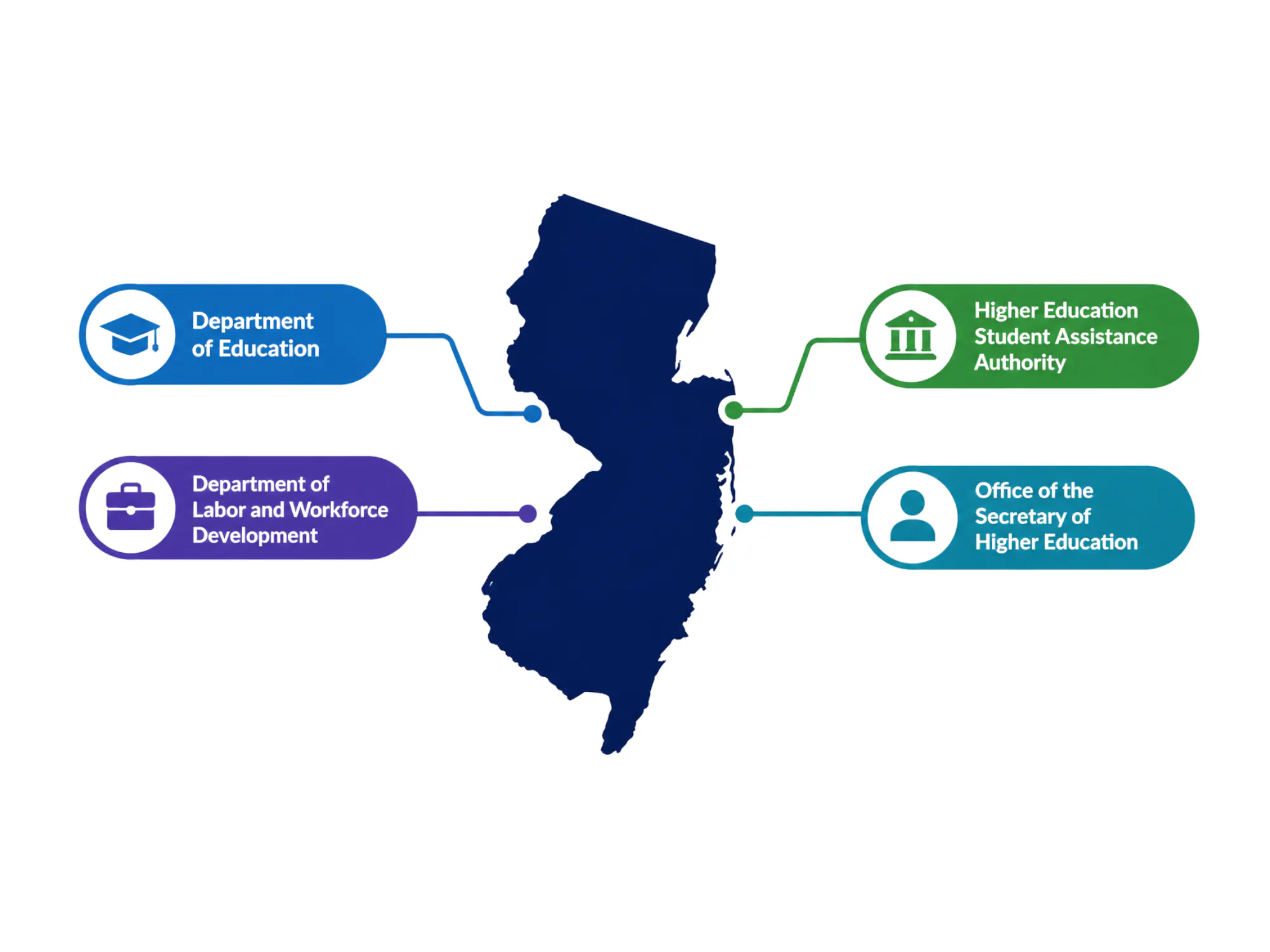
Across the country, if you were to ask a state agency, “Are our K-12 programs preparing students for good careers?” you might be surprised at how hard that is to answer. The Department of Education can tell you about graduation rates. The workforce agency knows who’s filing unemployment claims. Higher education tracks enrollment. But none of them, on their own, can connect the dots from a student’s first day of kindergarten to where they end up five or ten years after graduating high school. One state that has solved for this problem though is New Jersey. Only a few short years ago, individual agencies in the Garden State were making decisions based solely on their own data, without visibility into what happened to people before they entered their system or after they left. Programs were funded and policies were set without the full picture of what was working and what wasn’t. Today, that’s changed. In our new case study – State of New Jersey: Strengthening a Modern Data Ecosystem for Education, Workforce & Policy Insights – we detail how the state transformed its approach to education and workforce data, moving from fragmented, siloed systems to one of the most comprehensive cross-agency data ecosystems in the country. Building the Foundation New Jersey’s journey to a full view of their education-to-workforce pipeline data began with a K-12 data modernization effort that eventually grew into the New Jersey Statewide Data System (NJSDS). Operated by the Heldrich Center for Workforce Development at Rutgers University, the system now links administrative data from the Department of Education, the Department of Labor and Workforce Development, the Office of the Secretary of Higher Education, UI wage and claims records, workforce development programs, and even the Motor Vehicle Commission. Our partnership with New Jersey started in 2020 and then deepened through the Democratizing our Data Challenge (DDC) program, where the state’s team worked collaboratively with us to build a K-12 data model from the ground up – defining their own research questions, developing analytic methods, and creating documentation that other states could replicate. That collaborative foundation, combined with our secure Administrative Data Research Facility (ADRF) and Applied Data Analytics (ADA) training, helped the state grow from a small team of three or four researchers to a robust analytic operation of more than 70 people today. Seeing the Full Picture The shift the state experienced has created meaningful change when it comes to seeing what works. New Jersey can now follow students from elementary school, through postsecondary education, apprenticeships, workforce training, and employment – and understand which pathways lead to successful outcomes, and which don’t. That kind of visibility produces tangible tools. The state’s Postsecondary Employment and Earnings Dashboard, for instance, allows policymakers, institutions, and the public to see employment rates and median earnings for graduates of every New Jersey college – broken down by institution, major, race, and sex. It’s the kind of resource that turns infrastructure into something students, families, and educators can actually use. What This Means for K-12 As we outlined in our recent white paper, Challenges, Opportunities, and Solutions for Integrated Data Systems, the potential of connected data extends well beyond any single agency. When K-12 data is linked to workforce outcomes, states can move from measuring proxies, like test scores and graduation rates, to measuring real outcomes: whether students are finding their way to good careers. New Jersey’s experience illustrates this in practice. Cross-agency analyses have examined labor market outcomes for Career and Technical Education completers, revealing meaningful patterns in employment and earnings across career clusters. The state can now identify which programs produce the best results for which students, and direct resources accordingly. And by making its K-12 data model publicly available, New Jersey has given other states a structured starting point to build their own systems. Looking Ahead New Jersey isn’t done. The state is already exploring connections to licensing, human services, health, and cross-state workforce records, potentially extending visibility even further along the continuum of how people move through education and into work. As public resources tighten and the pace of economic change accelerates, states can no longer afford to make decisions without a complete picture. New Jersey’s story shows what’s possible when agencies stop working in silos and start building systems that follow people, not programs. Read the full case study
07 Apr 2026
From Silos to Systems: How Integrated Data Can Transform K-12 and Beyond
When discussions around education take place these days, it’s often through the myopic lens that it’s a singular, coherent system. As a result, conversations around ways to improve or change it lack the insight and ability to make meaningful, sustained progress. The reality is that early childhood programs, K-12 schools, higher education institutions, workforce development agencies, and social services all shape how students learn, grow, and enter the workforce. And students’ paths through them are rarely uniform. When a student graduates high school and goes straight into the workforce, then a talent development program, then back again – or goes on to community college and then a four-year university – their arc is nearly untraceable to states monitoring the progress of education programs within their borders. These systems rarely talk to each other. The data they generate sits in separate repositories, maintained by separate agencies, governed by separate rules – creating blind spots at the very moments when clear visibility matters most. Today’s learners move across what is often described as a P20W ecosystem—spanning preschool, K-12, postsecondary education, and the workforce. Their journeys are not linear pipelines but dynamic, iterative pathways shaped by changing economic conditions and personal circumstances. Without integrated data across these systems, states are effectively making decisions about education and workforce investments without visibility into how talent actually develops over time. This fragmentation carries real consequences. Educators spend valuable time reconciling information across platforms rather than supporting students. Policymakers make funding decisions without a complete picture of how people move through education and into careers. And early warning signals that could trigger timely interventions arrive too late to make a difference. More importantly, the challenge is not just about having better data. It is about having it soon enough to matter. Disconnected systems produce insights that are often delayed, limiting the ability to act when it counts. Integrated data systems, on the other hand, create the conditions for near real-time visibility, allowing educators, agencies, and policymakers to identify risks and intervene while outcomes are still being shaped, not after the fact. In our recent white paper, Challenges, Opportunities, and Solutions for Integrated Data Systems: An Adaptable Roadmap to Data Integration and Use to Support K-12 Education and Beyond, we lay out a framework for how states and agencies can overcome these barriers and build data systems that work across the full education and workforce continuum. One of the paper’s central findings is that integrated data systems enable a fundamental shift: moving from measuring indicators to measuring actual outcomes. Today, many states evaluate college-readiness programs by looking at test scores or intention surveys. But a test score is a proxy – it doesn’t tell you whether a student actually enrolled in postsecondary education or secured a quality job. When K-12 data is linked to enrollment records and workforce outcomes, leaders can see what’s really happening and direct resources toward what’s really working. This transformation does not require starting from scratch. States are at different stages of maturity, and progress is often non-linear. The roadmap outlined in the paper identifies five phases of development—from planning and design through implementation, scaling, and long-term sustainability—offering a practical structure for moving forward while adapting to each state’s context and capacity. Critically, our roadmap is designed to meet states wherever they are. Whether just beginning to address data silos or refining an already sophisticated system, the paper outlines five phases of development – from planning and assessment through sustainability and enhancement – along with practical guidance on data standards, privacy and security frameworks, stakeholder engagement, and governance structures that survive leadership transitions. Integration doesn’t require starting from nothing. It requires a clear, adaptable plan and the commitment to execute. The paper also looks ahead to what emerging technologies mean for the future of education and work. As data infrastructure matures, artificial intelligence and machine learning hold the potential to unlock real-time insights, predictive analytics, and more personalized learning experiences. But these capabilities depend entirely on a sound, connected data foundation. At the same time, expanding the use of data—particularly in an era increasingly shaped by AI—raises critical questions about privacy, governance, and trust. Integrated systems must be built on privacy-first frameworks, with clear access controls, strong security protocols, and shared governance models that ensure data is used responsibly. Without that foundation, the promise of advanced analytics will remain out of reach. Without integrated systems, advanced analytics remain aspirational. But with them, states can move from reactive decision-making to proactive, data-driven strategies that improve outcomes for students and communities. Integrated data systems are not just a technical upgrade, they represent a transformative opportunity to align education with the realities of the labor market and the needs of the people these systems serve. And as we chart a course that ensures public dollars create real outcomes, the question isn’t “can we build a system that looks holistically across education?” It’s “how quickly can we build the foundation to turn what we already know into better outcomes?” We also know the urgency is only increasing. As public resources tighten and the pace of economic and technological change accelerates, states can no longer afford to make decisions without a full view of how people move through education and into work. Read White Paper

31 Mar 2026
Coleridge’s 6th Annual National Conference Centers on the Importance of Collaboration Across Borders
Building Connections to Bridge Divides and Accelerate Decision-Making WASHINGTON, DC, March 31, 2026 — Coleridge hosted its 6th Annual National Conference in Arlington, VA, from March 24-27. The event convened 250 data experts, policymakers, and thought leaders from 39 states and multiple Federal agencies to explore the transformative power of administrative data in shaping public policy. This year’s theme, Data Beyond Borders, focused on the importance of collaborating across agencies, institutions, and sectors to build an interconnected infrastructure that makes data more actionable and impactful. “The theme of this year’s conference, Data Beyond Borders, captures something essential: data is at the center of everything, including AI,” said Ahu Yildirmaz, President and CEO of Coleridge. “Yet, that data must be connected to result in true collaboration and impact. Policy decisions drawn from linked datasets are clearer and more powerful when borders are crossed, both literal and figurative.” In the opening plenary, moderated by Mark Zandi, Chief Economist at Moody’s, panelists David Wilcox (Senior Fellow, Peterson Institute for International Economics and Director of US economic research at Bloomberg Economics), Cami Feek (Commissioner for the Employment Security Department (ESD) in Washington State), and Chris Kurz (Assistant Director at the Board of Governors of the Federal Reserve System) shared insights on the current state of statistics, data, and AI in the U.S. Rob Santos, the 26th Director of the U.S Census Bureau, moderated the subsequent plenary with Robert McGough (Chief Data Officer for the state of Arkansas), Erica Groshen (the 14th Commissioner of the U.S. Bureau of Labor Statistics), and Dominique Duval-Diop (Deputy Chief Data Officer and Acting Chief Data Officer, U.S. Department of Commerce). The panel of Federal and state data luminaries shared practical strategies for strengthening the evidence ecosystem to move toward impact. The conference brought together a wide-reaching community, with rising participation from academic institutions, nonprofit partners, and local education agencies, alongside returning partners from state and Federal government. Together, the group built new connections and networks to strengthen learning and enable meaningful policy impact. The conference underscored the importance of cross-organizational collaboration and advanced data integration strategies in driving meaningful impact. Discussions included: The State of Statistics, Data, and AI in the United States Infrastructure, Governance, and Tools Turn Data into Public Value Building AI-Ready Data and Secure Enclaves Administrative Data for Agile Evidence Building Designing Effective Education-to-Workforce Data Systems View the full Conference agenda The Data Champion of the Year Award for 2026 was presented to the state of New Jersey and accepted by Stephanie Walsh, Assistant Director of the John J. Heldrich Center for Workforce Development at Rutgers University, and Lesley Hirsch, Assistant Commissioner for Research & Information at the New Jersey Department of Labor & Workforce Development. Each year, the Award recognizes exceptional leadership in advancing data-driven innovation in the public sector. “It's an honor to receive this recognition from Coleridge. The key to New Jersey's achievement is our partnership model—among the agencies who collaborate to govern the New Jersey Statewide Data System (NJSDS) and with the John J. Heldrich Center for Workforce Development at Rutgers," said Hirsch. “We are grateful to Coleridge for the opportunities to network, collaborate, and learn, and are inspired by the work of the other states and their partners. Finally, we hope our experience offers proof that our day-to-day efforts can have a real impact on the people we all serve.” About Coleridge Coleridge is a nonprofit organization working with governments to ensure that data are more effectively used for public decision-making. Coleridge provides agencies with the opportunity to enhance their data literacy and collaborate within and across states to develop new technologies through the secure access and sharing of confidential microdata. Coleridge provides secure data enclave services to a diverse range of clients, including state government agencies, several federal agencies, and local governments, through the Administrative Data Research Facility (ADRF). The ADRF is a FedRAMP-authorized cloud-based platform that enables government agencies to link their longitudinal data with other states and agencies. To learn more, visit www.coleridge.us. Media contact: Nick Obourn, nick.obourn@coleridge.us
12 Mar 2026
Coleridge Awarded $4.3 Million Grant from Ascendium Education Group to Strengthen Cross-State Education-to-Workforce Data Infrastructure
The Four-Year Initiative Will Integrate Postsecondary and Workforce Data Across States to Improve Transitions and Advance Economic Mobility WASHINGTON, DC, March 12, 2026 — Coleridge today announced it has been awarded a $4.3 million, four-year grant from Ascendium Education Group to lead a multi-state initiative designed to strengthen cross-state education-to-workforce linkages. The project will build a scalable, standards-based data infrastructure that enables states to securely integrate postsecondary and workforce data to better support learners navigating transitions into sustainable and more meaningful employment. Despite growing demand for data-driven workforce strategies, many states face technical, legal, and governance barriers that limit their ability to link education and workforce systems across agencies, let alone across state lines. The new initiative will establish the infrastructure, agreements, applied learning models, and tools necessary to overcome those barriers and create a regional multi-state integrated data system within Coleridge’s Administrative Data Research Facility (ADRF). “Learners increasingly cross state lines to pursue education and employment, yet our data systems often stop at those borders,” said Ahu Yildirmaz, President and CEO of Coleridge. “With Ascendium’s support, we will work alongside state partners to build a secure, scalable model for integrating postsecondary and workforce data across states and therefore strengthening transitions for those in communities, informing and accelerating policy decisions, and expanding opportunity.” The initiative will establish regional convenings and state-specific readiness assessments to evaluate existing data infrastructure maturity and legal frameworks for cross-agency and cross-state sharing. Over the course of the project, Coleridge and state partners will develop and implement a standards-based, scalable infrastructure connecting administrative data across states. Participating teams will operate in applied learning cohorts and benefit from the development of tailored data products, including dashboards, reports, and policy analysis to address critical education-to-workforce policy questions. “Clearer insights into how education connects to employment are essential for strengthening pathways to economic mobility,” said Carol Rava, Vice President of Education Grantmaking at Ascendium. “We are confident in Coleridge's capacity and proven leadership to help states develop the tools and infrastructure needed to better understand outcomes and improve transitions from postsecondary education into the workforce.” About Coleridge Coleridge is a nonprofit organization working with governments to ensure that data are more effectively used for public decision-making. Coleridge provides agencies with the opportunity to enhance their data literacy and collaborate within and across states to develop new technologies through secure access and sharing of confidential microdata. Coleridge provides secure data enclave services to a diverse range of clients, including 24 state government agencies and several federal agencies, through the Administrative Data Research Facility (ADRF). The ADRF is a FedRAMP-authorized cloud-based platform that enables government agencies to link their longitudinal data with other states and agencies. To learn more, visit www.coleridge.us. Media Contact: Nick Obourn, nick.obourn@coleridge.us

24 Feb 2026
Coleridge Announces Inaugural Technology Advisory Board
New Advisory Board Strengthens Coleridge’s Leadership in Secure Data Infrastructure, AI, and Digital Modernization WASHINGTON, DC, February 24, 2026–Coleridge today announced the formation of its inaugural Technology Advisory Board, appointing three distinguished leaders in digital government, cybersecurity, and large-scale engineering: David Eaves, Associate Professor in Digital Government at the UCL Institute for Innovation and Public Purpose; Max Everett, Chief Information Security Officer at Shaw Industries and former Chief Information Officer of the U.S. Department of Energy; and David Carrico, Engineering Manager at Meta and veteran technical leader. The creation of the Technology Advisory Board marks a significant step in Coleridge’s continued evolution in digital innovation, thought leadership, and technical expertise. The new board will provide strategic guidance on secure system architecture, AI integration, digital modernization, and the governance of public-sector data systems. “Coleridge is entering a new phase as we embed AI and advanced digital capabilities into secure public-sector research environments,” said Ahu Yildirmaz, President and CEO of Coleridge. “David, Max, and David bring extraordinary depth across digital government, cybersecurity risk management, and engineering with globally successful organizations. Their insights will help ensure that our technological advancements are guided by deep knowledge and that our ADRF infrastructure remains secure, modern, and aligned with the evolving expectations of federal, state and local government partners.” David Eaves is Co-Deputy Director and Associate Professor in Digital Government at the UCL Institute for Innovation and Public Purpose, where he specializes in digital-era public administration and the governance of digital public infrastructure. A global expert in digital transformation, he has advised governments in the UK, South Africa, Brazil, and Canada. He co-founded Teaching Public Service in a Digital Age and established the Digital Public Infrastructure Map, now a widely used resource among researchers, donors, and development institutions worldwide. Read David Eaves Full Biography. Max Everett is a nationally recognized IT modernization and cybersecurity risk leader. Currently Chief Information Security Officer at Shaw Industries, he previously served as Chief Information Officer of the U.S. Department of Energy, where he accelerated cybersecurity risk management, led cloud migration efforts, and developed a Department-wide Cybersecurity Strategy. His experience includes serving as CIO for the White House and holding senior leadership roles across multiple federal agencies. Read Max Everett Full Biography. David Carrico is an accomplished engineering executive with more than 25 years of experience building distributed systems and mobile platforms at scale. As an Engineering Manager at Meta, he leads teams within the Instagram Professional ecosystem overseeing systems that manage over 50 million queries per second. His leadership includes the launch of major consumer platforms and large-scale developer efficiency programs. A combat veteran and former Lieutenant Colonel in the Army National Guard, he brings operational discipline and strategic scale to engineering leadership. Read David Carrico Full Biography. “The formation of our Technology Advisory Board strengthens Coleridge’s ability to build secure, scalable systems that meet the evolving needs of government partners,” said Rich Ferguson, Chief Technology Officer at Coleridge. “As we advance AI capabilities within the ADRF and continue modernizing our platform, this group’s expertise in world class AI engineering, zero trust cyber security, and public sector innovation will help ensure our technology remains resilient, compliant, and built for impact.” View the Full Technology Advisory Board About Coleridge Coleridge is a nonprofit organization working with governments to ensure that data are more effectively used for public decision-making. Coleridge provides agencies with the opportunity to enhance their data literacy and collaborate within and across states to develop new technologies through secure access and sharing of confidential microdata. Coleridge provides secure data enclave services to a diverse range of clients, including 24 state government agencies and several federal agencies, through the Administrative Data Research Facility (ADRF). The ADRF is a FedRAMP-authorized cloud-based platform that enables government agencies to link their longitudinal data with other states and agencies. To learn more, visit www.coleridge.us. Media Contact: Nick Obourn, nick.obourn@coleridge.us
10 Feb 2026
Launching The Data Link: Connecting Data, Insight, and Impact
Fresh off the unveiling of our new branding and look, we are excited to launch The Data Link, Coleridge’s new LinkedIn newsletter dedicated to exploring the many ways that data is being used more effectively to inform government decision-making. The Data Link is designed for public-sector leaders, researchers, and partners who are navigating complex policy challenges and looking for practical, forward-looking ideas on how data can accelerate insight and impact. Each month, The Data Link will feature thought leadership and cutting-edge perspectives on the responsible use of data within government agencies and partners. We’ll spotlight emerging practices, lessons from the field, and real-world examples of how innovators are linking data, building capacity, and strengthening governance to make better decisions. Our goal is not just to describe what’s possible, but to highlight what’s working, what’s scalable, and what others can learn. We invite you to subscribe to The Data Link on Linkedin and join the conversation by commenting and sharing your own perspectives. Whether you are shaping policy, building data infrastructure, or translating insight into action, we hope this newsletter becomes a valuable resource and a place to stay connected to the ideas shaping the future of data-driven government and the economy. Subscribe to The Data Link
05 Feb 2026
Introducing Coleridge: Data for Impact
As we celebrate our fifth year as an organization, we’re excited to share an important evolution in our growth. The Coleridge Initiative is now Coleridge, paired with a new tagline that reflects our purpose and direction: Data for Impact. We also got a new look, updating our logo and branding with our new name. The updated visual identity and name is connected to our past but refined for the future and the changes mark a milestone as we move from an emerging organization to a trusted, national partner helping governments use data more effectively to inform public decision-making. When Coleridge was founded, the word “Initiative” reflected our early-stage focus: building momentum, piloting new approaches, and proving what was possible. Five years later, our work has matured. Our secure data platform, the ADRF, is widely known for its innovative infrastructure and Coleridge maintains long-term state and federal partnerships through training and advisory support for public-sector agencies leveraging data to improve outcomes for people and communities. The new tagline, Data for Impact, captures a core belief that guides our work: data is not the end goal, it is the means to reach impact. Whether through secure data infrastructure, ADA training courses, or cross-state collaboration, Coleridge exists to ensure data leads to better decisions and real-world results for governments and partners. What hasn’t changed is our mission and our vision. We remain deeply committed to responsible and trusted data use, strong governance, and building capacity within government. As Coleridge, we’re excited to continue this work to partner with agencies, researchers, and leaders nationwide to ensure data is used not just securely, but meaningfully.

13 Jan 2026
Coleridge Initiative Announces Three New Members to Board of Directors
New Appointments Deepen Coleridge’s Expertise in Data Analytics, Economic Policy, and Organizational Governance. WASHINGTON, DC, January 13, 2026 — The Coleridge Initiative today announced the appointment of three distinguished leaders to its Board of Directors: Rinku Bhattacharya, Chief Financial and Operating Officer of the Boys and Girls Club of New Rochelle, New York; Brian M. Morgan, Vice President for Institutional Research and Planning and Chief Data Officer at Marshall University; and David Wilcox, Senior Fellow at the Peterson Institute for International Economics and Director of U.S. Economic Research at Bloomberg Economics. Together, they bring decades of experience spanning data analytics and institutional research, economic policy and federal statistical leadership, and nonprofit financial governance. These appointments expand the Board’s depth of expertise across key pillars of Coleridge’s mission to build secure data systems and accelerate the use of data by governments, researchers, and institutions nationwide. “Coleridge is entering a pivotal phase as we deepen our role in building the national data infrastructure that agencies rely on to make informed, data-driven decisions,” said Ahu Yildirmaz, President and CEO of Coleridge Initiative. “Brian, David, and Rinku each bring a unique combination of technical depth, policy experience, and governance leadership. Their perspectives will be invaluable as we continue to scale secure data access, strengthen cross-state collaboration, and translate data into real-world impact.” Rinku Bhattacharya is Chief Financial and Operating Officer of the Boys and Girls Club of New Rochelle, bringing more than 25 years of experience in financial management, compliance, and operational leadership within highly regulated nonprofit organizations. She also serves on multiple nonprofit governing boards and teaches management accounting and business strategy as an adjunct professor. Read Rinku Bhattacharya’s full biography. Brian M. Morgan is Vice President for Institutional Research and Planning and Chief Data Officer at Marshall University, where he leads enterprise data strategy, analytics modernization, and data governance. With more than two decades of experience in higher education analytics and administration, he is widely recognized for translating complex data into actionable insights. Read Brian Morgan’s full biography. David Wilcox is a Senior Fellow at the Peterson Institute for International Economics and Director of U.S. Economic Research at Bloomberg Economics. He previously served in senior leadership roles at the Federal Reserve Board and the U.S. Treasury Department, and chaired the Federal Economic Statistics Advisory Committee, advising federal statistical agencies on methodology and data quality. Read David Wilcox’s full biography. “These new Board members add extraordinary breadth and credibility to Coleridge’s leadership at a moment of growing national demand for trusted and responsibly-governed data systems,” said Jeff Thomson, Chair of the Coleridge Board of Directors. “Their collective experience across higher education, federal economic policy, and nonprofit financial operations will help guide Coleridge as we expand partnerships and ensure data is used responsibly to improve outcomes across the country.” View the Full Coleridge Board of Directors. About The Coleridge Initiative, Inc. The Coleridge Initiative is a nonprofit organization working with governments to ensure that data are more effectively used for public decision-making. Coleridge provides agencies with the opportunity to enhance their data literacy and collaborate within and across states to develop new technologies through secure access and sharing of confidential microdata. Coleridge provides secure data enclave services to a diverse range of clients, including 24 state government agencies and several federal agencies, through the Administrative Data Research Facility (ADRF). The ADRF is a FedRAMP-authorized cloud-based platform that enables government agencies to link their longitudinal data with other states and agencies. To learn more, visit www.coleridgeinitiative.org. Media Contact: Nick Obourn, nick.obourn@coleridgeinitiative.org
18 Dec 2025
Sponsor the 2026 Coleridge Annual National Conference
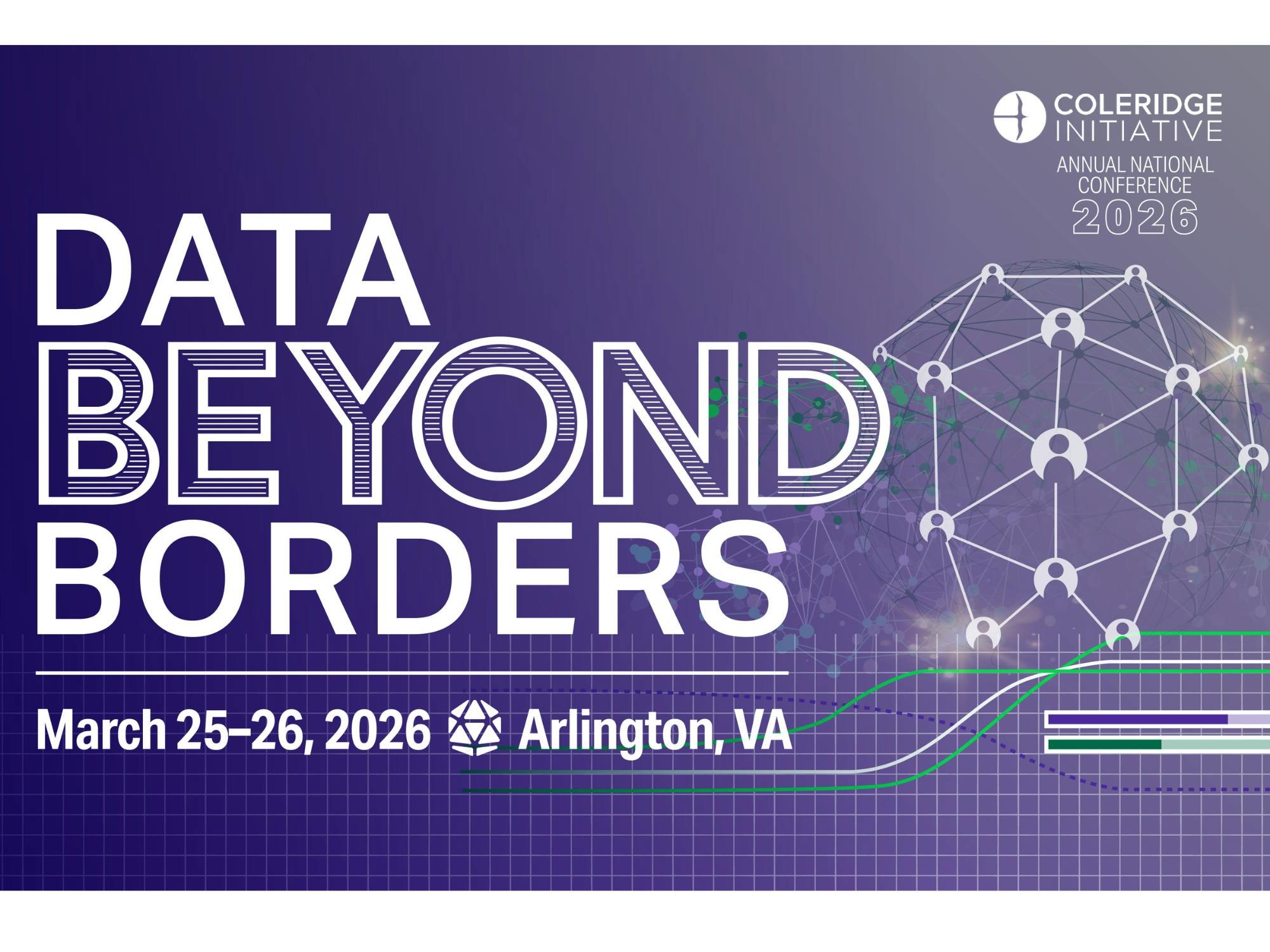
As a trusted partner in data infrastructure, Coleridge works with state and federal agencies to support data-driven decision-making and help accelerate measurable policy and program outcomes. Our Annual National Conference is the premier event for individuals advancing data for the public good. It convenes nearly 300 leaders, including policymakers, researchers, and philanthropic changemakers who are innovating data for the public sector. This year’s theme, Data Beyond Borders, explores how connected, secure, and privacy-preserving data systems can empower smarter decision-making across communities and agencies. By becoming a sponsor, your organization can: Showcase thought leadership to a national audience Reach and build relationships with policymakers, researchers, and innovators shaping data-driven policy and practice Demonstrate your organization's commitment to responsible, ethical, and impactful data use Help expand access to the conference by supporting student participation Support a future-focused event that drives collaboration and real-world change We invite you to join us in building the systems, standards, and skills that enable data to promote public good. View the 2026 Sponsorship Prospectus To learn more about sponsorship opportunities contact us at events@coleridgeinitiative.org.
01 Dec 2025
Coleridge Initiative Awarded Grant from ECMC Foundation to Develop Collaborative Data Network
A new grant awarded to the Coleridge Initiative from ECMC Foundation will develop a collaborative data network that seeks to enhance partnerships and improve educational, workforce, and economic outcomes in the Appalachian and Delta Regions. The nearly $750,000 grant will support the establishment of the Regional Learner Data Collaborative (RLDC), a data infrastructure which will build understanding of how learner outcomes impact economic development and labor markets in these regions. The catalyzing work will be housed within Coleridge's FedRAMP-authorized, cloud based Administrative Data Research Facility (ADRF). "States in the Appalachian and Delta regions bring strengths and shared opportunities to advance educational attainment and economic prosperity, even as they continue to confront long-standing regional challenges," said Dr. Ahu Yildirmaz, President and CEO of the Coleridge Initiative. “Thanks to the generosity of ECMC Foundation, this project will bring together education and economic development leaders across state lines to create comprehensive shared ecosystems, leverage these strengths, and align labor market demand and supply.” Through the project, Coleridge will engage and facilitate development of a consortium of Appalachian and Delta states to participate in the pilot, construct a collaborative learning agenda to guide the work, detail data needed for data sharing agreements, and outline governance for sustainable infrastructure. It will also produce an implementation plan for a Regional Learner Data Collaborative with sustained governance and data use within the ADRF, and a pathway to expanding to new states in the Appalachian and Delta regions. The work will be guided by state partner input to ensure that data products are equipped to effectively guide decision making that supports learner outcomes, labor markets, and the goals of the region now and into the future.
11 Nov 2025
Training Program Outcomes: Enhancing Labor Market Insights with Jobs Data
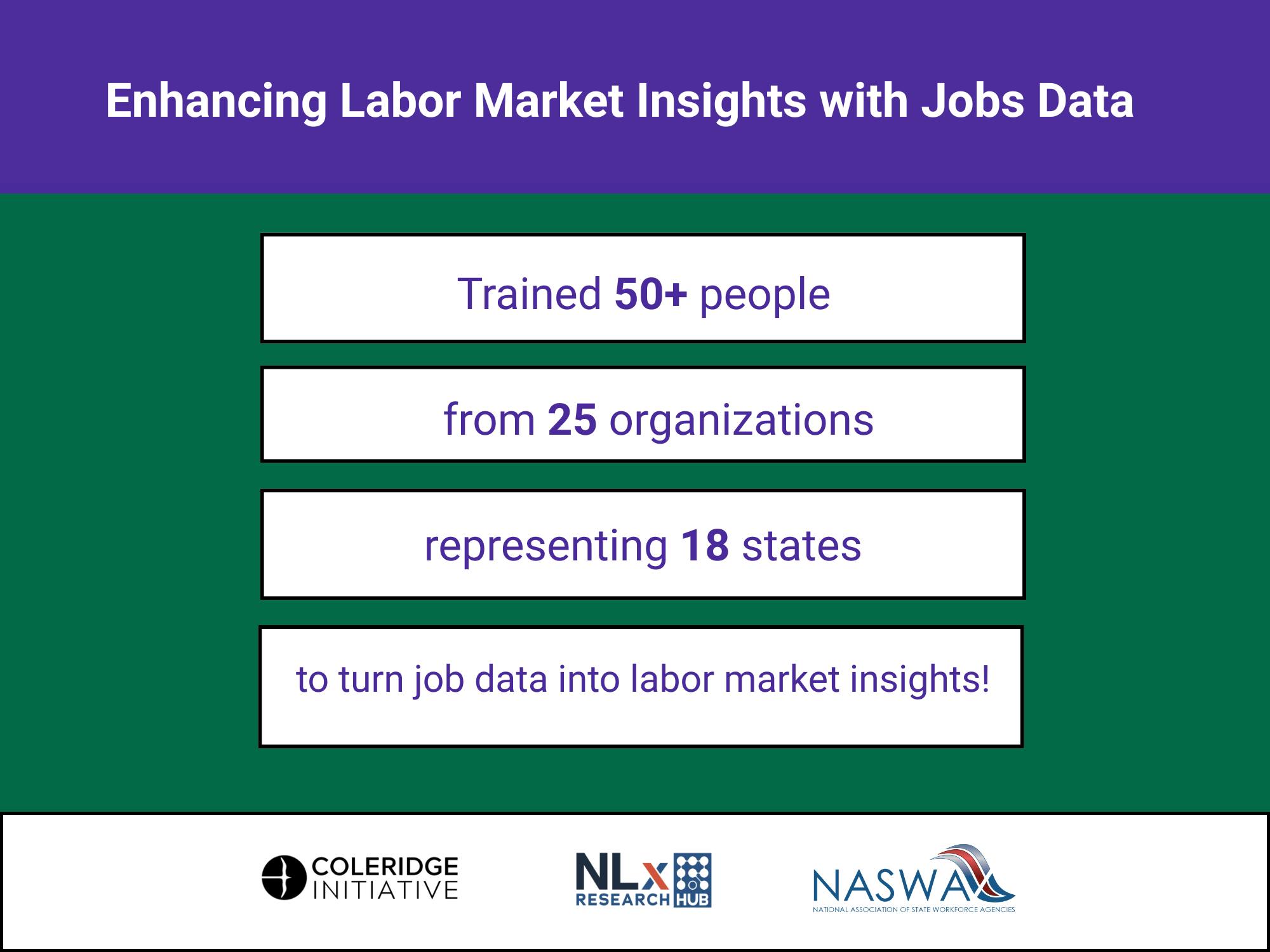
What do job postings reveal about the evolving labor market and how can those insights be used to shape workforce programs and policies? Our two-part Enhancing Labor Market Insights with Jobs Data Applied Data Analytics (ADA) Training Program equipped over 50 participants from 25 organizations across 18 states with the skills they needed to examine those questions. We co-led the program with the National Association of State Workforce Agencies (NASWA) and the National Labor Exchange (NLx) Research Hub across two cohorts from October 2024 to April 2025. Advancing Data Literacy to Support Evidence-Based Decision-Making Our Enhancing Labor Market Insights with Jobs Data program began with four weeks of training in basic coding concepts and use of the Administrative Data Research Facility (ADRF)–our secure cloud environment for working with restricted-use data. In the 12 weeks that followed, participants learned about exploratory data analysis, record linkages, contextualizing employment demand, labor market projects, and other key topics. From Knowledge to Action: Collaborative Research Projects With access to NLx job posting data from 2015 onward, participants applied their skills through collaborative research projects that explored eight key labor market questions. Team Connecticut and Oregon: How can job postings help educators identify skills in high demand? Using 2023–2024 NLx job postings data from Connecticut and Oregon, the team built an interactive dashboard that: · Identifies in-demand occupations · Reveals top skills currently in high demand from employers using O*NET · Highlights active employers · Links directly to current job ads Learn more here: https://tinyurl.com/2dtuyst8 Team Mississippi and Tennessee: How do employers adjust hiring requirements in response to worker shortages? Using 2018–2023 NLx job postings data from Mississippi and Tennessee, along with Occupational Employment and Wage Statistics, the team compared shifts in required education, skills, and experience across occupations and identified patterns of employer flexibility in response to labor market gaps. They also highlighted how these adjustments can inform workforce development strategies and pointed to future opportunities for deeper analysis of trends across industries and occupations. Learn more here: https://tinyurl.com/p6d542r6 Team New Jersey, Pennsylvania, and Ohio: How can job ads be used to measure labor demand across the economy? Using NLx job postings data, the Job Openings and Labor Turnover Survey (JOLTS), and the Quarterly Workforce Indicators (QWI), the team defined demand as the total requirement for labor and examined postings to capture employer needs for workers and specific types of work. Learn more here: https://tinyurl.com/3u4b5tv3 Team Maryland and Virginia: Which employers are driving growth in the rapidly expanding cybersecurity market and what does the demand for labor look like? The team used 2021–2024 NLx job postings data for their states and DC, Integrated Postsecondary Data System data, and the Maryland College Labor Sector and Wage Explorer to examine which: - Employers are driving the regional hiring surge - Cybersecurity roles are most in demand - Technical skills dominate job descriptions Learn more here: https://tinyurl.com/yzz7de47 Team Missouri and Wisconsin: How is the labor market being reshaped by the growing use of artificial intelligence (AI) tools? Using NLx job postings, the occupations list from Wisconsin’s Taskforce on Artificial Intelligence, Occupational Employment and Wages Statistics (OEWS), states’ employment projections data, O*NET/Standard Occupational Classification, and an “AI exposure” measure developed by the Wisconsin AI Task Force, the team compared job postings across ten high-exposure and ten low-exposure occupations to see where automation might hit hardest or barely register. They also examined shifts in demand and skills requirements, highlighting which workers are most at risk and how states can prepare for the future of work. Learn more here: https://tinyurl.com/ywkhd3k3 Team Colorado, Illinois, and Kentucky: How do layoffs correlate with trends in job postings? Using NLx job postings and WARN data, the team examined whether new opportunities emerge where jobs are lost, evaluated the reliability of WARN notices and other signals as early warnings, and analyzed whether displaced workers can realistically fill new job openings. Their approach sheds light on how labor market shocks ripple through the system and whether affected workers can be absorbed into new demand. Learn more here: https://tinyurl.com/5n77xby3 Team California and Washington: What are the most common requirements for occupations with low-barriers-to-entry and how do they differ for emerging occupations? Using NLx job postings, the team identified roles with minimal credentials that lead into fast-growing fields, revealing the first rungs on new career ladders. Their analysis highlights how these entry points shape worker mobility and guide state strategies for building inclusive pathways into the workforce. Learn more here: https://tinyurl.com/2d97n683 Team New York and Texas: How does labor demand line up with local labor supply across major metros? Using NLx job postings as demand and American Community Survey measures as supply, the team compared patterns by O*NET Job Zones in cities like New York and Dallas, incorporating wages to identify tight or slack markets. They revealed mismatches between who is hiring and who is available to work, and highlighted data caveats, such as geographic clustering and occupation definitions, to support smarter regional workforce planning. Learn more here: https://tinyurl.com/yc3pbhja
14 Oct 2025
Coleridge Initiative Announces Three New Members to Board of Directors
New Appointments Strengthen Coleridge’s Expertise in Data Science, Governance, and Cybersecurity Leadership WASHINGTON, DC, October 14, 2025 — The Coleridge Initiative today announced the appointment of three distinguished leaders to its Board of Directors: Robert L. Santos, the 26th Director of the U.S. Census Bureau; Roland Cloutier, former Global Chief Security Officer of ByteDance/TikTok and ADP; and Kate Garman Burns, Director of State and Local Innovation at the Federation of American Scientists. Together, they bring decades of experience spanning data learning and ethics, national statistics, public-sector innovation, and global information security. These appointments expand the Board’s depth of expertise across key pillars of Coleridge’s mission to accelerate state and federal government use of data more effectively for policymaking. “Coleridge is at the forefront of advancing the responsible use of data for public good,” said Ahu Yildirmaz, President and Chief Executive Officer of the Coleridge Initiative. “Robert, Roland, and Kate each bring an extraordinary record of leadership and impact in their respective fields. Their addition is a strategic leap forward for Coleridge as we continue to expand partnerships and strengthen the infrastructure that enables governments to use data responsibly for the public good.” The Honorable Robert L. Santos is a nationally renowned statistician. He served as the presidentially appointed and senate-confirmed 26th director of the U.S. Census Bureau between January 2022 and February 2025. Read Full Biography Roland Cloutier is a globally recognized cybersecurity and technology executive who has led enterprise protection programs for major multinational corporations, including TikTok and ADP. A U.S. Air Force veteran, he is the founder of The Business Protection Group and serves on multiple boards focused on cyber defense, privacy, and operational resilience. Read Full Biography Kate Garman Burns is the State and Local Innovation Director at Federation of American Scientists (FAS). Previously, she served as Executive Director at MetroLab Network and brought this work to (FAS). She has also held the role of Senior Associate at Cityfi, a firm focused on fostering innovation and new thinking in the urban environment and been part of two mayoral administrations as Technology Policy Advisor for Mayor Jenny Durkan in Seattle, WA and Innovation Policy Advisor for Mayor Sly James in Kansas City, MO. Read Full Biography “These new members bring not only remarkable professional experience, but also a shared commitment to advancing trust, ethics, and impactful uses of data in public policy,” said Jeff Thomson, Chair of the Coleridge Board of Directors. “Their guidance on the Board will help position Coleridge for success and accelerate the translation of data into policy decisions that improve lives.” View the Full Coleridge Board of Directors. About The Coleridge Initiative, Inc. The Coleridge Initiative is a nonprofit organization working with governments to ensure that data are more effectively used for public decision-making. Coleridge provides agencies with the opportunity to enhance their data literacy and collaborate within and across states to develop new technologies through secure access and sharing of confidential microdata. Coleridge provides secure data enclave services to a diverse range of clients, including 24 state government agencies and several federal agencies, through the Administrative Data Research Facility (ADRF). The ADRF is a FedRAMP-authorized cloud-based platform that enables government agencies to link their longitudinal data with other states and agencies. To learn more, visit www.coleridgeinitiative.org. Media Contact: Nick Obourn, nick.obourn@coleridgeinitiative.org
23 Sep 2025
Improving Access to Vital Data: How We Partnered with the Illinois Department of Economic Security
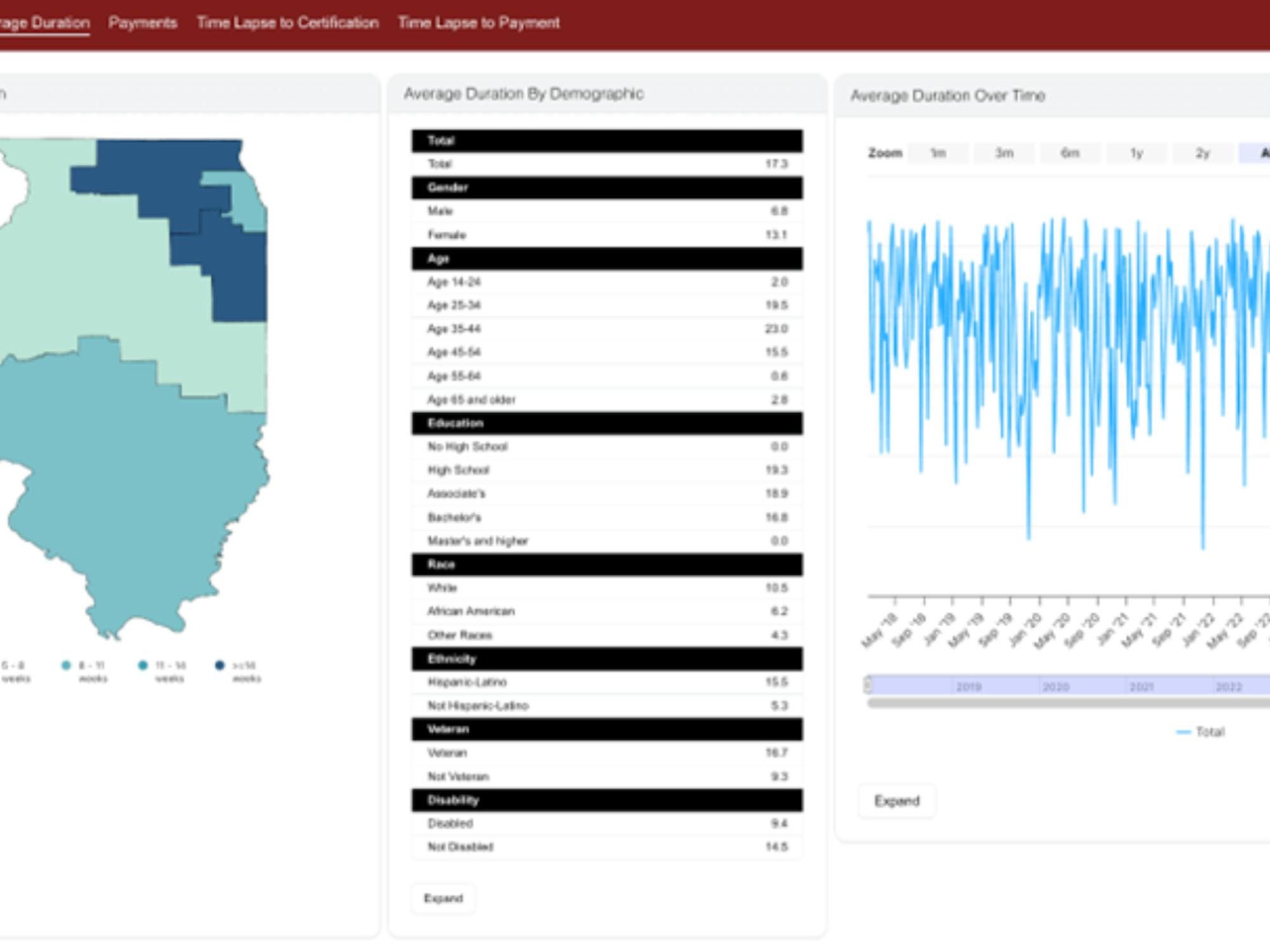
The Challenge: Navigating Complex Data Access and Security Barriers The Illinois Department of Employment Security (IDES) oversees the state’s unemployment insurance programs and labor market information. It struggled with a fragmented and resource-intensive process for managing data requests and research projects. Each request required lengthy legal reviews, needlessly customized data-sharing agreements and unique security procedures, often causing significant delays and bottlenecks. This patchwork approach made it difficult to efficiently share sensitive information while ensuring strict privacy and compliance. Enabling Faster, More Secure Data Access The Administrative Data Research Facility (ADRF)–our FedRAMP-authorized computational research platform–has transformed how IDES accesses, governs, and shares data. All data is de-identified and governed by strict privacy protocols, ensuring compliance while enabling secure collaboration with agencies and researchers. The development of centralized, shared legal templates and uniform data definitions enable IDES to access consistent, high-quality datasets across the board. Interactive data dashboards allow researchers to analyze granular, de-identified data, leadership to make more informed strategic decisions, and field staff to access localized insights and better address labor market shifts. Illinois implemented a tiered access system for its unemployment to reemployment dashboards to balance data security with the need for timely, actionable insights. The agency’s reach extends beyond Illinois, enabling cross-state research with Missouri, Indiana and others. Accelerating Research and Driving Data-Informed Policy We have significantly expanded IDES’s research and data capabilities, driving efficiencies in nearly every area of the team’s work. The agency’s Labor Market Information Director, Marty Johnson, stated, “We cut time spent managing research requests by over 30%, which enabled a 10-15% increase in approved projects, all without sacrificing oversight or security. A workforce program evaluation that had been stalled for more than a year was completed in just weeks thanks to these improvements.” Other key outcomes include: Streamlined legal reviews through standardized agreements Enhanced cross-agency and cross-state data sharing Real-time, data-driven support via tiered-access dashboards Empowered local labor economists with regional data insights Recognition as a national model for data governance and collaboration Read Case Study
16 Sep 2025
Call for Proposals: Coleridge Initiative Annual Conference 2026
Learn more about the 6th Annual National Conference and register today! The Coleridge Initiative is pleased to open the Call for Proposals for its 6th Annual National Conference, taking place March 24–27, 2026, in Arlington, VA. This annual gathering brings together data pioneers, policymakers, researchers, and practitioners from across the country to explore innovative approaches to accelerating secure, shared data for policy development and improved public outcomes. We invite proposals that showcase best practices and case studies, research findings and results, collaborative projects and partnerships, and success stories where evidence-based decision-making improved policy or program outcomes. Areas of focus include (but are not limited to): Data governance and privacy protection Cross-sector and cross-jurisdictional data sharing Advanced analytics and data science applications related to workforce, education, health, or other community focused sectors Success stories demonstrating how evidence-based decision-making improved policies or programs Data infrastructure and secure environments Development and capacity building for organizations and entities working in data-driven policymaking. We welcome submissions in the following formats: Presentations (30–60 minutes) Panel discussions (45–60 minutes) Roundtables (60 minutes, interactive) Lightning talks (5–10 minutes) Poster sessions (5 minutes) Submission deadline: October 15, 2025, at 5:00 PM ET. Submit your Proposal: https://www.surveymonkey.com/r/X8SLQN5 Learn more about last year’s conference Watch highlights from last year’s conference. About the 2026 Conference Theme: “Data Beyond Borders” The theme Data Beyond Borders reflects the growing potential and complexities of leveraging data across organizational, sector, and jurisdictional boundaries to inform policy, improve public programs, and drive better outcomes for communities and economies at scale. At the 2026 Annual Conference, we are especially interested in exploring how secure and responsible data sharing can break down silos, foster collaboration, and accelerate innovative, data-driven decision-making. We encourage proposals that showcase approaches to sharing and using data beyond traditional limitations, whether that means across government agencies, sectors, states, or research domains. Sessions might highlight success stories, lessons learned, governance strategies, analytics tools, or capacity-building initiatives that make cross-boundary data use possible and effective. By bringing together data leaders, policymakers, and practitioners, Data Beyond Borders seeks to spark new ideas, accelerate partnerships, and advance the responsible use of data and technologies to improve policies and programs nationwide. Join us in shaping the conversation on secure data use and data-driven policy at Coleridge’s 2026 National Conference.
26 Aug 2025
Coleridge Initiative Awarded $1.5 Million Grant from the Robert Wood Johnson Foundation (RWJF) to Advance Health Data Infrastructure
Two-Year Project Will Integrate Health, Workforce, and Other Supplemental Data to Help States Design More Equitable Policies and Improve Community Outcomes WASHINGTON, DC, August 26, 2025 — Millions of Americans face barriers to health and economic stability because data systems for public health are siloed and incomplete. The Coleridge Initiative today announced it has been awarded a $1.5 million grant from the Robert Wood Johnson Foundation (RWJF) to launch a two-year project, Demonstrating the Value of Administrative Data for Statewide Equitable Data Infrastructure. The project will build an equity-focused data infrastructure to support public health agencies, community-based organizations (CBOs), and policymakers in making better data-informed decisions. By linking health data with workforce, housing, and benefits information, the initiative will create actionable insights examining how structural factors affect health outcomes and access to care. “Public health, economic stability, and equity are deeply interconnected,” said Dr. Ahu Yildirmaz, President and CEO of the Coleridge Initiative. “Health data and health equity is adding another piece to completing the puzzle of how linked data can benefit communities and policymakers. With RWJF’s support, we will build a replicable model that equips states and community organizations to use integrated data to design more inclusive, effective policies, ultimately improving health outcomes and opportunity for all.” In implementing the project, the Coleridge Initiative will work with state and local partners to identify, clean, and standardize administrative health data, while establishing privacy protocols and ethical data-sharing standards. The project will also focus on building capacity through hands-on training and support for agency staff and community-based organizations. The grant will support the establishment of new partnerships and governance frameworks, then build and test infrastructure through pilot activities, and finally the sharing of results with a roadmap for national scalability. Deliverables will include interactive dashboards, training materials, and a comprehensive evaluation to guide replication nationwide. About The Coleridge Initiative, Inc. The Coleridge Initiative is a nonprofit organization working with governments to ensure that data are more effectively used for public decision-making. Coleridge provides agencies with the opportunity to enhance their data literacy and collaborate within and across states to develop new technologies through secure access and sharing of confidential microdata. Coleridge provides secure data enclave services to a diverse range of clients, including 24 state government agencies and several federal agencies, through the Administrative Data Research Facility (ADRF). The ADRF is a FedRAMP-authorized cloud-based platform that enables government agencies to link their longitudinal data with other states and agencies. To learn more, visit www.coleridgeinitiative.org. Media Contact: Nick Obourn, nick.obourn@coleridgeinitiative.org

19 Aug 2025
AI with Purpose: Coleridge’s Vision for Secure, Responsible Innovation
Artificial intelligence (AI) is reshaping work across every sector, from healthcare to education and workforce development. At the Coleridge Initiative, we’re harnessing its power to enhance data use and security to solve real-world problems while also addressing AI’s potential risks, especially when it comes to sensitive data. Our tools safely support the sharing, transferring, and exporting of data, while reducing security breaches and other composite risks of data spillage. The Critical Connection Between Data and AI As our CEO Ahu Yildirmaz has said, data and AI have a symbiotic relationship. Data fuels AI, and AI, when thoughtfully applied, unlocks the full value of data. High-quality, well-managed data enables AI to deliver insights that are trustworthy and relevant. In turn, AI can make sense of complex data, accelerating discovery and efficiency and revealing patterns that may otherwise remain hidden. But the connection only works if both sides are supported by expertise and transparency. We know that AI is evolving faster than the quality of the data that feeds it. So AI tools that deliver good results can only happen through investing in clear data, building cross-functional teams that understand both the technology and the policy context, and holding AI to the same rigorous standards as the data it consumes. Tools that Promote Security and Efficiency At a time when many AI-supported integrations and platforms are being rushed to market, our approach is to develop AI tools within our FedRAMP-authorized Administrative Data Research Facility (ADRF) environment that uphold our commitment to safe data management. Every AI capability we introduce inside our ADRF is tested, undergoes a formal Third Party Review, and operates in a fully secure, air-gapped environment. We also design for purpose. The AI tools we build are embedded into research workflows, solving specific challenges our partners face. For example, our Exports AI Assistant uses AI to triage and score export requests inside the ADRF, helping researchers comply with disclosure agreements and guiding them through compliance without slowing their work. Looking ahead, our forthcoming AI-Powered Research Assistant will provide dynamic summaries, code translation, and real-time insights within ADRF, so researchers can get more done in a secure environment. The Big Picture For us, AI isn’t about replacing human expertise. It’s about augmenting it. We see AI as a catalyst for better decision-making, helping researchers, policymakers, and agencies focus their resources on interpreting their data and shaping policy more efficiently and securely. This is why we believe the conversation about AI is bigger than what it can do. It’s about what it should do and how to ensure it does it safely. AI may be the most powerful tool of our generation, but that power alone doesn’t build trust. That comes from careful, principled, security-first innovation.
07 Aug 2025
Coleridge Initiative Partners with Jobs for the Future to Promote Economic Mobility for People with Records
At the Coleridge Initiative, we believe in harnessing data to provide all individuals and communities with high-quality educational and employment opportunities. That’s why we are excited to partner with Jobs for the Future (JFF) to support their visionary Fair Chance to Advance initiative—made possible through a $19.5 million investment from Ascendium Education Group. The Fair Chance to Advance initiative promotes economic mobility for individuals with criminal records by working across key sectors to eliminate systemic barriers. Investing in State-Led Solutions JFF will fund four states as the first cohort of the Fair Chance to Advance State Action Networks. Each state will receive: • Up to $2.1 million to expand access to postsecondary education and training programs in prisons and equip program participants with the credentials, employer networks, and support services they need to thrive professionally • Membership in a national peer learning network to expedite ongoing systems change • Over $1.8 million in technical assistance to develop data systems that monitor education and employment outcomes to foster transparency and lasting change, which we will provide in partnership with JFF We know that data is most powerful when it is integrated, shared, and used collaboratively. We look forward to supporting the first cohort of states with our applied data analytics training, secure data environments, and expertise in interagency collaboration as they work to serve justice-impacted learners and workers. How to Apply to Join the First Cohort Prospective applicants may submit a nonbinding letter of intent by August 26, 2025, to be considered for the first cohort of Fair Chance to Advance State Action Networks. Final proposals are due by October 14, 2025. For more information on the proposal process, visit the FC2A webpage.

04 Aug 2025
Coleridge Initiative Marks Five-Year Anniversary
August 2025 marks a major milestone for the Coleridge Initiative: five years of turning data into action and insights for the public good. What began as a bold experiment—to build a secure, collaborative infrastructure for linking administrative data across agencies and states—has evolved into a thriving national ecosystem for evidence-based policymaking. Through strong partnerships with state and federal agencies, academic institutions, and philanthropic funders, Coleridge has helped unlock the potential of data to inform more inclusive, effective, and timely decisions for communities. In just five years, the Administrative Data Research Facility (ADRF) has supported over 130 research projects, spanning education, workforce, support services, and other sectors. Programs like the Democratizing Our Data Challenge have led to the development of powerful tools like Arkansas’s AIROS dashboard and the Multi-State Postsecondary Report. We’ve delivered hands-on Applied Data Analytics training to over 1,000 government professionals, building capacity at every level of government. And we’ve partnered with Federal agencies like the USDA to modernize coding workflows and launch a secure enclave for food and agricultural data research. These are just a few examples of the incredible work we’ve accomplished in our first five years. But it is about more than infrastructure and data. We are mission driven and partnership minded. By working together, we can all make data-driven policymaking more accessible and more powerful, while operating with purpose and innovation. As we look forward, we do so with momentum and clarity. Our mission is more relevant than ever, and our ability to deliver is stronger than it’s ever been. Let’s keep building together.
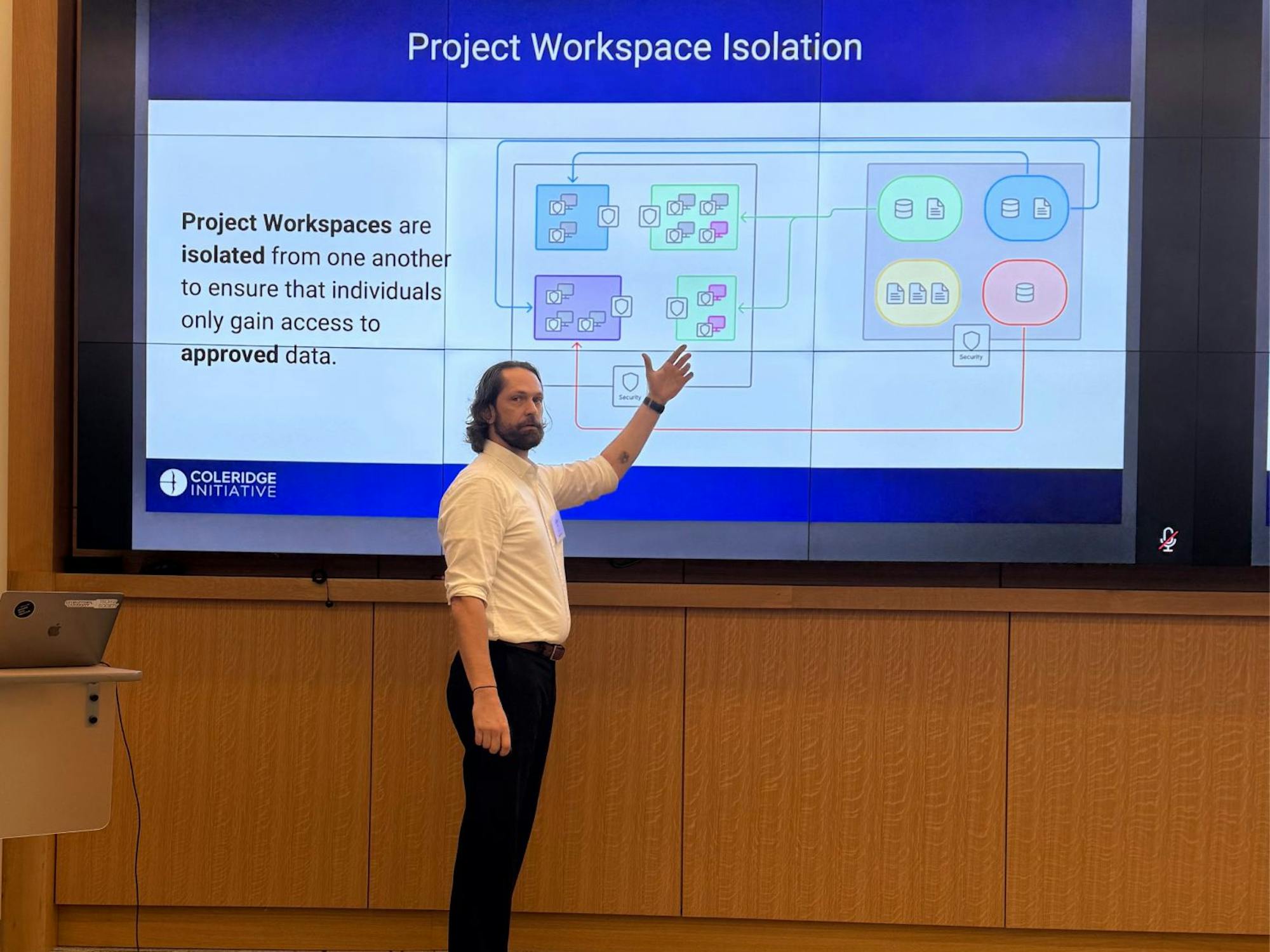
01 Jul 2025
The State of Administrative Data: ADRCon 2025
On June 24-25, leaders and researchers from across the administrative data community gathered in Washington, D.C. for the first ADRCon 2025: Data for Public Good conference. Co-hosted by Georgetown University’s Massive Data Institute, Mathematica, and Northwestern University’s Institute for Artificial Intelligence in Medicine, ADRCon offered a powerful platform for collaboration and insight-sharing between attendees who came from academia, government, and the private sector. Coleridge Initiative CEO, Ahu Yildirmaz, joined the mainstage panel, "The Future of Administrative Data: Charting a Path Forward in Uncertain Times," alongside Richard Hendra, Director of the Center for Data Insights at MDRC and moderator, Michael Lenczner, CEO of DARO. The conversation tackled the evolving administrative data landscape, influenced by disruptions in federal data access and the emergence of state-led innovations. Yildirmaz shared how across these changes, Coleridge is helping public agencies move from fragmented systems to secure, collaborative infrastructure that delivers real-world impact. In addition to the mainstage discussion, Coleridge's Vice President of Data Enclave Operations, Jonathan Mills (pictured), presented as part of a session on infrastructure and strategy. He gave a deep dive into Coleridge's "5 Safes" framework that underpins the Administrative Data Research Facility (ADRF). The presentation highlighted how the ADRF platform enables security, access, and governance to facilitate multi-agency collaboration without compromising trust or compliance. The conference also featured Coleridge’s work on real-time labor market insights in a session focused on tools for public services. Using the Unemployment-to-Reemployment Portal as a case study, Yildirmaz detailed how secure, tiered-access dashboards are helping states understand unemployment trends and service gaps at a granular level and how Coleridge is working to scale these tools across additional states and geographic regions. ADRCon 2025 reaffirmed what we at Coleridge know: administrative data, when responsibly linked and thoughtfully applied, is one of the most powerful tools we have to improve public policy. This current moment is a building moment for our field. We have an opportunity and a responsibility, to create data infrastructure that is trustworthy, usable, and truly impactful across sectors. Learn more about ADRCon 2025
23 Jun 2025
Advancing Data For the Public Good: The Coleridge Initiative 2024 Impact Report
We are pleased to release our 2024 Impact Report, showcasing a year in which we deepened partnerships and reach with states and the federal government, expanded access to secure data, and empowered agencies with the tools and training to unlock insights for more informed policy decisions. Through innovation, collaboration, and a commitment to public impact, Coleridge continued to deliver on its mission to help governments use data more effectively to serve people and communities. Read the 2024 Impact Report This year’s report includes our work ranging from technological upgrades in our FedRAMP-authorized Administrative Data Research Facility (ADRF), to new applied training offerings and data products to meet partner needs. Projects like the Arkansas Enrollment-to-Employment Dashboard and Wisconsin’s tiered access tools are examples of how secure, integrated data and project-based training can drive better decisions for education, workforce, and support services. In 2024, we achieved major milestones, such as securing a landmark $7.5 million agreement with the USDA, launching the State IMPACT Collaborative in partnership with MDRC, and hosting over 200 leaders at our Fourth Annual National Convening in Washington, DC. The report also features the powerful work of our Democratizing Our Data Challenge (DDC) program teams, whom, with funding from Coleridge Initiative and access to the ADRF, designed scalable, collaborative tools to address policy issues in their states. From creating K-12 data models in New Jersey to building unemployment-to-reemployment dashboards in Wisconsin, these projects represent the future of data innovation in public service. As we continue into 2025, our momentum is only growing and demand for high-quality and clear data is only increasing. We are proud to be shaping the future of data-driven public policy at Coleridge Initiative and we hope you enjoy the 2024 report!

17 Jun 2025
COLERIDGE INITIATIVE ANNOUNCES NEW COHORT OF DEMOCRATIZING OUR DATA CHALLENGE TO ADVANCE DATA-DRIVEN POLICY
Three teams awarded funding in the areas of workforce, education, and corrections.
COLERIDGE INITIATIVE ANNOUNCES NEW COHORT OF DEMOCRATIZING OUR DATA CHALLENGE TO ADVANCE DATA-DRIVEN POLICY Three teams awarded funding in the areas of workforce, education, and corrections. WASHINGTON, DC, June 17, 2025 —The Coleridge Initiative today announced the latest cohort for Round Three of its Democratizing Our Data Challenge (DDC) program. The DDC is designed to facilitate the use of administrative data to help researchers develop, build, and scale innovative data products that support public policy and programs. Leveraging Coleridge’s secure data platform, the Administrative Data Research Facility (ADRF), the teams in the DDC program collaborate on developing practical tools that help public leaders make more informed policy decisions. Since its launch in 2022, the DDC program has aimed to tackle high-impact challenges through partnerships within and across state agencies, universities, nonprofits, and mission-driven companies. This third round of the DDC awards will support two projects from Connecticut, and one multi-state project from Washington, DC, Virginia, and Maryland, which are focused on workforce, education, and corrections. “It is so inspiring to see the DDC teams take administrative data and transform it into something so powerful — not just for policy, but for people.” said Dr. Ahu Yildirmaz, President and CEO of the Coleridge Initiative. “By equipping them with philanthropic funding, secure infrastructure like the ADRF, and expert guidance, we’re helping them move from insight to impact — and ultimately driving better outcomes in education, justice, and family well-being.” Third Round Awardee Projects Include: DC/VA/MD Award Connecting Education to Employment: By linking education and workforce data across the region for the first time, this project will help the jurisdictions better understand outcomes for residents who began in its K-12 schools, regardless of where they live or work in the region. This project will demonstrate the value of sharing data across states. Connecticut Corrections Award: Supporting Re-Entry through Workforce Training: This project will study how prison education and training programs, like Vocational Village and Second Chance Pell, affect people’s chances of getting jobs and staying financially stable after release. This project will report on program participation and provide insights into the efficacy of these programs beyond the DOC setting. Connecticut Childcare Award: Childcare and Family Stability: By linking data from the Jobs First Employment Services (JFES), Care 4 Kids, and K-12 education programs, the project will create foundational knowledge on how these programs affect families, specifically through exploring how receiving childcare subsidies helps parents complete job training and enter the workforce. The DDC program has been supported by generous funding from Ascendium Education Group, Gates Foundation, and the Walton Family Foundation. Past Project Highlights In Rounds 1 and 2, DDC awardees developed innovative tools via multi-state data collaborations to improve workforce and education insights, including: New Jersey (Rutgers University’s Heldrich Center): Developed a comprehensive dashboard integrating workforce and education data to analyze employment outcomes across diverse demographic groups. Kentucky, Indiana, and Tennessee: Developed a Multi-State Postsecondary Report dashboard that provides insights on employment outcomes after postsecondary education. Ohio: Created new measures of non-degree credential outcomes for inclusion in the Multi-State Postsecondary Report dashboard hosted by KYSTATS. Rhode Island, New Jersey, Virginia, and Kentucky: Enhanced the Multi-State Postsecondary Report with data from the eastern states to present employment outcomes of postsecondary graduates. Indiana–Education Design Lab: Developed a data model to evaluate the effectiveness of micro-pathways in improving employment outcomes for learners completing non-degree programs. Media Contact: Nick Obourn, Senior Director of Marketing and Communications, Coleridge Initiative. nick.obourn@coleridgeinitiative.org About The Coleridge Initiative, Inc. The Coleridge Initiative is a nonprofit organization working with governments to ensure that data are more effectively used for public decision-making. Coleridge provides agencies with the opportunity to enhance their data literacy and collaborate within and across states to develop new technologies through the secure access and sharing of confidential microdata. Coleridge provides secure data enclave services to a diverse range of clients, including 24 state government agencies and several federal agencies, through the Administrative Data Research Facility (ADRF). The ADRF is a FedRAMP-authorized cloud-based platform that enables government agencies to link their longitudinal data with other states and agencies. To learn more, visit www.coleridgeinitiative.org

28 Apr 2025
Insights From The Semafor World Economy Summit
Attending the Semafor World Economy Summit in Washington, D.C. from April 23–25 was a powerful reminder of the importance of dialogue between the public and private sectors and the integral role media outlets can play as a convener. The Summit brought together CEOs, policymakers, economists, and public sector leaders from the state and federal levels to share perspectives on the economy, the future of innovation, the role of responsible leadership, and the need for stronger collaboration across sectors to address today’s complex challenges. I was encouraged to see policy leaders from several states we work closely with including Kentucky, Connecticut, and Illinois. One of the highlights of my experience was participating in a roundtable discussion on AI and Public Sector. It was an engaging and forward-looking conversation about how governments and private companies are shaping the development of AI to serve the public good. AI is a tool above all else that can be deployed in any number of directions and at Coleridge Initiative, we are embracing this by applying the technology within our secure data environments to strengthen privacy safeguards and streamline research workflows for government partners. As the roundtable wrapped, a consensus emerged around the idea that while AI systems can be impactful it also takes public-private collaboration to build systems that are transparent and beneficial to society. Many of the sessions at the Summit were structured as brief 20-minute conversations on focused topics, and I found the format informative and easily digestible. On Thursday afternoon, the session with Ian Bremmer, President and Founder of Eurasia Group and GZERO Media, was a fast-paced, deep dive into geopolitical shifts, emphasizing how global uncertainty is reshaping both markets and policymaking. His remarks highlighted the importance of agility, innovation, and cross-sector collaboration, which align deeply with Coleridge’s approach to building a connected data ecosystem for public impact. At Coleridge Initiative, we believe that data collaboration across sectors is essential for smarter public policy and that cannot take place without innovation across sectors. Participating in the World Economy Summit affirmed that our mission—to make secure, accessible, and actionable data central to public decision-making—is aligned with the broader movement and ecosystem to build stronger bridges between the private and public spheres to inform decision making.

04 Apr 2025
A Pivotal Moment to Gather
“Isn’t this a pivotal moment?” I kicked off our Fifth Annual Coleridge Convening in Washington, D.C. with this question, acknowledging the changing landscape in our nation’s capital and its implications for our work. Our nearly 250 Convening participants representing 37 states, who gathered in Arlington, VA, March 26-28, recognized the unique challenges of our current environment, with many noting that delivering on our Coleridge mission – empowering leaders, policymakers, and government agencies to create value through data literacy that inform better policies for the public good – is more critical than ever. Across the main stage and breakout room discussions, there was an unwavering confidence in data-driven decision making – the belief that the real potential for transformative change in government is in secure, accessible, and what I like to call “elegant” data. By elegant, I mean dynamic, nimble, and versatile data that addresses the needs of the moment while preparing us for the future. This isn't theoretical. We had three new states join us this year from New York, Kansas, and West Virginia and one of the driving factors in their attendance was the real application of data collaboration in the Administrative Data Research Facility (ADRF) shared at the Convening. For example, with help from KYStats we launched the Multi-State Postsecondary Report, which allows partner states to track how their residents move across state lines for postsecondary education and into the workforce, offering insights that no single state could capture on its own. Building on that momentum, our Democratizing Data Challenge program helped launch the Eastern States Longitudinal Data Collaborative, which brought together New Jersey, Rhode Island, and Virginia to expand the model regionally. These are a few of the cases where traditional systems have faced hurdles and Coleridge Initiative’s collaborative approach launched them over those obstacles. And we stand ready to do so again. Five critical opportunities emerged from our discussions that will shape our work in this pivotal moment: Data Integrity As Mark Zandi, Chief Economist at Moody's and Coleridge Initiative board member, emphasized in his keynote, “we have seen the quality of the data eroding, and it is increasingly difficult to trust traditional sources.” Changes at the federal level have magnified these issues. With federal data infrastructure at risk, Coleridge's commitment to the highest standards of privacy and security has never been more essential. Our rigorous standards ensure policymakers can trust the evidence guiding their decisions. Pioneering Collaborative Governance Models The "sandbox" we've created with the ADRF – where agencies can safely test innovative approaches to data sharing – continues to evolve. At this year's Convening, we unveiled Coleridge PASS (Privacy, Access, Safety, and Security), a groundbreaking layer that streamlines collaboration across agencies, datasets, agreements, and research projects. This framework maintains trust while accelerating insights. Bottom-Up Data Ecosystem While federal agencies navigate transition, an extraordinary opportunity emerges for states to lead. Coleridge Initiative has partnered with almost all 50 states in its five years and through the ADRF, we're witnessing the power of a bottom-up approach to data infrastructure. Each new agency, partner, and dataset creates a network effect that strengthens the entire ecosystem. Enhanced Compliance through Responsible AI While secure data sharing will always require human oversight, we're strategically deploying AI to strengthen – not replace – critical safeguards. Our models build additional fail-safes into disclosure review and export processes. We’ve specifically enabled the use of AI as a data “export assistant,” allowing AI triage to surface potential data exposure issues for human review. This hybrid approach significantly reduces the risk of sensitive data transfer while maintaining rigorous oversight. Translating Data into Action through Impact Storytelling Marty Johnson, Director State Labor Information, Illinois Department of Employment Security, reminded us: “Data, when used in the right way, can tell the story that sits with people more deeply.” The growing Multi-state Data Collaborative demonstrates how sharing outcomes across boundaries amplifies impact and secures crucial investment. With dozens of projects currently underway across multiple government agencies, we're committed to helping you translate technical achievements into compelling narratives that resonate with policymakers and funders. The time is now to champion administrative data and prove once and for all that collaborative, data-driven approaches generate meaningful societal impact, even in uncertain times. We’re not just ready for the moment. We were built for it.
31 Mar 2025
COLERIDGE INITIATIVE'S 5TH ANNUAL NATIONAL CONVENING HIGHLIGHTS THE FUTURE OF DATA-DRIVEN POLICY FOR PUBLIC GOOD
Data Leaders Converge to Champion Evidence-Based Policy at Critical Time WASHINGTON, DC, March 31, 2025 — The Coleridge Initiative hosted its 5th Annual National Convening in Arlington, VA, from March 26-28, bringing together nearly 300 data experts, policymakers and thought leaders to explore the transformative power of administrative data in shaping public policy. This year’s Convening, titled Empower Collaboration, Unlock Innovation, and Drive Impact, underscored how strategic partnerships and groundbreaking technology are impacting decision making for state, federal, and private sectors and unlocking the potential of data for public good. “We stand at a pivotal moment when the need for secure, accessible, and elegant data has never been more critical,” said Dr. Ahu Yildirmaz, President and CEO of the Coleridge Initiative. “This Convening highlights that need and the huge opportunity we have to work in partnership to advance data infrastructure, governance, and accessibility to drive better policies that improve lives.” The keynote address by Mark Zandi, Chief Economist at Moody’s, emphasized the urgent need for data-driven policymaking amid funding constraints and workforce reductions. “We have seen the quality of data eroding, and it is increasingly difficult to trust traditional sources,” said Zandi. “Data is critical to understanding what is going on and how we respond.” Yildirmaz celebrated five years of growth and looked to the future: “We are building something greater than a platform – we’re working to generate a network effect,” said Yildirmaz. “Coleridge is not just building a technology platform—we’re helping shape a national data ecosystem. One where every dataset, every agency, every partner contributes to something larger than itself.” Attendees rose to the challenge, focusing on collaboration between organizations and groundbreaking innovations in data integration to achieve meaningful impact on a range of societal issues. Discussions included: Empowering Collaboration Across the Public and Private Sectors Data Innovation to Drive Opportunity and Access in Higher Education Unlocking Responsible AI Uses with State and Federal Data Best Practices for Data Sharing, Governance, and Infrastructure Multi-State Data Collaborative (MSDC) Real-World Outcomes View the full Convening agenda A standout moment of the Convening was the presentation of the Data Champion of the Year Award to Robert McGough, Chief Data Officer for the state of Arkansas. The award recognizes exceptional leadership in advancing data-driven innovation in the public sector. “I am honored to be recognized as Data Champion of the Year, especially among the many incredible data professionals from whom I have learned so much,” said McGough. Mike Rogers (Chief Workforce Officer), Dr. Jake Walker (Chief Research Officer), and I sincerely appreciated the opportunity to share how Arkansas is digitally transforming learning, employment, and advancement through new platforms and improving whole-person care through the Arkansas Integrated Referral and Outcomes System (AIROS). The Coleridge Initiative has been a vital partner in Arkansas’ data journey, and I am excited about the new efforts we have underway this year and the value they will provide to Arkansas and beyond.” About The Coleridge Initiative, Inc. The Coleridge Initiative is a nonprofit organization working with governments to ensure that data are more effectively used for public decision-making. Coleridge provides agencies with the opportunity to enhance their data literacy and collaborate within and across states to develop new technologies through the secure access and sharing of confidential microdata. Coleridge provides secure data enclave services to a diverse range of clients, including 24 state government agencies and several federal agencies, through the Administrative Data Research Facility (ADRF). The ADRF is a FedRAMP-authorized cloud-based platform that enables government agencies to link their longitudinal data with other states and agencies. To learn more, visit www.coleridgeinitiative.org Media contact: Nick Obourn, nick.obourn@coleridgeinitiative.org
26 Mar 2025
COLERIDGE INITIATIVE LAUNCHES COLERIDGE PASS TO REVOLUTIONIZE GOVERNMENT DATA ACCESS AND COLLABORATION
WASHINGTON, March 26, 2025 /PRNewswire/ -- The Coleridge Initiative, a leading nonprofit dedicated to advancing data-driven policy, today launched Coleridge PASS, a pioneering development designed to streamline data access, enhance security, and facilitate seamless collaboration for researchers, data scientists, and government officials. With a more intuitive interface and powerful new features, Coleridge PASS accelerates user onboarding, simplifies data imports, and strengthens support services—empowering agencies and researchers on the Administrative Data Research Facility (ADRF) platform to have a superior user experience and work more efficiently and securely than ever before. "With Coleridge PASS, we are transforming how government agencies and researchers interact with data," said Dr. Ahu Yildirmaz, President and CEO of the Coleridge Initiative. "By enhancing security and streamlining access, we are not only increasing efficiency but also breaking down barriers to drive the future of data-driven policymaking, enabling government agencies to develop better policies and practice for the public good." A Smarter, More Secure Platform As a software layer to the ADRF, Coleridge PASS optimizes operational workflows between agencies, datasets, agreements, and research projects. Key enhancements include: One-Stop Research Hub: Coleridge PASS consolidates essential functions into a single, user-friendly platform, allowing researchers to manage projects, collaborate, and request access to data—all without leaving the portal. Significant UI/UX improvements enhance self-service capabilities, streamline data imports, and accelerate user onboarding and provisioning. Enhanced Security & Compliance: Strengthened data governance features allow users to track data access, manage permissions with greater precision, and securely share code with colleagues—all while ensuring strict compliance with federal data security standards. "The new Coleridge PASS builds upon the ADRF, making it easier to monitor and manage data, projects, and access with additional useful information," said Robert McGough, Chief Data Officer for Arkansas. "With these new innovations, we are more able to harness data and evidence to drive meaningful change." About The ADRF Platform The Coleridge Initiative's award-winning Administrative Data Research Facility (ADRF) is a FedRAMP-authorized cutting-edge computational research platform that enables seamless, secure, and scalable data sharing across agencies and geographic boundaries. Designed to break down silos and enhance data-driven decision-making, ADRF empowers researchers, data scientists, and government agencies to collaborate more effectively while maintaining the highest standards of privacy and security. By providing advanced analytical tools, streamlined workflows, and robust support services, ADRF accelerates insights that drive policy innovation and improve public outcomes. About The Coleridge Initiative, Inc. The Coleridge Initiative is a nonprofit organization working with governments to ensure that data are more effectively used for public decision-making. Coleridge provides agencies with the opportunity to enhance their data literacy and collaborate within and across states to develop new technologies through the secure access and sharing of confidential microdata. Coleridge provides secure data enclave services to a diverse range of clients, including 24 state government agencies and several federal agencies, through the Administrative Data Research Facility (ADRF). The ADRF is a FedRAMP-authorized cloud-based platform that enables government agencies to link their longitudinal data with other states and agencies. To learn more, visit www.coleridgeinitiative.org Media contact: Nick Obourn, nick.obourn@coleridgeinitiative.org
18 Mar 2025
Coleridge Initiative Offers No Cost Services to Unlock the Power of Data
WASHINGTON, D.C. – The use of data, or lack thereof, in government decision making is in the news daily. Questions abound on how the Federal government stores, analyzes, and accesses data and how, especially at this moment, there are fundamental decisions on the structure and impact of the government being made using massive collections of data as a guide. All these actions underscore the power of data and the crucial role it has come to play in how policy decisions are made, both at the federal and state levels. At Coleridge Initiative, we have long partnered with government agencies to unlock the power of data for public good. We believe that data, when used effectively, is a powerful tool that brings clarity for leaders; it’s a catalyst for informed decision-making, and a driver of real impact in communities. Whether it’s improving educational outcomes, shaping economic and workforce policies, or optimizing public resources, our focus on data-driven collaboration has highlighted firsthand how it leads to smarter and more effective policies. As always, we are committed to bridging the gap between data and decision-making. Because we believe the most good comes from sharing knowledge and learning together, we are happy to announce that we are currently offering several of our core services at no cost to partner organizations and those who wish to learn more about Coleridge Initiative. We are pleased to offer fully subsidized seats to state agency staff and their nonprofit partners for our highly regarded Applied Data Analytics Training. Our 2025 offerings will focus on the domains of secondary and post-secondary education, corrections, and workforce. Learn more about our ADA Training Program. In addition, we welcome meetings and conversations with state and federal leaders to discuss access and complimentary seats to the ADRF, our FedRAMP authorized computational research platform, where we provide educational tools, videos, and presentations on best practices in coding. Learn more about our ADRF research platform. Request to learn more about our service offerings. About The Coleridge Initiative, Inc. The Coleridge Initiative is a nonprofit organization working with governments to ensure that data are more effectively used for public decision-making. The organization empowers agencies to enhance workforce data literacy and fosters collaboration across states to develop innovative technologies through secure data sharing. Its FedRAMP-authorized Administrative Data Research Facility (ADRF) enables agencies to link longitudinal data across states and organizations. Learn more at www.coleridgeinitiative.org.
16 Jan 2025
Jeffrey Thomson Named Chair of The Coleridge Initiative Board of Directors
WASHINGTON, D.C. – The Coleridge Initiative is pleased to announce the election of Jeffrey Thomson as Chair of the Board of Directors, succeeding Dr. Michael Holland, who has served on the board since the organization's inception. This leadership transition reflects Coleridge's continued growth and dedication to advancing data-driven decision-making for the public good. Thomson brings significant executive experience and expertise, leading a large accounting non-profit (501c3) as CEO for nearly 15 years, demonstrating deep expertise in governance, strategic planning, business transformation, enterprise risk management, and internal control. Joining the Coleridge Board of Directors in 2023, he has demonstrated a strong alignment with the organization's mission and values. "I am honored to step into the role of Chair and am inspired by Coleridge's commitment to harnessing data and analytics to address critical societal challenges," said Thomson. "Building on the strong foundation developed by Mike and the board, Coleridge is uniquely positioned to help state and federal agencies securely break data silos to transform how the government serves people." An Accomplished Leader Thomson last served as President and CEO of the Institute of Management Accountants (IMA) for nearly 15 years. Previously, he was CFO for Business Sales at AT&T, where he worked for 23 years. His contributions to the fields of accounting and finance have earned him recognition on Accounting Today's "Top 100 Most Influential People List" for 14 consecutive years, as well as a Lifetime Achievement Award from Trust Across America/Trust Across the World. "Jeff brings precisely what Coleridge needs at this pivotal moment – a proven leadership in scaling organizations and deep, cross-sector expertise," said Ahu Yildirmaz, President and CEO of Coleridge. "His exceptional track record of driving innovation, coupled with his genuine passion for leveraging data to transform public policy, will be invaluable as we expand our impact." Outgoing Chair Holland added, "Jeff's unique combination of skills, experience, and passion for the Coleridge mission will ensure the organization's continued success." During his six years guiding the board, first as Treasurer and then as Chair, Holland helped lead Coleridge from a nascent startup into a well-established nonprofit organization with robust governance and operational structures. His leadership ensured sustainability and scalability while keeping the organization focused on its mission. "Mike Holland's steadfast dedication and visionary leadership have been pivotal to Coleridge's success," said Yildirmaz. "His ability to navigate critical growth phases have helped position us for continued impact. We extend our heartfelt gratitude for his invaluable service." Holland stated, "Serving as Chair of the Coleridge board has been one of the most rewarding experiences of my career. I am deeply proud of what we have accomplished together and confident that Jeff's expertise and passion will propel the organization to even greater achievements." About The Coleridge Initiative, Inc. The Coleridge Initiative is a nonprofit organization working with governments to ensure that data are more effectively used for public decision-making. The organization empowers agencies to enhance workforce data literacy and fosters collaboration across states to develop innovative technologies through secure data sharing. Its FedRAMP-authorized Administrative Data Research Facility (ADRF) enables agencies to link longitudinal data across states and organizations. Learn more at www.coleridgeinitiative.org.
07 Nov 2024
State IMPACT Collaborative Awardees Announcement
Coleridge and MDRC are pleased to announce that three state agencies will be awarded funding and research support through the State IMPACT (Innovative Models for Policy Acceleration & Collaborative Testing) Collaborative. The Collaborative provides funding and research support to transform state policymaking by leveraging advanced data analytics and collaborative research to foster evidence-based decision-making and sustainable development. State IMPACT Collaborative Awarded Projects: Led by AccelerateMS, which connects education, training, and employers to build a unified, future-ready talent system. Reemployment Services and Eligibility Assessment Enhancement Project: Led by the Ohio Department of Job and Family Services, in partnership with The Ohio State University, this project aims to test the effectiveness of expanding RESEA services to individuals receiving Supplemental Nutrition Assistance Program and Unemployment Insurance who are currently not being served by RESEA services. Improve Cross-Program Referrals: Led by the Pennsylvania Department of Labor and Industry and the Pennsylvania Workforce Development Board, this project aims to test the effectiveness of different strategies for implementing cross-program referrals from workforce development services increasing enrollment in services. About the State IMPACT Collaborative The State IMPACT Collaborative is a project of MDRC and Coleridge with support from Arnold Ventures. Over two years, the State IMPACT Collaborative consists of training and technical assistance to state agencies committed to using research and evaluation to advance economic mobility among individuals and families with low incomes. This collaborative will build on MDRC’s proven learning-by-doing approach to increasing state agencies' data analytic capacity and MDRC’s 50 years of experience carrying out high-quality rigorous evaluations. Awardees will utilize Coleridge’s renowned Administrative Data Research Facility (ADRF), which enables secure cross-agency and cross-state collaboration, and participate in a new Applied Data Analytics training program in partnership with the state of Arkansas that will include a new co-developed curriculum in evaluation methods.
04 Nov 2024
U.S. DEPARTMENT OF AGRICULTURE AWARDS COLERIDGE INITIATIVE UP TO $7.5 MILLION FOR SECURE DATA ENCLAVE SERVICES
WASHINGTON, D.C. – The U.S. Department of Agriculture (USDA) awarded the Coleridge Initiative a contract with a maximum potential value of $7.5 million over a five-year period to provide a secure data enclave service through Coleridge Initiative’s Administrative Data Research Facility (ADRF), a FedRAMP-authorized, cloud-based computational research platform. This secure data enclave solution will make USDA data more accessible for researchers while protecting privacy and confidentiality. The solution will also enhance data stewardship capabilities by improving the ability of the USDA to manage data access requests, agreements, and reporting metrics. The ADRF is a FedRAMP-authorized AWS GovCloud platform with a security architecture designed to meet federal government protections regarding confidentiality, integrity, provenance, and availability of government data. This platform will facilitate data analysis in economics, agriculture, and nutrition by research universities, NGOs, and government researchers. “This contract enables USDA employees and approved external users to securely collaborate and conduct research with restricted-access datasets,” said Dr. Ahu Yildirmaz, President and CEO of the Coleridge Initiative. “As our collaboration grows, we remain committed to providing comprehensive services, including secure researcher access, advanced tools for data stewardship, and scalable resourcesility. Our platform enables researchers to harness food scanning and consumer survey data to inform program decisions. Our team is dedicated to delivering the highest standards of service and security for our partners, enabling broader access to data and empowering its use for informed decision-making that serves the public good.” About The Coleridge Initiative, Inc. The Coleridge Initiative is a nonprofit organization working with governments to ensure that data are more effectively used for public decision-making. Coleridge provides agencies with the opportunity to enhance their data literacy and collaborate within and across states to develop new technologies through the secure access and sharing of confidential microdata. Coleridge provides secure data enclave services to a diverse range of clients, including 24 state government agencies and several federal agencies, through the Administrative Data Research Facility (ADRF). The ADRF is a FedRAMP-authorized cloud-based platform that enables government agencies to link their longitudinal data with other states and agencies. Learn more: www.coleridgeinitiative.org ###
01 Oct 2024
Boost for Public Data Systems as Coleridge Initiative Scales Up Work
Growth Campaign to Support Major Strategic Goals
NEW YORK – The Coleridge Initiative is pleased to announce the expansion of its work with government agencies to leverage data to address complex issues, improve public decision-making, and improve the lives of students and workers across the country. To make this expansion possible, Coleridge is launching a $15 million fundraising campaign. The Bill & Melinda Gates Foundation has committed to match the first $6 million of this campaign to strengthen Coleridge’s organizational capacity and accelerate growth to support the use of data to inform better policy. To support government data systems, Coleridge provides a platform to securely link data within and across government agencies, and trains staff in data literacy, all while protecting privacy and ensuring data laws are followed. These systems help agencies track educational attainment, gain insights into the economic mobility of adult learners, and help ensure that educational programs are aligned and position students to succeed in today’s global economy. With the launch of a major growth campaign and the support of additional data and infrastructure funders, Coleridge will be able to strengthen organizational capacity, sustain technological leadership, accelerate growth and impact, expand the reach of its services, and enhance training and product adoption. “We have progressed from our successful initial stages of development to become a thriving and dynamic organization. Our operations have expanded significantly, demonstrating measurable impact,” said Ahu Yildirmaz, President and CEO of Coleridge Initiative. “This initiative will bolster our ability to utilize data in addressing complex challenges and driving evidence-based public decision-making.” Currently, Coleridge offers a number of core programs to its government partners. Coleridge’s Administrative Data Research Facility (ADRF) is a secure, cloud-based environment that makes it possible for researchers to develop data models, allowing government agencies to review and analyze their K-12 and workforce data to answer key questions on student outcomes that were previously not possible. The Democratizing Our Data Challenge (DDC) enables government agencies to scale and replicate data products, such as tools tracking state unemployment insurance statistics or dashboards tracking student outcomes from education to the workforce. The DDC builds a community of practice around the use of administrative data for the public good, where teams gain knowledge that can benefit other teams within their respective DDC cohorts. Through the Applied Data Analytics Training Program (ADA), Coleridge provides applied data analytics training to enhance the data literacy of government agency employees so that they can better use and understand their administrative data. “This grant and our continued fundraising effort will allow us to expand these programs by reaching more states, offering more virtual, on-demand training opportunities, and strengthening our internal capacity to support the development of more innovative solutions, like the ADRF, for public data systems,” said Yildirmaz. About The Coleridge Initiative, Inc. The Coleridge Initiative is a nonprofit organization working with governments to ensure that data are more effectively used for public decision-making. Coleridge provides agencies with the opportunity to enhance their workforce data literacy and collaborate within and across states to develop new technologies through the secure access and sharing of confidential microdata. Coleridge’s secure data hosting platform, the Administrative Data Research Facility (ADRF), is a FedRAMP-certified environment that enables government agencies to link their longitudinal data with other states and agencies. Learn more: www.coleridgeinitiative.org
24 Jul 2024
Coleridge Initiative Welcomes New Board Member
NEW YORK – The Coleridge Initiative, Inc. announced that Nicole Ifill was elected to the Coleridge Initiative Board of Directors. Ifill complements the composition of the board with her wealth of expertise and knowledge in strengthening data infrastructures by improving the availability, quality, and use of data. "I am thrilled to welcome Nicole Ifill to the Coleridge Initiative Board of Directors," said Dr. Michael Holland, Chair of the Coleridge Initiative Board of Directors. "Her wealth of expertise and experience ensuring data quality, availability, and use will undoubtedly strengthen the Coleridge mission." “I am very excited to have Nicole join the Coleridge Board of Directors,” said Dr. Ahu Yildirmaz, President and CEO of the Coleridge Initiative. “She has been a long standing supporter of our mission and has a wealth of knowledge when it comes to building and strengthening a secure data infrastructure that can be used to support evidence-based decision-making.” Nicole Ifill is a Deputy Director on the U.S. Program Data strategy team at the Bill & Melinda Gates Foundation where she works to strengthen data infrastructure by improving the availability, quality, and use of data that connects educational attainment to workforce outcomes. She also oversees the team’s measurement, learning, and evaluation efforts. This work helps ensure that institutions, policymakers, and researchers have the information they need for data-driven decision-making and that learners can make informed decisions about their career paths. Nicole has devoted her career to addressing barriers to postsecondary education and issues surrounding persistence and attainment, especially for learners from low-income backgrounds. Before joining the foundation in 2017, she managed several data analysis projects at RTI International, including as analytic director of the 2012/17 Beginning Postsecondary Students Longitudinal Study and as project director of the annual data update of College Results Online, a web tool developed by the Education Trust that provides detailed institution-level data on student graduation rates and labor market outcomes to multiple stakeholders. Nicole has a master’s degree in statistics from the University of California, Santa Barbara, and a bachelor’s degree in political science-statistics from Columbia University. About The Coleridge Initiative, Inc. The Coleridge Initiative is a nonprofit organization working with governments to ensure that data are more effectively used for public decision-making. Coleridge provides agencies with the opportunity to enhance their workforce data literacy and collaborate within and across states to develop new technologies through the secure access and sharing of confidential microdata. Coleridge’s secure data hosting platform, the Administrative Data Research Facility (ADRF), is a FedRAMP-authorized environment that enables government agencies to link their longitudinal data with other states and agencies. Learn more: www.coleridgeinitiative.org ###
15 May 2024
Coleridge Initiative Welcomed Didem Tuzemen as New Vice President of Product and Development
NEW YORK – The Coleridge Initiative, Inc. announced on Wednesday, May 15th that Dr. Didem Tuzemen joined the organization as a new Vice President of Product and Development. Dr. Tuzemen will lead the development of data products for labor and benefits. “As our new VP of Product and Development, Didem will play a pivotal role in helping us to deepen and expand our portfolio,” said Dr. Ahu Yildirmaz, CEO of the Coleridge Initiative. “Didem has a wealth of knowledge and expertise which will greatly contribute to our organization’s advancements.” “Joining the Coleridge Initiative is an exciting opportunity to work with a mission-driven organization dedicated to expanding access to data within government agencies while developing cutting-edge data products to inform policymakers,” said Dr. Didem Tuzemen, Vice President of Product and Development. Dr. Tuzemen previously served as a Senior Economist at the Federal Reserve Bank of Kansas City. She also served as Executive Director of the Kansas City Federal Statistical Research Data Center. Dr. Tuzemen holds a doctorate in economics from the University of Maryland College Park. About The Coleridge Initiative, Inc. The Coleridge Initiative is a nonprofit organization working with governments to ensure that data are more effectively used for public decision-making. Coleridge works with government agencies to create value by providing public agencies with the opportunity to enhance their workforce data literacy in order to develop better policies for the public good. They facilitate the development of collaborations within and across states allowing for new technologies to be developed through the secure access to and sharing of confidential microdata. They do this by providing a platform to securely link confidential data within and across states and agencies, and by providing training classes to agency staff. Their platform is the Administrative Data Research Facility (ADRF) which is a secure, FedRAMP-certified, cloud-based environment that enables government agencies to link their longitudinal data with other states and agencies. For more information about Coleridge, the ADRF, and their training program, visit: www.coleridgeinitiative.org ###
20 Mar 2024
COLERIDGE INITIATIVE’S FOURTH ANNUAL NATIONAL CONVENING HIGHLIGHTS INNOVATIVE POTENTIAL OF DATA PARTNERSHIPS FOR PUBLIC POLICY AND ADMINISTRATION
ARLINGTON, VA. – The Coleridge Initiative, Inc. hosted its fourth annual national convening in Arlington, V.A. on March 18th-20th. The convening explored how government leaders in the field are pushing the boundaries of traditional governance, forging data partnerships, and collaborating for better outcomes in public policy and administration. “To drive change in how evidence and data are used to inform policy, we must work collaboratively to leverage partnerships and embrace innovative technologies that can empower policymakers and program administrators to make informed decisions for the betterment of our communities,” said Dr. Ahu Yildirmaz, President and CEO of the Coleridge Initiative. “The successful development and implementation of government policies and practices also relies on the adoption of technologies that support a data collaboration ecosystem.” "The Convening, hosted by our partners at the Coleridge Initiative, has been a huge success in showcasing the work of those engaged with the Multi-State Data Collaborative (MSDC) and the impactful work in areas such as reemployment and post-secondary completions," said Scott B. Sanders, President and CEO of NASWA. "These discussions and as well as support from foundations will help grow our member participation in the MSDC, allow partnerships with research groups to unfold, and move their vision to value generation in evidence-based policy discussions." During the three-day convening, attendees participated in interactive panel discussions for insights into how data collaboration can lead to better outcomes in public policy and administration. Attendees learned about innovative projects funded through the Democratizing our Data Challenge, domain-specific multi-partner product development, state-driven research practices, effective code modernization and reproducibility, cross-domain privacy-preserving techniques, and legal frameworks to break data-sharing barriers. Convening attendees also learned about federal and philanthropic funding progress with initiatives on data innovation and collaboration including state data linkages and use, training programs, technological enhancements, and collaborative community building. About The Coleridge Initiative, Inc. The Coleridge Initiative is a nonprofit organization working with governments to ensure that data are more effectively used for public decision-making. Coleridge provides agencies with the opportunity to enhance their workforce data literacy and collaborate within and across states to develop new technologies through the secure access and sharing of confidential microdata. Coleridge’s secure data hosting platform, the Administrative Data Research Facility (ADRF), is a FedRAMP-certified environment that enables government agencies to link their longitudinal data with other states and agencies. Learn more:www.coleridgeinitiative.org
19 Mar 2024
Revolutionizing State Policy: MDRC and Coleridge Initiative Forge New Partnership to Drive Sustainable Change
ARLINGTON, VA. – In an unprecedented collaboration, MDRC and the Coleridge Initiative announced the launch of the State IMPACT (Innovative Models for Policy Acceleration & Collaborative Testing) Collaborative on Tuesday, March 19th. This groundbreaking initiative aims to provide funding and research support to transform state policymaking by leveraging advanced data analytics and collaborative research to foster evidence-based decision-making and sustainable development. At the Heart of State IMPACT: Innovative Data Integration: Utilizing Coleridge Initiative’s renowned Administrative Data Research Facility (ADRF), which enables secure cross-agency and cross-state collaboration, the collaboration provides an unparalleled platform for data use, applied analytics training, and research for effective policymaking and program administration. Expertise and Experience: Drawing on MDRC’s track record of conducting high-impact evaluations and the strong relationships both organizations have developed with state agencies, the Collaborative will bring about meaningful policy improvements. Collaborative Excellence: The Collaborative will foster synergy between data providers, state employees, expert researchers, and data scientists working together to test new strategies in critical areas such as education, criminal justice, and employment. "Through the State IMPACT Collaborative, we're setting a new standard for how states can use data to inform policy and drive progress," said Dr. Ahu Yildirmaz, President and CEO of the Coleridge Initiative. "By harnessing our combined expertise with the innovative use of data, we're poised to make significant strides in evidence-based policymaking." Virginia Knox, President of MDRC, highlighted the collaborative spirit of the initiative. "We are excited to launch this new partnership with our longstanding colleagues at the Coleridge Initiative and with states interested in using their data to build stronger and more effective policies and programs,” said MDRC President Virginia Knox. “Each of us brings unique skills and capacities that will advance this important work.” The State IMPACT Collaborative will vastly streamline data acquisition for use by evaluators and enhance the skills of state staff to conduct analyses of their own. Inspired by the success of an earlier initiative, the TANF Data Collaborative, the State IMPACT Collaborative will bring together data providers, state employees, MDRC researchers, and Coleridge data scientists to collaborate on high-quality tests of the effectiveness of new state strategies in education, criminal justice, income support, and employment, using linked sources of government data. Ultimately, this initiative has the potential to foster a culture of experimentation in state agencies, to bridge gaps in the fragmented data infrastructure in these state systems, and to build states’ analytic capacity, culminating in a public report that demonstrates the benefits to states of moving in this direction. For more information on the Collaborative, visit the Coleridge Initiative website. About MDRC MDRC, a nonprofit, nonpartisan organization founded in 1974, conducts rigorous studies of programs and policies that affect people with low incomes, actively disseminates lessons to policymakers and practitioners, and works directly with programs and agencies to help improve their effectiveness. About The Coleridge Initiative, Inc. The Coleridge Initiative is a nonprofit organization working with governments to ensure that data are more effectively used for public decision-making. Coleridge provides agencies with the opportunity to enhance their workforce data literacy and collaborate within and across states to develop new technologies through the secure access and sharing of confidential microdata. Coleridge’s secure data hosting platform, the Administrative Data Research Facility (ADRF), is a FedRAMP-certified environment that enables government agencies to link their longitudinal data with other states and agencies. Learn more: www.coleridgeinitiative.org
28 Feb 2024
Richard Ferguson Joined the Coleridge Initiative as New Chief Technology Officer
NEW YORK – The Coleridge Initiative, Inc. announced on Wednesday, February 28th that Richard Ferguson has been appointed as the new Chief Technology Officer. Ferguson will help lead the continued expansion and innovation of Coleridge’s Administrative Data Research Facility (ADRF). “As the new CTO, Rich will play a critical role in the advancement of our award-winning ADRF platform,” said Dr. Ahu Yildirmaz, CEO of the Coleridge Initiative. “Rich has a wealth of knowledge and his diverse experience will greatly contribute to our organization’s technological advancements. He has extensive background and expertise in strategically applying information security, software development, and systems engineering across government and non-governmental sectors.” “The potential of the ADRF platform in revolutionizing data analysis and decision-making in the public sector is immense and truly inspiring,” said Richard Ferguson, Chief Technology Officer, Coleridge Initiative. “I am eager to work with the team to further enhance this technology, making it more robust, user-centric, and innovative. We have the opportunity to make a significant impact on public policy and governance, and I look forward to contributing to this transformative journey.” Ferguson previously served as a Federal Chief Information Officer at the Federal Labor Relations Authority, as Chief of Technology Engineering for the Executive Office of the President, and as Chief Technology Officer for Lulius Innovation. He also served as a National Security Fellow at Harvard University and as a Brookings Congressional Fellow working for the U.S. Senate Majority Leader on Capitol Hill. Ferguson holds a bachelor’s degree in biology from the University of Nevada and a master’s degree in Leadership from Georgetown University. About The Coleridge Initiative, Inc. The Coleridge Initiative is a nonprofit organization working with governments to ensure that data are more effectively used for public decision-making. Coleridge works with government agencies to create value by providing public agencies with the opportunity to enhance their workforce data literacy in order to develop better policies for the public good. They facilitate the development of collaborations within and across states allowing for new technologies to be developed through the secure access to and sharing of confidential microdata. They do this by providing a platform to securely link confidential data within and across states and agencies, and by providing training classes to agency staff. Their platform is the Administrative Data Research Facility (ADRF) which is a secure, FedRAMP-certified, cloud-based environment that enables government agencies to link their longitudinal data with other states and agencies. For more information about Coleridge, the ADRF, and their training program, visit: www.coleridgeinitiative.org ###
04 Jan 2024
Unleashing 'Evidence 2.0'
Commentary | The power of data linkages in evidence-based policymaking
Evidence-based policymaking thought leaders Nick Hart and Jason Saul recently heralded a new phase in the drive for evidence-based policymaking. “Evidence 1.0 is great: we’ve generated a wealth of better knowledge, and that is fantastic. But the real point is to make all that knowledge accessible and usable.” Evidence 2.0, they said, is all about the data. Actually, I think it’s all about turning data into actionable insights. While current evidence building efforts are generating a lot of information, we may be missing genuine insights that are right under our noses. In our experience at the Coleridge Initiative, you need to connect disparate data points to derive actionable insights. It's about recognizing and tapping into the immense potential inherent in data linkages. The true essence lies not just in the data itself, but in the art of connecting, itself. Imagine having multiple pieces of a jigsaw puzzle, each held by different individuals in separate rooms. Read the full article below.
19 Jul 2023
Jeffrey C. Thomson Joins Coleridge Initiative Board of Directors
NEW YORK – The Coleridge Initiative, Inc. announced on Wednesday, July 19th that Jeffrey C. Thomson, CMA, CSCA was elected to the Coleridge Initiative Board of Directors on June 30, 2023. Thomson complements the composition of the board with his knowledge and technical expertise in financial and management accounting. “I am pleased to announce that Mr. Thomson has joined our board,” said Dr. Ahu Yildirmaz, President and CEO of the Coleridge Initiative. “With his extensive experience as a chief financial officer and CEO, Jeffrey brings a unique blend of financial expertise and analytical acumen to our organization.” “I am honored to join the Coleridge Initiative’s esteemed board,” said Thomson. “I am deeply inspired by Coleridge’s fundamental purpose to use ‘big data’ and data analytics for societal good. I truly believe that data science can transform professions and serve the public interest, in this case, positively influencing public policy and programs across the U.S. in workforce development and K-12 education.” “I am thrilled to have Jeff Thomson join the board,” said Dr. Michael Holland, Chair of the Coleridge Initiative Board of Directors. “Jeff’s technical expertise in financial and management accounting are skills that will benefit Coleridge as we grow. But more than that, Jeff has a clear passion for the mission of the Coleridge Initiative.” Thomson is Senior Strategic Advisor for Competent Boards, Inc., and Executive in Residence – Thought Leadership for Becker Professional Development, both global brands focused on competency development for senior business leaders in the face of a disruptive, high velocity and transformative global market. Thomson has been named in Accounting Today’s “Top 100 Most Influential People List” for the past 14 years and was honored with the Lifetime Achievement Award by Trust Across America/Trust Across the World. Thomson earned his master’s degree in mathematical statistics from Montclair State University, and completed executive education programs at Wharton, MIT, and Columbia University. About The Coleridge Initiative, Inc. The Coleridge Initiative is a nonprofit organization working with governments to ensure that data are more effectively used for public decision-making. Coleridge provides agencies with the opportunity to enhance their workforce data literacy and collaborate within and across states to develop new technologies through the secure access and sharing of confidential microdata. Coleridge’s secure data hosting platform, the Administrative Data Research Facility (ADRF), is a FedRAMP-certified environment that enables government agencies to link their longitudinal data with other states and agencies. Learn more: www.coleridgeinitiative.org ###
28 Jun 2023
Investing in Data and Evidence-Based Policy - Democratizing our Data Challenge Round Two Awardees Announced
NEW YORK – The Coleridge Initiative, Inc. announced the awardees of round two of the Democratizing our Data Challenge on June 28th. The winning teams are the Eastern States Longitudinal Data Collaborative - Teacher Workforce Report, Education Design Lab, and ResultsOHIO. “The Democratizing our Data Challenge has been a tremendous success and has garnered enormous interest from state agencies wanting to collaborate and develop valuable data products for evidence-based policy,” said Ahu Yildirmaz, President and Chief Executive Officer of the Coleridge Initiative. “Funded by philanthropic organizations, the challenge has enabled states to develop data products and collaborate across jurisdictions through the Multi-State Data Collaboratives.” The three teams, consisting of three state agencies, four universities, and four nonprofit organizations, have been funded to develop actionable information and data products about the teacher workforce, employment outcomes for micro-pathway participants, and community college outcomes. The three winning teams will move immediately to develop and scale their innovative approaches to understanding these important issues. The second round of the Democratizing our Data Challenge was funded by the Bill & Melinda Gates Foundation, Ascendium Education Group, Overdeck Family Foundation, and Walton Family Foundation. The challenge was designed to develop and scale innovative product ideas for understanding public policy and programs by using administrative data that are securely hosted in the Coleridge Initiative’s Administrative Data Research Facility. Successful projects are sustainable and scale across agencies, states, and communities through the collaboration of agencies and partner organizations such as universities, nonprofits, and mission-driven private organizations. To learn more about the awarded proposals, please visit the Coleridge Initiative website. About The Coleridge Initiative, Inc. The Coleridge Initiative is a nonprofit organization working with governments to ensure that data are more effectively used for public decision-making. Coleridge provides agencies with the opportunity to enhance their workforce data literacy and collaborate within and across states to develop new technologies through the secure access and sharing of confidential microdata. Coleridge’s secure data hosting platform, the Administrative Data Research Facility (ADRF), is a FedRAMP-certified environment that enables government agencies to link their longitudinal data with other states and agencies. Learn more: www.coleridgeinitiative.org ###
21 Jun 2023
Coleridge Initiative Launched Innovative ADRF Management Portal to Streamline Data Workflows and Empower Public Decision-Making
NEW YORK – The Coleridge Initiative, Inc. launched the new Administrative Data Research Facility (ADRF) Management Portal on June 21st. The portal has been developed to efficiently manage operational workflows between agencies, datasets, agreements, and research projects utilizing the Administrative Data Research Facility. “At Coleridge, we strive to provide agencies and researchers with the tools they need to ensure that data are more effectively used for public decision-making,” said Ahu Yildirmaz, Chief Executive Officer at Coleridge Initiative. “The ADRF Management Portal is a huge step forward as we continue to scale and innovate by providing users with key insights on performance measurement and utilization while enabling self-service capabilities to improve turnaround time and efficiency.” “Providing researchers with a user-friendly management system that enables self-service for optimal operational efficiency has been our top priority,” said Mahesh Sahore, Chief Technology Officer at Coleridge Initiative. “The new management portal will eliminate user dependency on our help desk to fulfill the provisioning of requests by taking full advantage of the self-service capability while also being able to view operational data analytics.” Coleridge strives to maximize user benefits and enhance the user experience for researchers utilizing the ADRF platform. Some of the key benefits of the new management system include a digitized workflow, easy tracking and reporting, standardized forms that minimize user request and project workspace turnaround time, and the ability to scale with faster user request fulfillment. New capabilities of the management system include a shared isolation model and entitlements for tracking and reporting. About The Coleridge Initiative, Inc. The Coleridge Initiative is a nonprofit organization working with governments to ensure that data are more effectively used for public decision-making. Coleridge provides agencies with the opportunity to enhance their workforce data literacy and collaborate within and across states to develop new technologies through the secure access and sharing of confidential microdata. Coleridge’s secure data hosting platform, the Administrative Data Research Facility (ADRF), is a FedRAMP-authorized environment that enables government agencies to link their longitudinal data with other states and agencies. Learn more: www.coleridgeinitiative.org
29 Mar 2023
Cross-Agency Collaboration for Evidence-Building
The Transformative Potential of Collaborations among Federal, State, and Proprietary Data Owners
WASHINGTON -- The Coleridge Initiative, Inc. hosted their third annual national convening in Washington, D.C. from March 27th-29th. The convening highlighted the transformative potential of collaborations among government agencies and researchers that use linked administrative data to produce actionable insights to improve government programs. "States play a critical role in building evidence to improve the impact of federal programs administered at the state and local levels," said Dr. Ahu Yildirmaz, President and CEO of the Coleridge Initiative. "They should be partners in creating the evidence-building ecosystems needed to leverage all data in ways that benefit constituents, improve programs, and inform policy." "The Coleridge Initiative's 3rd Annual National Convening has been a highly valuable gathering of multi-state, cross-agency, and cross-sector peers," said Robert McGough, Chief Data Officer of the State of Arkansas. "The convening served to catalyze, scale, and accelerate the incredible benefits being realized through the multi-state data collaboratives and Coleridge's Administrative Data Research Facility." "The Convening – the first in person - hosted by our partners at the Coleridge Initiative has been a huge success in continuing the conversation from the curious to the committed," said Scott B. Sanders, President and CEO of NASWA. "These discussions have helped our members in the multi-state data collaboratives move their vision to value generation in evidence-based policy discussions." This year's convening sparked interest and continued to build upon the interest of federal, state, and proprietary data owners to work together to harness the rich government administrative and statistical data as well as private sector data to answer important policy questions. Sessions highlighted state and federal projects working with linked data, state data products being used to inform policy, and the impact of the Democratizing our Data Challenge. About The Coleridge Initiative, Inc. The Coleridge Initiative is a nonprofit organization working with governments to ensure that data are more effectively used for public decision-making. Coleridge provides agencies with the opportunity to enhance their workforce data literacy and collaborate within and across states to develop new technologies through the secure access and sharing of confidential microdata. Coleridge's secure data hosting platform, the Administrative Data Research Facility (ADRF), is a FedRAMP-certified environment that enables government agencies to link their longitudinal data with other states and agencies. Learn more: www.coleridgeinitiative.org Contact: Johana Caba, M.A. johana.caba@coleridgeinitiative.org
28 Feb 2023
Mark Zandi Joins the Coleridge Initiative Board of Directors
NEW YORK – The Coleridge Initiative, Inc. announced today that Dr. Mark Zandi was elected to the Coleridge Initiative Board of Directors on October 23, 2022. Dr. Zandi compliments the composition of the board with his wealth of expertise and knowledge in financial markets and policy. “I am thrilled to announce that Mark has joined the board,” said Dr. Ahu Yildirmaz, President and CEO of the Coleridge Initiative. “His reputation as one of the nation’s top economists and experience with policymakers are valuable additions to the board.” “It is a great honor to join the Coleridge board,” said Dr. Zandi. “I admire Coleridge’s mission of facilitating the use of government data for more effective public policy decisions, and look forward to using my experience as an economist that has relied heavily on government data throughout my career to advance Coleridge’s work.” “We are honored that Mark Zandi has joined us on the board,” said Dr. Michael Holland, Chair of the Coleridge Initiative Board of Directors. “Mark’s experience co-founding Economy.com, a data analytics company providing economic and demographic research services and data curation on industrial, financial and regional markets, that has grown and evolved over the 30 years are indispensable for Coleridge’s continued growth.” Dr. Zandi is chief economist of Moody's Analytics where he directs economic research. Moody's Analytics, a subsidiary of Moody's Corp., is a leading provider of economic research, data and analytical tools. He is a trusted adviser to policymakers and an influential source of economic analysis for business, journalists and the public. Dr. Zandi frequently testifies before Congress and conducts regular briefings on the economy for corporate boards, trade associations, and policymakers at all levels. Dr. Zandi earned his bachelor of science from the Wharton School at the University of Pennsylvania and his doctorate at the University of Pennsylvania. About The Coleridge Initiative, Inc. The Coleridge Initiative is a nonprofit organization working with governments to ensure that data are more effectively used for public decision-making. Coleridge provides agencies with the opportunity to enhance their workforce data literacy and collaborate within and across states to develop new technologies through the secure access and sharing of confidential microdata. Coleridge’s secure data hosting platform, the Administrative Data Research Facility (ADRF), is a FedRAMP-certified environment that enables government agencies to link their longitudinal data with other states and agencies. Learn more: www.coleridgeinitiative.org ###
12 Jan 2023
White House Office of Science and Technology Policy Announces 2023 the Year of Open Science
NEW YORK – The White House Office of Science and Technology Policy (OSTP) announced on January 11th that 2023 is the Year of Open Science featuring actions across the federal government to advance national open science policy, provide access to the results of the nation’s taxpayer-supported research, accelerate discovery and innovation, promote public trust, and drive more equitable outcomes. OSTP also announced new actions to advance open and equitable research, including new grant funding, improvements in research infrastructure, broadened research participation for emerging scholars, and expanded opportunities for public engagement. “The Coleridge Initiative is thrilled to see the Administration’s commitment to new investments in research, science, and innovation to drive progress for the public throughout the nation,” said Dr. Ahu Yildirmaz, CEO of the Coleridge Initiative. “To make informed data-driven policy decisions that are in the best interest of the public, we need efforts like this to transform how we collect, analyze and link data from across agencies and jurisdictions. Public data and statistics offer immense value when they are connected and linked across public agencies to generate new insights and develop data products that can be used to inform public policy decisions with evidence.” Dr. Yildirmaz oversees the Coleridge Initiative’s work with states and federal government agencies to leverage data for the public good. About The Coleridge Initiative, Inc. The Coleridge Initiative is a nonprofit organization working with governments to ensure that data are more effectively used for public decision-making. Coleridge works with government agencies to create value by providing public agencies with the opportunity to enhance their workforce data literacy in order to develop better policies for the public good. They facilitate the development of collaborations within and across states allowing for new technologies to be developed through the secure access to and sharing of confidential microdata. They do this by providing a platform to securely link confidential data within and across states and agencies, and by providing training classes to agency staff. Their platform is the Administrative Data Research Facility (ADRF) which is a secure, FedRAMP-certified, cloud-based environment that enables government agencies to link their longitudinal data with other states and agencies. For more information about Coleridge, the ADRF, and their training program, visit: www.coleridgeinitiative.org ###
10 Jan 2023
Jessica Cunningham Joins the Coleridge Initiative as Vice President of State Programs
New York – The Coleridge Initiative, Inc. announced on Tuesday, January 10th that Dr. Jessica Cunningham has been appointed as the new Vice President of State Programs. As the Vice President of State Programs, Dr. Cunningham will help lead the continued expansion of state engagement and collaborative research within Coleridge’s Administrative Data Research Facility. “I am pleased to announce that Jessica will be joining the Coleridge team,” said Dr. Ahu Yildirmaz, CEO of the Coleridge Initiative. “Jessica has been an integral member of our external community and a key partner in helping us develop and expand the Multi-State Collaboratives. She has served as an executive committee member for the Southern Regional Collaborative and has led the Multi-State Collaborative effort for cross-state postsecondary education and workforce outcomes out of the Midwest Collaborative.” “I have been passionate about the Coleridge Initiative since its inception from my involvement as a leading state partner both in training and innovative research,” said Dr. Jessica Cunningham, Vice President of State Programs, Coleridge Initiative. “It is an honor to join the effort, and I hope to continue to support the actionable use of data for the public good. I look forward to strengthening current state and federal partner relationships in a different capacity while fostering new connections to expand the use of data in research and training.” Dr. Cunningham previously served as Executive Director and Labor Market Information Director at the Kentucky Center for Statistics (KYSTATS). She led the development, maintenance, and reporting for one of the nation’s leading longitudinal data systems (Kentucky Longitudinal Data System) and the Kentucky Labor Market Information. During her tenure, she led the Kentucky research through three biannual strategic agendas to inform policymakers, practitioners, and the public on topics related to program outcomes across education, public assistance, criminal justice, and workforce. Dr. Cunningham brings with her experience in writing, managing, and evaluating state, federal, and philanthropic grants as well as teaching and research experience from her time as faculty in North Carolina and Kentucky. Dr. Cunningham earned a doctorate in Educational Policy Studies and Evaluation from the University of Kentucky specializing in Measurement and Statistics. She also earned a master’s of science and a bachelor’s of science in Mathematics from the University of Kentucky and Georgetown College respectively. About The Coleridge Initiative, Inc. The Coleridge Initiative is a nonprofit organization working with governments to ensure that data are more effectively used for public decision-making. Coleridge works with government agencies to create value by providing public agencies with the opportunity to enhance their workforce data literacy in order to develop better policies for the public good. They facilitate the development of collaborations within and across states allowing for new technologies to be developed through the secure access to and sharing of confidential microdata. They do this by providing a platform to securely link confidential data within and across states and agencies, and by providing training classes to agency staff. Their platform is the Administrative Data Research Facility (ADRF) which is a secure, FedRAMP-certified, cloud-based environment that enables government agencies to link their longitudinal data with other states and agencies. For more information about Coleridge, the ADRF, and their training program, visit: www.coleridgeinitiative.org ###
23 Sep 2022
Experts Assessing the Real-Life Value of Training of Foreign-Born Scientists and Engineers
Linking federal and state data assets to measure the Return on Investment of U.S. Education
Washington, D.C. – As global demand for scientists and engineers scales up, so are questions around the availability and value of U.S. training opportunities for foreign-born scientists and engineers to become part of the U.S. workforce. To help answer some of those questions, the Coleridge Initiative, a non-profit organization that works with government agencies to ensure effective use of data in public decision-making, hosted a conference, Foreign-Born Scientists and Engineers: Creating a New Data Infrastructure in the U.S. The two-day conference, Sept. 21-22, served as the inaugural meeting of a team of researchers from the Coleridge Initiative, the Kentucky Center for Statistics (KYSTATS), the Heldrich Center for Workforce Development, Rutgers University, and the Arkansas Department of Transformation and Shared Services, Division of Information Systems, ARData. The conference is part of a project funded by the National Science Foundation through America’s DataHub to establish the foundations of a national data infrastructure to address gaps in knowledge about foreign-born scientists and engineers in the United States. The project seeks to establish the feasibility of creating a platform that would link state-level education data to individual and firm-level employment data. “This project is an opportunity to test linking federal and state level data assets to establish the foundations of a national data infrastructure,” said Dr. Ahu Yildirmaz, president and chief executive officer of the Coleridge Initiative. “With this initiative, we will be able to address unanswered questions about foreign-born scientists and engineers in the United States. From this, we hope to demonstrate a new tool to help mold data-driven policy choices.” Participants in the conference expressed optimism moving forward: “I am pleased to be here with our partners from the Coleridge Initiative and the states of Arkansas and Kentucky to watch my colleague Stephanie Walsh present our work on creating a data model for the Foreign-Born Scientists and Engineers grant project,” said Sean Simone, Acting Executive Director & Director, Research and Evaluation for the Heldrich Center for Workforce Development at Rutgers University. “This important work can serve as a model for federal and state data sharing partnerships to answer the difficult policy questions at the local and national levels,” Simone said “The convening was an energizing and productive event bringing together a diverse group of experts for productive collaboration towards establishment of a national data infrastructure for secure research and evidence-based policy and practice,” said Robert McGough, Deputy Chief Data Officer for the State of Arkansas. “The ARData team is humbled and appreciative to have the opportunity to contribute to this pivotal effort through research and development on highly scalable, privacy-preserving record linkage methods to address the specific challenges of supporting administrative data research on foreign born scientists and engineers.” “The Kentucky Center for Statistics (KYSTATS) is excited to expand the work we began with the Multistate Postsecondary Workforce Dashboard and delve into building a linked data infrastructure to help us better understand education and workforce flows for foreign-born scientists and engineers with our partners the Coleridge Initiative, Arkansas and New Jersey,” said Dr. Jessica Cunningham, Executive Director, KYSTATS. “This work will allow us to understand the current data landscape available to answer key questions and the available opportunities to improve it,” Dr. Nathan Barrett, Vice President of Programs and Development, Coleridge Initiative. About the Coleridge Initiative The Coleridge Initiative is a nonprofit organization working with governments to ensure that data are more effectively used for public decision-making. Coleridge works with government agencies to create value by providing public agencies with the opportunity to enhance their workforce data literacy in order to develop better policies for the public good. They facilitate the development of collaborations within and across states allowing for new technologies to be developed through the secure access to and sharing of confidential microdata. They do this by providing a platform to securely link confidential data within and across states and agencies, and by providing training classes to agency staff. Their platform is the Administrative Data Research Facility (ADRF) which is a secure, FedRAMP-certified, cloud-based environment that enables government agencies to link their longitudinal data with other states and agencies. For more information about Coleridge, the ADRF, and their training program, visit: www.coleridgeinitiative.org ###
09 May 2022
DataSpark Turns Attention to Rhode Island's 'Brain Drain'
Funded by the Coleridge Initiative’s Democratizing Our Data Challenge and in collaboration with New Jersey and Virginia, DataSpark will be leading the effort to create a multi-state postsecondary report for New England and the Mid-Atlantic. The effort will securely link education and employment records cross-state and explore to what extent postsecondary graduates work out-of-state following graduation. As it turns 30, DataSpark, located at the University of Rhode Island Libraries, is about to undertake a major, multi-state effort to determine whether Rhode Island and its neighboring states are, in fact, experiencing a “brain drain.” DataSpark operates and maintains Rhode Island’s statewide longitudinal data system (SLDS), also known as the RI DataHUB, linking individual level data from early childhood through time in the workforce.
15 Mar 2022
Democratizing our Data Challenge Winners
Ten teams are funded to innovate in the use of data and evidence to inform policy in a fast-changing world.
Chevy Chase, MD – The Coleridge Initiative, Inc. announced the first-round winners of the Democratizing our Data: A Challenge to Invest in Data and Evidence-based Policy on Tuesday, March 15. The Democratizing our Data Challenge was designed to build on successful investments made by government agencies to collaborate, develop, and scale tools and practices—such as dashboards, reemployment portals, applied data analytics training programs, and data models—in order to have better evidence that informs education and workforce policy. Ten teams from 21 major agencies and seven universities have been funded to develop actionable information about pressing issues related to people seeking to enter or re-enter the workforce, including low-income workers and learners, at-risk youth, and formerly incarcerated individuals. “The first round of the data challenge, launched in September, was a huge success and garnered an enormous amount of interest,” said Julia Lane, chief scientist of the Coleridge Initiative. “The winning proposals showed that state government agencies are eager and able to collaborate with many types of organizations to produce useful products of value. There is enormous willingness to explore new domains, such as the training of formerly incarcerated individuals, K-12 education, and credentials. We’re looking forward to the results–and to new proposals in Round 2.” The ten winning teams will move immediately to develop and scale their innovative approaches to understanding employment outcomes. Their work will be highlighted at a national meeting, Multi-state Data Collaboratives: From Projects to Products to Practice, on March 30-31. A series of lightning talks will provide a brief summary of each project from 2:05-2:55pm Eastern Time; more in-depth conversations with the community are featured the morning of March 31. Register here to attend. And check the Data Challenge website regularly for updates on the teams’ progress. The second round of the Democratizing our Data Challenge is launched on March 15, 2022, and is also intended to inspire collaboration between states and partners to produce actionable, evidence-based products to inform policy. State agencies, postsecondary institutions, nonprofits with data and research capabilities, and mission-driven private organizations are eligible and encouraged to submit a Letter of Intent (LOI) by June 15, 2022. For more information and to apply visit the Democratizing Our Data Challenge website. Democratizing our Data Challenge Round 1 Winners Transitions in Education to Workforce Expanding the Multi-State Postsecondary Report Dashboard: Collaborative Education to Workforce Flows: Led by Kentucky Center for Statistics, this collaboration will expand the Multi-State Postsecondary Report dashboard to include Indiana and Tennessee postsecondary completers, view regional student flow patterns, and gain greater insight into the relationships of state policies on postsecondary and workforce outcomes, with breakdowns by various demographic groups and measures of “quality” employment. Eastern States Longitudinal Data Collaborative: Led by Rhode Island, New Jersey, and Virginia, this proposal will collaborate with Kentucky to bring the Multi-State Postsecondary Report to the eastern states. The dashboard will use postsecondary and workforce data to provide insight into education and employment outcomes and improve cross-state policymaking. Implementing a Value Data Framework Institute for Higher Education Policy: This proposal will conduct an applied data analytics training class to implement the Institute for Higher Education Policy’s Postsecondary Value Framework, which establishes an empirical basis for understanding the return on investment in postsecondary education, particularly by race/ethnicity, income, and gender. The training, meant for state agency staff and other policy stakeholders, will use microlevel data from up to three participating states to develop a common data model and code that are easily scalable to other states. The Value of Credentials in the Workforce Education and Credentialing of Childcare Workers in Illinois: This proposal would explore and develop cross-state replicable tools to better understand and monitor the connection between the education of childcare workforce and their employment dynamics, including public-facing dashboards and detailed data for program administrators through an innovative new tiered-access approach. Expanding Multi-State Postsecondary Report Dashboard with Workforce Credentials and Students without Degrees: This proposal will build the capacity of the Multi-State Postsecondary Report by incorporating data on workforce credentials and students without degrees. Specifically, the Ohio Education Research Center will develop the updated dashboard to include data on career and technical education, registered apprenticeships, individuals with stranded credits, and individuals with “stranded credits” but not a full degree. Indiana Credential Outcome Transparency: This proposal creates a technical blueprint for mapping the Credential Engine schema to wage, employment, and training provider data, and a prototype “Return on Credential Investment” app that enables youth, unemployed, displaced, and transitioning workers to better understand high demand career pathways. Unemployment to Reemployment Portals ARDATA Unemployment Claims Resource Planning Dashboard: This proposal, led by Arkansas, will fully implement and expand a prototype Unemployment Claims Resource Planning Dashboard developed through a prior Applied Data Analytics training program sponsored by the Department of Labor Employment and Training Administration. Education and Training as a Gateway to Reemployment of the Unemployed: Through the Lens of Equity: Led by Illinois, this proposal will develop measures and tableau visualizations on unemployment spell behavior by education categories of local unemployment insurance (UI) claimants to understand how the progression of certification weeks impacts the reemployment probability by education level. The proposal will incorporate the National Directory of New Hires for timely measures of reemployment activity, and will augment the work through a national Applied Data Analytics training. Wisconsin Department of Workforce Development: This proposal will bring the Unemployment-to-Reemployment portal to Wisconsin, informed by an inaugural Applied Data Analytics training course, with an interest in cross-state workflows between Illinois and Michigan. The training will help teach workforce boards and agency staff how to use the portal, and to deepen partnerships and collaboration among states and agencies. Building Better Understanding and Use of K-12 Data Chicago: Inclusive Economy Labs: This proposal will create data dashboards linking Chicago Public Schools and Chicago Community Colleges data to inform understanding of transitions from education to workforce. Heldrich Center for Workforce Development: This proposal will develop a publicly available data model for state K-12 data submissions to the ADRF, outline use cases, describe existing data models, and create technical documentation detailing tables, elements, options set, and entity relationships. Support for the Democratizing our Data Challenge and the Multi-State Data Collaboratives convening is provided by the Bill & Melinda Gates Foundation, Ascendium, Overdeck Family Foundation, and the Walton Family Foundation. About The Coleridge Initiative, Inc. The Coleridge Initiative is a not-for-profit organization, originally established at New York University, which became fully independent in August 2020. Coleridge is at the forefront of transforming the empirical foundation of social science research and policymaking in the United States. Their work on building new technologies is combined with training programs and consulting services that help build agency capacity to better serve society. The Coleridge Initiative works with government agencies to break down the barriers to accessing confidential data. They manage a secure computational research platform, the Administrative Data Research Facility (ADRF), to provide access to sensitive and confidential microdata. Since the organization was founded, they have worked with over 250 federal, state, and local agencies and trained almost 1,000 agency staff. For more information on Coleridge, the ADRF, training programs, and events, visit: www.coleridgeInitiative.org ###
21 Oct 2021
Ahu Yildirmaz Joins the Coleridge Initiative as New CEO
Chevy Chase, MD – The Coleridge Initiative, Inc. announced on Monday, October 25th that Ahu Yildirmaz has been appointed as the new Chief Executive Officer. Julia Lane, who has been the Chief Executive Officer as well as President of the Board of Directors, will continue as Chief Scientist. Dr. Yildirmaz has more than 20 years of experience in several senior management and leadership roles, including finance, strategy, research and data analytics. Prior to joining the Coleridge Initiative, Dr. Yildirmaz was the co-Head of the ADP Research Institute, where she created a legacy framework of unique data analyses and insights leveraging the company’s administrative payroll data. “We are very excited to have Ahu join our team,” said Julia Lane, Chief Scientist and President of the Board of Directors for the Coleridge Initiative. “Ahu’s deep understanding of how data can be used in evidence-building will help us continue to support government agencies in their efforts to advance public policy.” “I am delighted to lead such a high impact organization,” said Ahu Yildirmaz, Chief Executive Officer of the Coleridge Initiative. “The Coleridge Initiative is uniquely positioned to work in the public and private sector to ensure that data are more effectively used to improve policy decisions. I am thrilled to become part of a strong team that has contributed so much to national, state, and local decision-making in just a few years.” Dr. Yildirmaz previously held leadership roles with progressing responsibilities at ADP, Johnson & Johnson and AT&T in the areas of research, strategy, corporate finance and market insights. She has also taught several courses in economics and finance at New York University, Manhattan College and the City University of New York. Dr. Yildirmaz earned a doctorate degree in economics from the Graduate Center of the City University of New York and a bachelor’s degree in economics from Bogazici University in Istanbul, Turkey. About The Coleridge Initiative, Inc. The Coleridge Initiative is a not-for-profit start-up, originally established at New York University’s Center for Urban Science and Progress. The Coleridge Initiative became fully independent in August 2020 and is led by world renowned experts including Rayid Ghani, Robert Goerge, Frauke Kreuter, and Julia Lane. Coleridge is at the forefront of transforming the empirical foundation of social science research and policymaking in the United States. Their work on building new technologies is combined with training programs and consulting services that help build agency capacity to better serve society. The Coleridge Initiative works with government agencies to break down the barriers to accessing confidential data. They set up and manage a secure computational research platform, the Administrative Data Research Facility (ADRF), to promote access to sensitive and confidential microdata. Since the organization was founded, they have worked with over 100 federal, state, and local agencies and trained over 500 agency staff. For more information on Coleridge, the ADRF, training programs, and events, visit: www.ColeridgeInitiative.org ###