28 Apr 2026
In the news
From Fragmented Data to a Full Picture: How New Jersey Built an Integrated Education-to-Workforce System
Across the country, if you were to ask a state agency, “Are our K-12 programs preparing students for good careers?” you might be surprised at how hard that is to answer.
The Department of Education can tell you about graduation rates. The workforce agency knows who’s filing unemployment claims. Higher education tracks enrollment. But none of them, on their own, can connect the dots from a student’s first day of kindergarten to where they end up five or ten years after graduating high school.
One state that has solved for this problem though is New Jersey.
Only a few short years ago, individual agencies in the Garden State were making decisions based solely on their own data, without visibility into what happened to people before they entered their system or after they left. Programs were funded and policies were set without the full picture of what was working and what wasn’t.
Today, that’s changed. In our new case study – State of New Jersey: Strengthening a Modern Data Ecosystem for Education, Workforce & Policy Insights – we detail how the state transformed its approach to education and workforce data, moving from fragmented, siloed systems to one of the most comprehensive cross-agency data ecosystems in the country.
Building the Foundation
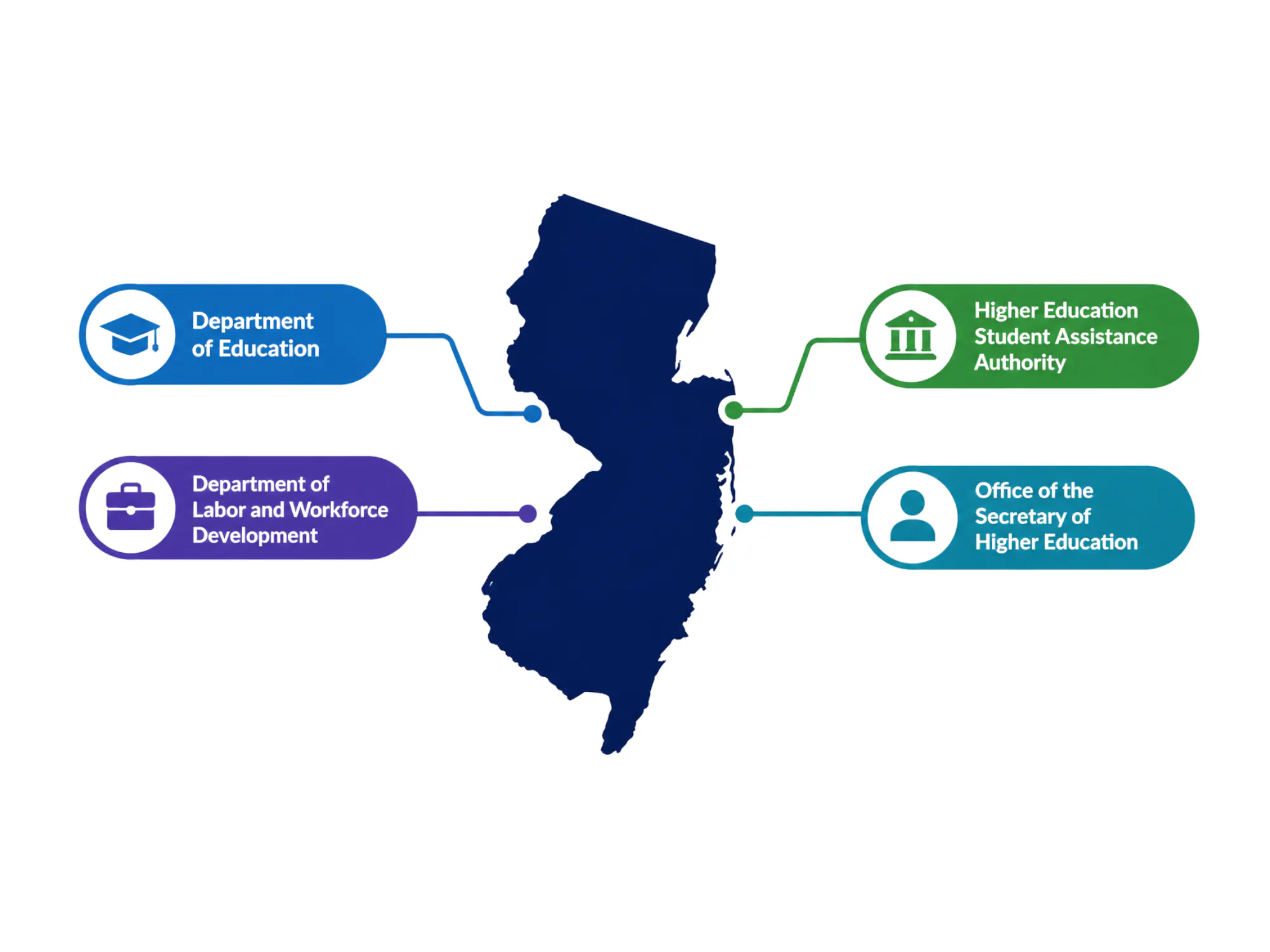
New Jersey’s journey to a full view of their education-to-workforce pipeline data began with a K-12 data modernization effort that eventually grew into the New Jersey Statewide Data System (NJSDS). Operated by the Heldrich Center for Workforce Development at Rutgers University, the system now links administrative data from the Department of Education, the Department of Labor and Workforce Development, the Office of the Secretary of Higher Education, UI wage and claims records, workforce development programs, and even the Motor Vehicle Commission.
Our partnership with New Jersey started in 2020 and then deepened through the Democratizing our Data Challenge (DDC) program, where the state’s team worked collaboratively with us to build a K-12 data model from the ground up – defining their own research questions, developing analytic methods, and creating documentation that other states could replicate. That collaborative foundation, combined with our secure Administrative Data Research Facility (ADRF) and Applied Data Analytics (ADA) training, helped the state grow from a small team of three or four researchers to a robust analytic operation of more than 70 people today.
Seeing the Full Picture
The shift the state experienced has created meaningful change when it comes to seeing what works. New Jersey can now follow students from elementary school, through postsecondary education, apprenticeships, workforce training, and employment – and understand which pathways lead to successful outcomes, and which don’t.
That kind of visibility produces tangible tools. The state’s Postsecondary Employment and Earnings Dashboard, for instance, allows policymakers, institutions, and the public to see employment rates and median earnings for graduates of every New Jersey college – broken down by institution, major, race, and sex. It’s the kind of resource that turns infrastructure into something students, families, and educators can actually use.
What This Means for K-12
As we outlined in our recent white paper, Challenges, Opportunities, and Solutions for Integrated Data Systems, the potential of connected data extends well beyond any single agency. When K-12 data is linked to workforce outcomes, states can move from measuring proxies, like test scores and graduation rates, to measuring real outcomes: whether students are finding their way to good careers.
New Jersey’s experience illustrates this in practice. Cross-agency analyses have examined labor market outcomes for Career and Technical Education completers, revealing meaningful patterns in employment and earnings across career clusters. The state can now identify which programs produce the best results for which students, and direct resources accordingly. And by making its K-12 data model publicly available, New Jersey has given other states a structured starting point to build their own systems.
Looking Ahead
New Jersey isn’t done. The state is already exploring connections to licensing, human services, health, and cross-state workforce records, potentially extending visibility even further along the continuum of how people move through education and into work.
As public resources tighten and the pace of economic change accelerates, states can no longer afford to make decisions without a complete picture. New Jersey’s story shows what’s possible when agencies stop working in silos and start building systems that follow people, not programs.