Events
17 Mar 2027
Coleridge 7th Annual National Conference: Data Beyond Borders
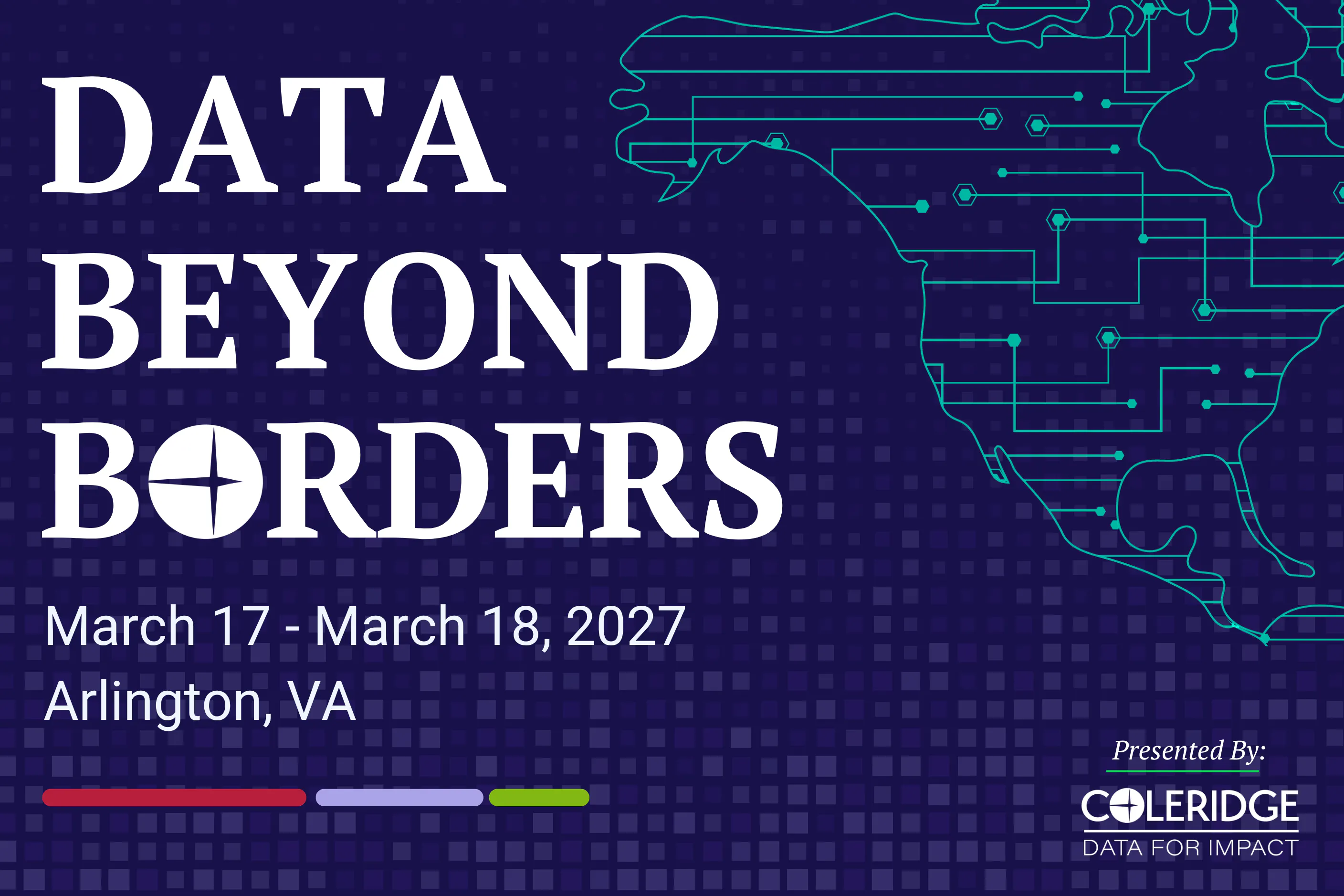
Save the Date for Coleridge's 7th Annual National Conference: Data Beyond Borders in Arlington, VA, on March 17-18, 2027.
SAVE THE DATE Coleridge 7th Annual National Conference Data Beyond Borders March 17-18, 2027, Arlington, VA Overview Technology is advancing at an extraordinary pace, changing how we work, learn, conduct research, and make decisions. For governments, this moment brings both enormous opportunity and a critical challenge: how do we ensure our data systems and institutions are ready for what comes next? Realizing the potential of emerging technologies will require more than adopting new tools. States and federal agencies need trusted administrative data, modern infrastructure, strong governance, skilled people, and the ability to securely and responsibly connect information across programs and agencies. These foundations are essential to harnessing technologies such as AI to generate stronger evidence, inform better decisions, and ultimately improve outcomes for people and communities. At this pivotal moment, the 7th Annual National Conference: Data Beyond Borders returns March 17-18, 2027 in Arlington, Virginia, to bring together leaders from government, research, technology, philanthropy, and the nonprofit sector. Together, we’ll examine how governments can strengthen their data infrastructure and capacity today to become more data-ready, more connected, and better prepared for the opportunities ahead. The Conference will Explore Conversations will examine some of the most important questions facing governments and leaders focused on data for impact today: How should states modernize their data infrastructure for an AI-enabled future? How can agencies securely connect administrative data across traditional boundaries? What governance frameworks are needed as analytic capabilities become more powerful? How do we build the workforce and institutional capacity necessary to use these tools responsibly? And how can better data ultimately translate into better policy and better outcomes? Through keynotes, conversations, workshops, and peer learning, participants will hear from leaders who are putting these ideas into practice and helping shape what comes next. 7th Annual National Conference Agenda-at-a-Glance Wednesday, March 17, 2027 Sessions and Meetings: 8:00 AM - 5:45 PM Welcome Reception: 6:00 PM - 8:00 PM Thursday, March 18, 2027 Sessions and Meetings: 8:00 AM - 4:15 PM Conference Sponsorship Please refer to our Sponsorship Prospectus to learn more about opportunities at the National Annual Conference. Registration and full program details coming soon.
25 Sep 2026
Code Glow-Up: Modernizing Mission-Critical Data Infrastructure
You open a long code script and immediately feel overwhelmed. You’re trying to understand why something is done a certain way, or you’re untangling a web of code across Stata, SAS, Excel, and one-off calculations. Does this sound familiar?
You open a long code script and immediately feel overwhelmed. You’re trying to understand why something is done a certain way, or you’re untangling a web of code across Stata, SAS, Excel, and one-off calculations. Does this sound familiar? For government statistical agencies, this kind of legacy infrastructure isn’t just a headache; it supports data that researchers, policymakers, and the public rely on. Join Coleridge for a conversation about giving mission-critical data systems a modern-day “glow-up.” We’ll explore the transition from aging, high-maintenance code and tool spaghetti to more efficient, open-source infrastructure designed to make statistical data production more transparent, accessible, maintainable, and reproducible. The session will share practical lessons from our multi-year collaboration with the U.S. Department of Agriculture’s Economic Research Service (USDA ERS). These lessons include approaches to managing and documenting code, improving workflows, and transitioning to modern tools and processes, even when teams have limited time and resources. Read the Code Modernization White Paper View the Webinar Slide Deck Watch the Webinar on YouTube
07 Aug 2026
Eastern States Summit
The Eastern States Summit is an invite-only gathering hosted by Coleridge that brings together state government leadership from higher education agencies and institutions, workforce and labor agencies, human services, research organizations, philanthropy, and other public-sector domains to explore how administrative data can be used to improve policy, programs, and outcomes.
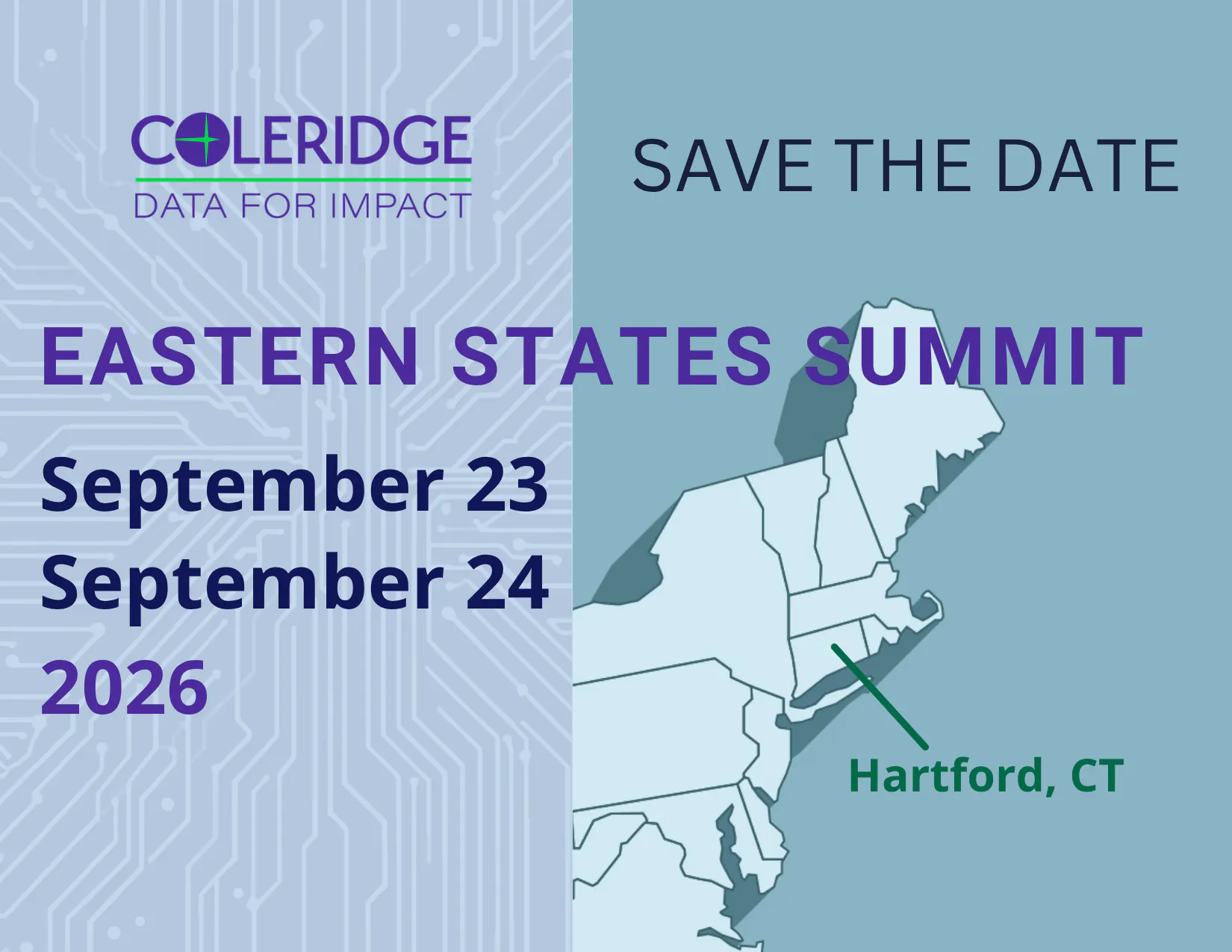
The Eastern States Summit is an invite-only gathering hosted by Coleridge that brings together state government leadership from higher education agencies and institutions, workforce and labor agencies, human services, research organizations, philanthropy, and other public-sector domains to explore how administrative data can be used to improve policy, programs, and outcomes. The Summit includes a full-day of sessions and activities with a second half-day targeted at states who are interested in potentially participating in the grant project. • Regional Data Leadership Summit – September 23rd includes a variety of sessions that focuses on cross-sector data collaboration, governance, infrastructure, and evidence-building. Participants will explore innovative approaches to using administrative data to support decision-making, improve public services, and strengthen regional partnerships. • Ascendium Grant Partner Track – September 24th is a half-day track that brings together states and agencies who are interested in learning more about an Ascendium Education-funded grant opportunity to develop a regional data collaborative to connect data across the region to support education-to-workforce initiatives. Programming will focus on identifying shared regional policy questions, measuring learner and workforce outcomes, and strengthening collaboration among higher education and workforce partners in the region. Across both tracks, participants will have opportunities to: • Share innovative approaches to data-informed policy and program improvement • Explore data governance, infrastructure, and cross-agency collaboration models • Learn from peer states and regional initiatives • Strengthen partnerships that support evidence-based decision-making • Identify practical strategies for using administrative data to address public-sector challenges The Eastern States Summit is designed to foster collaboration among state leaders while connecting participants to Coleridge's infrastructure, partnerships, and tools that support sustainable, data-driven decision-making. Learn More and View the Agenda Watch the Introductory Webinar
04 Aug 2026
Building Stronger Education-to-Workforce Data Partnerships
Do you know what happens to your graduates and workforce once they cross state lines? Tracking cross-state mobility is critical for evaluating outcomes and informing policy—especially in the Northeast, where migration rates are high. To help states harness this information, Ascendium Education Group has funded Coleridge to coordinate a multi-state project linking data across agencies and borders in your region. This initiative is designed to strengthen education-to-workforce data partnerships and expand your capacity for evidence-based decision-making. Please join colleagues from across the region for a webinar to learn how this effort can support your state’s goals for cross-agency collaboration, data governance, and improved workforce outcomes.
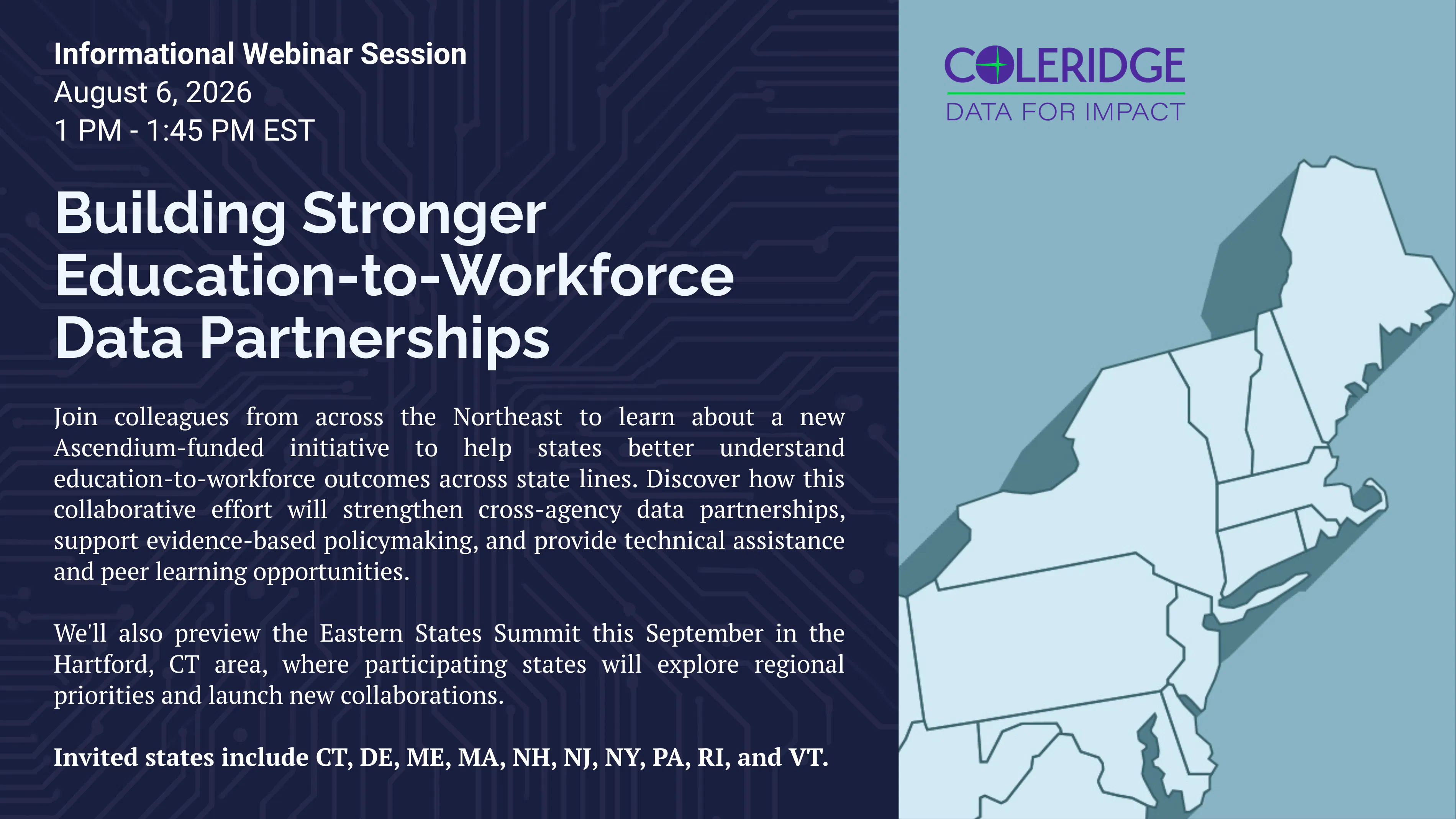
Join us August 6, 2026 at 1:00 PM EST for a Webinar for Eastern States. Do you know what happens to your graduates and workforce once they cross state lines? Tracking cross-state mobility is critical for evaluating outcomes and informing policy—especially in the Northeast, where migration rates are high. To help states harness this information, Ascendium Education Group has funded Coleridge to coordinate a multi-state project linking data across agencies and borders in your region. This initiative is designed to strengthen education-to-workforce data partnerships and expand your capacity for evidence-based decision-making. Please join colleagues from across the region for a webinar to learn how this effort can support your state’s goals for cross-agency collaboration, data governance, and improved workforce outcomes. The session will cover: An overview of the Ascendium-funded initiative and its vision. What participating states can expect, including technical assistance and peer learning. How this initiative complements existing state priorities and investments. An open Q&A to discuss opportunities specific to your state. We will also provide a preview of the Eastern States Summit taking place this September in the Hartford, CT area. This regional conference will highlight data-driven policy efforts and provide a space to build relationships, identify shared priorities, and launch regional collaborations. Invited states include: CT, DE, ME, MA, NH, NJ, NY, PA, RI, and VT. Watch the Recording of the Webinar Whether your state is ready to participate or simply wants to learn more, we encourage you to join the conversation. For more information or to ask any initial questions, please contact: events@coleridge.us
13 Apr 2026
Prison Education Programs (PEPs) Applied Data Analytics Training
Coleridge will deliver a fully subsidized Applied Data Analytics training program focused on Prison Education Programs (PEPs) to investigate the impact of educational opportunities on employment outcomes and upward socioeconomic mobility for incarcerated and formerly incarcerated individuals. This training is being developed in partnership with the State of Arkansas, linking corrections records, postsecondary education data, and Unemployment Insurance wage data into a unified cross-agency data infrastructure. The effort is generously supported by Ascendium Education Group.
APPLICATIONS ARE NOW CLOSED FOR THE PEP ADA COURSE. Strengthening Prison Education Program Insights and Post-Release Outcomes Coleridge invites state agency staff, researchers, and cross-agency partners working in corrections, postsecondary education, and workforce development to apply for this fully funded, project-based training. Participants will build practical analytical skills, collaborate across agencies, and develop insights to evaluate Prison Education Programs using a newly developed data infrastructure. What You'll Do Work with Linked Administrative Data Access and analyze a newly developed data infrastructure linking corrections records, postsecondary education data, and UI wage data. You'll load, inspect, and join datasets across systems while maintaining analytic integrity and navigating real-world data quality challenges. Investigate PEP Access, Equity, and Effectiveness Construct standardized measures of PEP participation, educational attainment, employment, wage growth, and employment stability. You'll use these measures to formulate and answer a policy-relevant research question focused on how Prison Education Programs affect post-release outcomes across demographic groups. Design a Reproducible Dashboard Design and develop a dashboard that integrates narrative text, code, tables, and visualizations to communicate your team's findings clearly and responsibly to policymakers and agency leadership. Collaborate on a Team-Based Research Project Work within a small, cross-agency team to divide tasks, share and review code, and synthesize results. You'll receive ongoing guidance from Coleridge staff and subject matter experts in corrections, education, and labor economics throughout the process. Share Your Findings Present your team's findings to an external audience and produce a written summary documenting your research question, data sources, methods, findings, and limitations — all drawn directly from your dashboard workflow. Application Information You're welcome to apply as an individual or as part of a team, but priority will be given to team submissions, especially those representing cross-agency collaborations. Applying as a Team States benefit most when they send a team of 4–6 participants from multiple agencies or partner organizations, representing a balanced mix of policy, research, and technical expertise. Two or more team members should have programming skills in R, Python, and/or SQL to support the hands-on data work. Teams submit a single application. As part of the application, the following information will need to be provided for each applicant: A recent resume or CV, including current organization and job role information Work email address for each team member Apply for the Prison Education Programs (PEPs) Applied Data Analytics Training. Those applying as individuals will be placed with a team as space allows. Individuals or state teams with questions about requirements are encouraged to email pep-training@coleridge.us noting their interest. Live, Online Session Schedule Live, online sessions will be hosted weekly on Tuesdays from May 19 through Sep 22 (excluding 5/26, 7/7, 7/14, 9/8). Each of the 14 instructor-led sessions will be complemented with self-paced exercises and structured team collaboration between sessions. A detailed schedule of classes is available on the application website.
10 Apr 2026
The TANF Data Collaborative 2.0 (TDC 2.0) Applied Data Analytics Training
The TDC 2.0 ADA training is offered at no cost and will provide participating agency teams an opportunity to build their data analytic capacity through expert-led instruction, self-guided learning, and the completion of a data analysis project using TANF and other administrative data. The training is intended to increase teams’ capacity to routinely use data to inform policy and practice in order to improve outcomes for individuals and families. The training is sponsored by the Administration for Children and Families (ACF) and will be led by Coleridge and its TDC 2.0 partners— MDRC, National Opinion Research Center (NORC) at the University of Chicago, and Actionable Intelligence for Social Policy (AISP) at the University of Pennsylvania.
THE NOMINATION DEADLINE HAS NOW PASSED FOR TDC 2.0. The TANF Data Collaborative 2.0 (TDC 2.0) is seeking nominations from interested state and local TANF agencies to participate in the TDC 2.0 Applied Data Analytics (ADA) training. The TDC 2.0 ADA training is offered at no cost and will provide participating agency teams an opportunity to build their data analytic capacity through expert-led instruction, self-guided learning, and the completion of a data analysis project using TANF and other administrative data. The training is intended to increase teams’ capacity to routinely use data to inform policy and practice in order to improve outcomes for individuals and families. The training is sponsored by the Administration for Children and Families (ACF) and will be led by Coleridge and its TDC 2.0 partners— MDRC, National Opinion Research Center (NORC) at the University of Chicago, and Actionable Intelligence for Social Policy (AISP) at the University of Pennsylvania. Course Details Teams will participate in the 23-week virtual training from June 17, 2026 to November 18, 2026, using a "learning by doing" approach. The ADA training equips public sector staff with practical analytical and coding skills using modern data tools to better inform policy and practice. Teams will work with real administrative data provided by the state of Arkansas inside Coleridge’s secure Administrative Data Research Facility (ADRF). Participants will not be required to use or bring the data from their agency into the ADRF. The training will be delivered through a combination of self-guided learning, expert-led instruction, and team-based data analysis projects: First 4 weeks: Four self-paced units introducing concepts, each with a one-hour weekly support session. Next 12 weeks: Weekly two-hour virtual sessions, with the first hour for lectures and the second for guided project work. Sessions will be held on Wednesdays during work hours. The course includes breaks and dedicated time for collaboration and making progress on team-based project. Each team will be required to present their data analysis project and submit a final report at the end of the course. The final report will document the team’s analyses and findings. The report will be shared with Arkansas to offer insights on their TANF program. Lessons and findings may also be relevant to the team’s own TANF program. The course is designed for all skill levels. Whether the team is new to data or comfortable coding, the course is structured to be challenging, yet accessible. Participants will learn how to: Scope realistic projects based on available data Translate transactional records into meaningful analytic units Reconstruct participant experiences as they move on and of the TANF program Define, test, and refine measures that reflect program dynamics By the end of the course, participants will have: A better understanding of how to work with state’s administrative data Reusable code to generate analytical reports and support ongoing analysis Course Timeline Nomination Information Interested agencies may self-nominate or, with their consent, be nominated by their research partners (such as a university or organization). Examples of relevant information to provide in the nomination statement (250-word limit) include, but are not limited to, the following: Names and roles of proposed team members Brief description of team members’ skills in areas such as policy, data analytics, and coding Short statement on why the team is interested in participating Current agency goals that align with and would benefit from the ADA training Coleridge and project partners intend to select up to five teams of 4-6 individuals who represent a balanced mix of policy, research, and technical expertise. Team members may include individuals from partner agencies or other organizations (such as university-based researchers or multi-agency data partners), but the team lead(s) must be TANF agency staff. At least two team members should have programming or analytic skills (R and/or SQL) to support hands-on data work. Nominations submitted to tdc-training@coleridge.us by May 15, 2026 will be considered. Selection Announcement: June 1, 2026 Course Kick-off: June 8, 2026 Additional Information and Links Coleridge’s Applied Data Analytics Training TANF Data Collaborative Approach TANF Data Collaborative 2.0 Questions? For questions about the TDC 2.0 projects, please email Melissa Wavelet at melissa.wavelet@mdrc.org. For questions about the ADA training, please email tdc-training@coleridge.us

13 Nov 2025
Let’s Talk AI: Sharing Strategies and Insights
This interactive webinar is designed for ADRF users and will explore ways AI tools are being used to enhance their work.
Join the ADRF User Community from 12:00-1:00 pm ET on November 13 for an interactive webinar exploring how data professionals use AI tools to enhance their daily work. The event will be led by Ekaterina Levitskaya, Senior Data Scientist. The event will open with a live poll asking participants how they currently use AI, followed by a discussion on effective and responsible collaboration with these tools. What to Expect: Short demos of common AI use cases in data analysis and coding Insights from experienced practitioners on best practices and cautions for working with AI responsibly in data settings Overview of AI implementation at Coleridge Open discussion on participants’ experiences, challenges, and AI policies in their organizations Whether you’re an experienced AI user or just curious about integrating it into your workflow, this webinar offers an open and collaborative space to share ideas and learn from peers. Should you have questions about the webinar, please contact community@coleridgeinitiative.org Register here: https://coleridgeinitiative-org.zoom.us/meeting/register/9cbLZxDhTfW-SpB8O6GMzA
21 Oct 2025
Education-to-Workforce Indicator Framework Applied Data Analytics Training
The Coleridge Initiative will deliver a fully subsidized Applied Data Analytics training program focused on education-to-workforce transitions to investigate if students are graduating from high school on time and successfully transitioning into further education, training, or employment. This training is being developed in partnership with the State of New Jersey, and with Mathematica, developers of the Education-to-Workforce Indicator Framework (E-W Framework). The effort is generously supported by the Gates Foundation.
Application Deadline: November 7, 2025 Empowering States to Strengthen SLDS Insights and Workforce Pathways The Coleridge Initiative invites state agency staff, academic researchers, and other SLDS and integrated data system partners to apply for a fully funded applied data analytics training program focused on improving education-to-workforce outcomes. This project-based experience helps build practical skills, provides opportunities for cross-agency collaboration, and results in insights that build capacity to explore education-to-workforce transitions using your own state’s data infrastructure. This training is being developed in partnership with the State of New Jersey, and with Mathematica, developers of the Education-to-Workforce Indicator Framework (E-W Framework). The effort is generously supported by the Gates Foundation. What You’ll Do Conduct Research in a Secure, Supported Environment Collaborate on a team-based research project by accessing restricted-use, linked, multi-agency administrative data inside the FedRAMP-certified Administrative Data Research Facility (ADRF) platform. You’ll investigate variations in outcomes and generate actionable insights through policy-relevant analysis grounded in education and workforce data. Use a Proven Framework to Guide Your Analysis Apply the Education-to-Workforce Indicator Framework to identify key indicators and metrics that matter for policy and practice. Bring Methods and Findings Back to Your Agency or System Leverage the methods and questions you explore during this training to data from your own state. Many teams use the training to prototype analyses, refine cross-agency workflows, and identify metrics they can replicate or adapt at home. What It’s Like You’ll collaborate in a small team to design and complete a research project that explores a question aligned with the course themes and your professional interests. Teams will have access to New Jersey’s micro-data through Coleridge’s ADRF platform, using it to answer meaningful questions about education-to-workforce transitions. The training includes weekly lectures from subject matter experts and guided project work, with a total time commitment of 3–5 hours per week. Each session is structured to support the skills you want to build and apply directly in your day-to-day work. Application Information You’re welcome to apply as an individual or as part of a team, but priority will be given to team submissions, especially those representing cross-agency collaborations. Accommodations for individual participants or state teams unable to meet the requirements are encouraged to email training@coleridgeinitiative.org, noting their interest. Applying as a Team States benefit most when they send a team of 4–6 participants from multiple agencies or partner organizations, such as university-based researchers or others who support your state’s multi-agency data efforts. Your group should include a mix of policy, research, and technical expertise. Two or more team members should have programming or analytic skills, ideally in R and/or SQL, to support the hands-on data work. Teams are also encouraged to designate a team lead embedded within their state. The team lead plays a light-touch coordination role—helping guide the team’s project work and serving as the main point of contact with Coleridge Initiative staff. Team leads must submit a resume/CV. Teams submit a single application. As part of the application, the following information will need to be provided for each applicant: A recent resume or CV, a LinkedIn profile link is also acceptable Supervisor name and contact information (required for setting up any needed NDAs related to data access) Applications will be reviewed on a rolling basis. Priority will be given to complete team submissions with a designated team lead. All other applications will be considered in the order they are received. Key Dates November 7, 2025: Applications Due December 2, 2025: Kick-Off December 9, 2025: Tech Orientation January 6 - April 7, 2026: Live, Online Class Sessions on Tuesdays, 2-4 pm ET April 14, 2026: Final Presentations

18 Sep 2025
Demo of PASS Portal: User Engagement and Feedback
This interactive webinar is designed for ADRF users and will highlight current and new PASS Portal features. It will also demonstrate how to share feedback via the portal and gather ideas for fixes and new features in real time.
We invite you to attend a webinar demo for PASS Portal: User Engagement and Feedback on September 18, from 12:00-1:00 pm ET. The webinar will allow you to: 1) Explore current PASS Portal features and preview the new Export Module 2) Learn how to submit feedback on suggested fixes and new features 3) Share your feedback to guide improvements and enhancements in real time PASS Portal Demonstration The PASS Portal allows users to launch and manage projects in one place. In this session, we’ll demonstrate features that simplify access, safety, and collaboration including: Existing features Navigation overview (projects, users, agreements, datasets, tasks, and usage views) Project setup & provisioning Dataset tracking User access and management New feature Export Module Your Feedback Matters We are continuously working to enhance the PASS Portal. As users, you understand what fixes and features can help improve it. During the second half of the webinar, we will show how to submit feedback directly through the PASS Portal and listen to your suggestions for fixes and new features in real time. Come prepared to: Tell us what’s missing or confusing. Share examples such as a great data dictionary. This is your chance to help shape a world-class system! Have questions about the webinar, contact community@coleridgeinitiative.org Register here: https://coleridgeinitiative-org.zoom.us/webinar/register/WN_e0H0bj8gSxSjJcQYnalw9w
10 Jun 2025
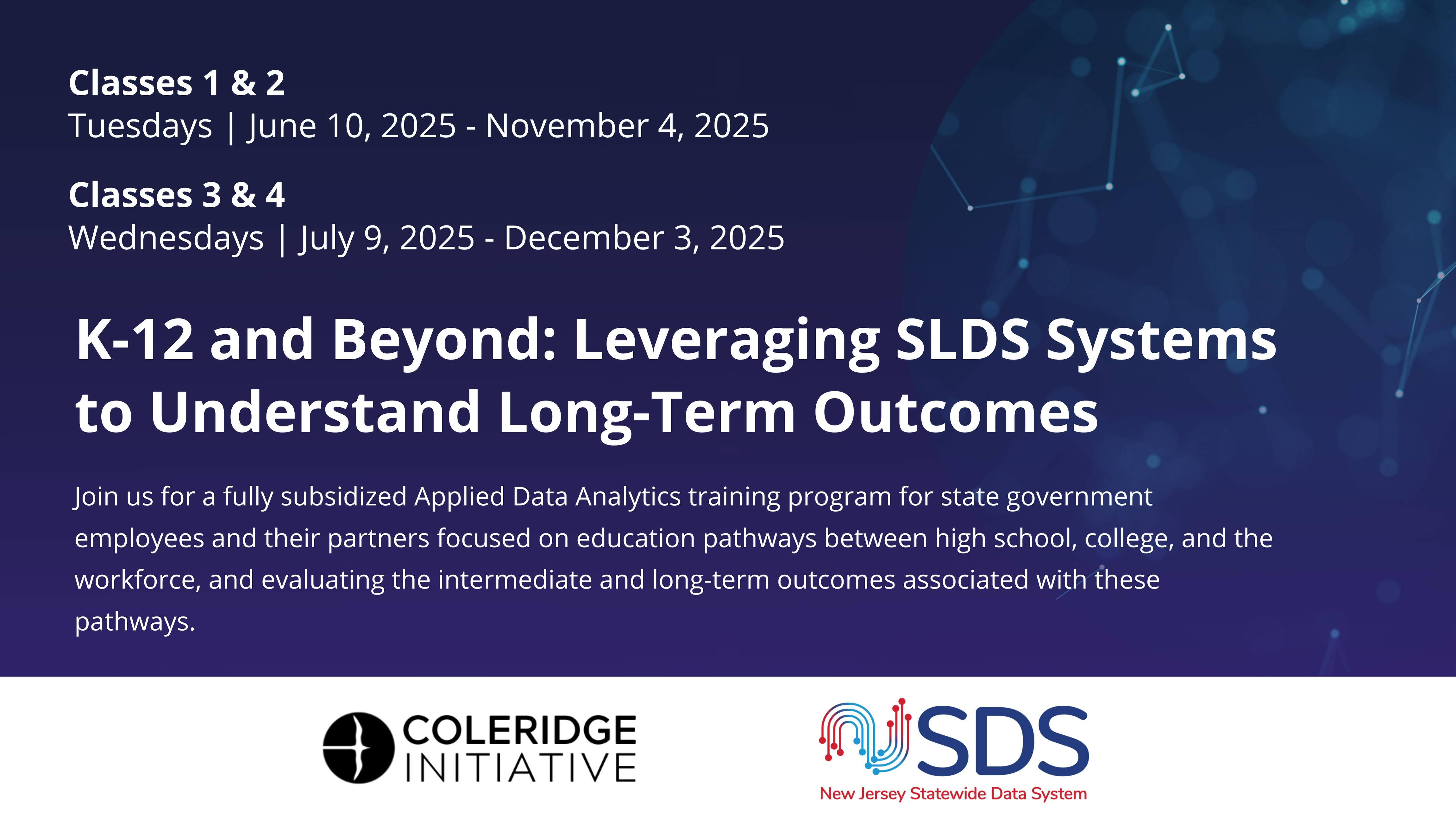
K-12 and Beyond: Leveraging SLDS Systems to Understand Long-Term Outcomes
The Coleridge Initiative will deliver four fully subsidized Applied Data Analytics training programs for state government employees and their partners focused on education pathways between high school, college, and the workforce, and evaluating the intermediate and long-term outcomes associated with these pathways. The classes will be developed in partnership with the State of New Jersey, using the New Jersey Statewide Data System, and are supported by the Walton Family Foundation and the Gates Foundation.
Application Deadline Extended to June 6, 2025 Watch the recording of the Introductory Webinar to learn more about the classes. Overview The Coleridge Initiative will deliver four fully subsidized Applied Data Analytics training programs for state government employees and their partners focused on education pathways between high school, college, and the workforce, and evaluating the intermediate and long-term outcomes associated with these pathways. The classes will be developed in partnership with the State of New Jersey, using the New Jersey Statewide Data System, and are sponsored by the Walton Family Foundation and Bill & Melinda Gates Foundation. Accepted class participants will learn and apply data analytic approaches such as record linkage, measurement creation, and data visualization to restricted-use linked K-12, postsecondary, and workforce data provided by the State of New Jersey and accessed inside the Coleridge Initiative’s award-winning Administrative Data Research Facility (ADRF). Prospective participants are expected to apply as project teams (more in the following section), and should not plan on providing their own data as part of the training. The first two programs will begin on June 10, 2025, and the latter two will begin on July 9, 2025. The courses are designed with the understanding that it is difficult for state agency staff to make time for professional development, and participants are expected to devote no more than 2 to 4 hours a week to the endeavor. More information on the schedule is available below. Application Information State teams should consist of four to six participants, with at least two having strong programming skills (ideally in R and/or SQL). Teams should feature participants from multiple state agencies or partners, and priority will be given to teams that apply with a designated team lead embedded within the work capable of facilitating team discussions and overseeing and guiding the project development—we believe this setup will contribute to further advancement of the work following the completion of the training. The team lead does not count as one of the 4-6 members of the participating team. Accommodations for individual participants or state teams unable to meet the requirements are encouraged to email training@coleridgeinitiative.org noting their interest. Teams only need to submit one application. As part of the application, the following information will need to be provided for each applicant: A recent resume or CV. A statement describing how their participation supports their professional development. A statement from their supervisor describing how participation will support their organization in the near and long-term future and confirming that they will be able to dedicate sufficient time to the training. Team leads will need to provide a recent resume or CV and a personal statement describing why they are well-suited to support the work as a team lead. All personal and supervisor statements should be no longer than one page. Teams will also be asked to indicate a preference for the class they would like the team to attend, and can respond with “no preference.” The deadline to submit applications is June 6, 2025. Schedule Class sessions will occur at most once a week, with breaks for federal holidays. Classes 1-4 will contain the same content. Please choose the class series that works best with your schedule. Classes 1 and 2: June 10 - November 18 Classes 1 and 2 Kickoff: June 10, 1:00 PM (1 hour) Module 1, Foundations of Data and Technical Literacy: June 17, 24 and July 1, 8 (1 hour each) at 1:00 PM. Module 2: July 15, 22, 29, August 5, 12, 19, 26, September 9, 16, 23, 30, and October 7 (2 hours each). Classes occur from 10:00 AM-12:00 PM or 2:00 PM-4:00 PM, depending on class selection 1 or 2. Self-Paced Project Work with Team: October 8-November 4 Final presentations: November 18 Classes 3 and 4: July 9 - December 3 Classes 3 and 4 Kickoff: July 9, 1:00 PM (1 hour) Module 1, Foundations of Data and Technical Literacy: July 16, 23, 30, and August 6 (1 hour each) at 1:00 PM. Module 2: August 13, 20, 27, September 10, 17, 24, October 1, 8, 15, 22, 29, and November 5 (2 hours each). Classes occur from 10:00 AM-12:00 PM or 2:00 PM-4:00 PM, depending on class selection 3 or 4. Self-Paced Project Work with Team: November 6-December 2 Final presentations: December 3
04 Jun 2025
ADRF User Community
Collaboration is essential to impactful research. Join Coleridge Initiative leaders for an interactive meeting on June 4, from 12:00 - 1:00 PM ET, to learn about tools available in the ADRF to accelerate working together and increase efficiency. This session is designed for current ADRF users and will highlight built-in collaboration tools available within the ADRF, share practical tips for working efficiently with partners across agencies and institutions, and offer guidance on maximizing research coordination in a secure environment.
A platform for users to collaborate, shape ADRF improvements, and foster a community of practice by: Sharing Knowledge – Building community events and a resource hub to support common best practices. Problem-Solving – Identifying and resolving data or technology challenges. Enhancing ADRF – Providing user-driven feedback to improve features and services. About The Coding Best Practices Series: Effective data analysis requires both a strong understanding of the programming language needed to complete the analysis and adherence to coding best practices that ensure efficiency, scalability, and maintainability. In these series, we will delve into the essential best practices for coding in modern data analysis, with a specific focus on the Administrative Data Research Facility (ADRF). The series will offer insights on how to optimize coding practices to make data accessible and understandable for policymakers. From code modernization efforts to enhancing the user experience for ADRF users, we will explore various strategies to improve the utilization of the platform. Materials from the previous online community events (Coding in R, RStudio, version control in Git and Coding in SQL, DBeaver, and memory management) are available inside the ADRF. Examples of coding best practices reference materials include: Video on creating database diagram in DBeaver Writing robust code and organizing code checklist Video on creating R package with functions, testing, automated documentation Video on using code snippets in RStudio OpenAI API code in Python Coding best practices for modern data analysis (recording, slide deck) Coding in R/RStudio and version control in Git (recording, slide deck, resources) Coding in SQL, DBeaver, and memory management (recording, slide deck, resources) Please reach out to community@coleridge.us for more information about accessing these materials.
30 Apr 2025
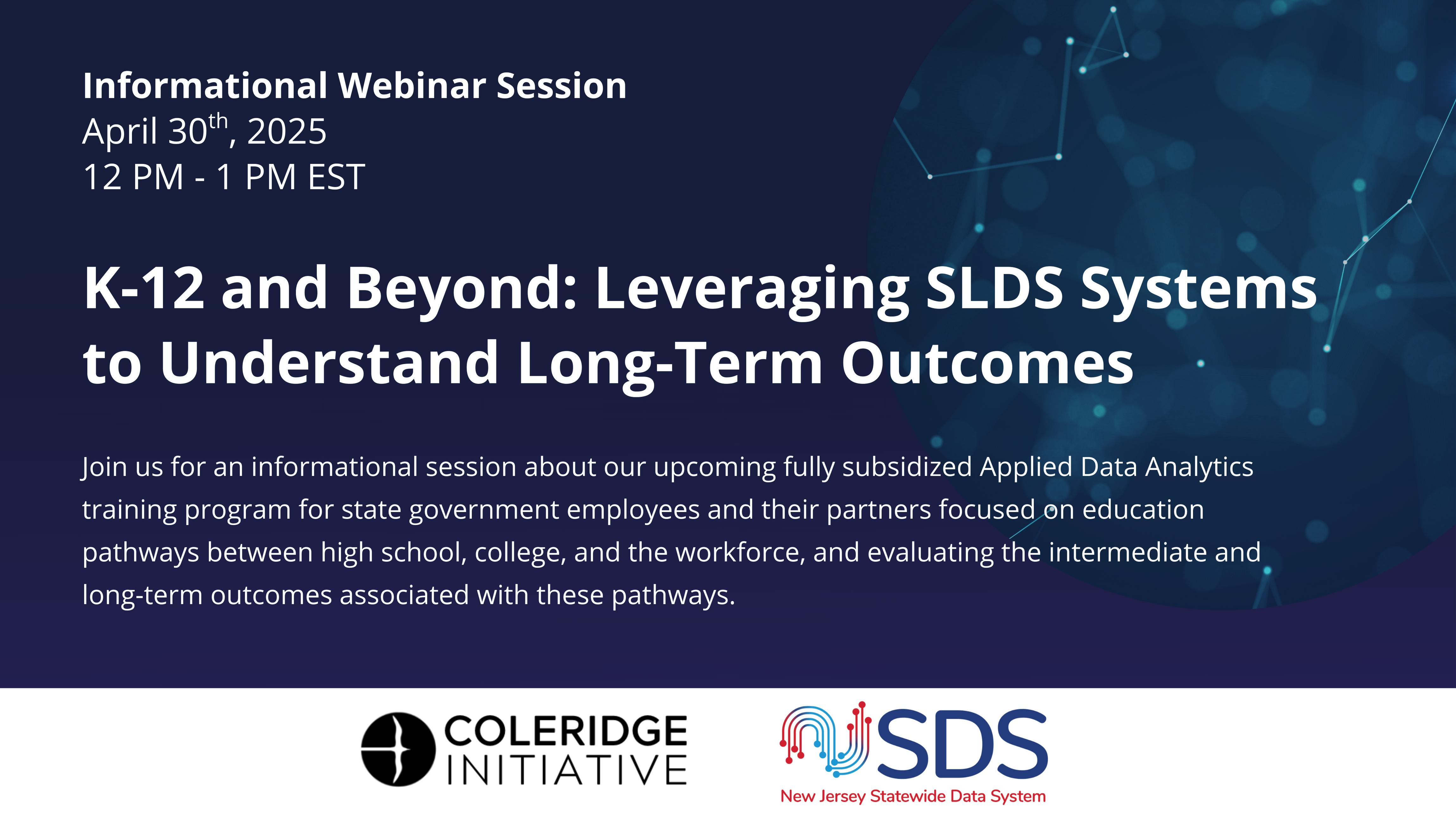
Informational Webinar: K-12 and Beyond: Leveraging SLDS Systems to Understand Long-Term Outcomes
The Coleridge Initiative will deliver four fully subsidized Applied Data Analytics training programs for state government employees and their partners focused on education pathways between high school, college, and the workforce, and evaluating the intermediate and long-term outcomes associated with these pathways.
The Coleridge Initiative will deliver four fully subsidized Applied Data Analytics training programs for state government employees and their partners focused on education pathways between high school, college, and the workforce, and evaluating the intermediate and long-term outcomes associated with these pathways. The classes, each of which will feature the same content on different days and time slots, will be developed in partnership with the State of New Jersey, using the New Jersey Statewide Data System, and will feature the state’s restricted-use linked K-12, postsecondary, and workforce data. In this webinar, attendees will learn more about this opportunity and the application process.
25 Jan 2025
R Programming: Basic
The R Programming: Basic course will provide participants with fundamental knowledge of the R programming language for working with multiple types of data, reproducible research, data manipulation, and reporting.
Participants in the course will have the opportunity to explore synthetic microdata, based on commonly used administrative data, using the Rstudio development environment and tools from the tidyverse suite of R packages within the ADRF secure data environment. Topics include R data types and their manipulation using the tidyverse, project usage, data management, and using R for reporting and constructing publication-quality output and reports. Upon completion of this short course, participants will have exposure and experience with core elements of the R programming language, and experience using R for fundamental data analysis and reporting tasks, preparing them for more advanced coursework in applied data analytics. Tuition for this course is $1,000. This course is only available to applicants in the United States. This course has no prerequisites and is offered 2-3 times per year. The next course will begin January 24, 2025, with classes meeting on Fridays from 12:00 PM to 2:00 PM EST and optional office hours on Mondays from 1:00 PM to 2:00 PM EST.
18 Oct 2024
Advanced Data Visualization
The Advanced Data Visualization course will provide participants with advanced tools for the creation of data visualizations using the R programming language.
Participants in the course will have the opportunity to explore confidential microdata using the Rstudio development environment and tools from the tidyverse suite of R packages within the ADRF secure data environment. Topics include customization of ggplot objects, advanced visualization techniques and geometries, mapping of spatial data, creation of animations and interactive plots, and an introduction to Shiny apps. Upon completion of this short course, participants will be able to produce customized visualizations of a variety of different data types, as well as interactive visualization tools. Tuition for this course is $1,000. This course is only available to applicants in the United States. The prerequisite for this course is Exploratory Data Analysis and Visualization. This course is offered 1-2 times per year. The next class will be held on October 18 - November 15, 2024, with classes meeting on Fridays from 12:00 PM to 2:00 PM EST and optional office hours on Mondays from 1:00 PM to 2:00 PM EST.
02 Oct 2024
Democratizing our Data Challenge Round 3 Information Session
Join the Coleridge Initiative and the Multi-State Data Collaborative on October 2nd, 2024 at 1 PM ET to learn more about the Democratizing our Data Challenge Round 3 opportunity and how to apply.
The successful design of government policies and practices relies heavily on strategic collaboration between data partners. The Coleridge Initiative’s Democratizing our Data Challenge has enabled the collaboration of multi-partner teams from across the United States to expand existing data products developed in the Administrative Data Research Facility (ADRF) and develop new data linkages, dashboards, portals, APIs, data models, and code repositories. Through the Challenge, we have gained invaluable insights and experience in data-sharing agreements, multi-partner collaboration, secure technology, data governance and compliance, and data infrastructures. In this webinar session, we will provide an overview of the Democratizing our Data Challenge and discuss how to apply for Round 3 of the Challenge.
01 Oct 2024
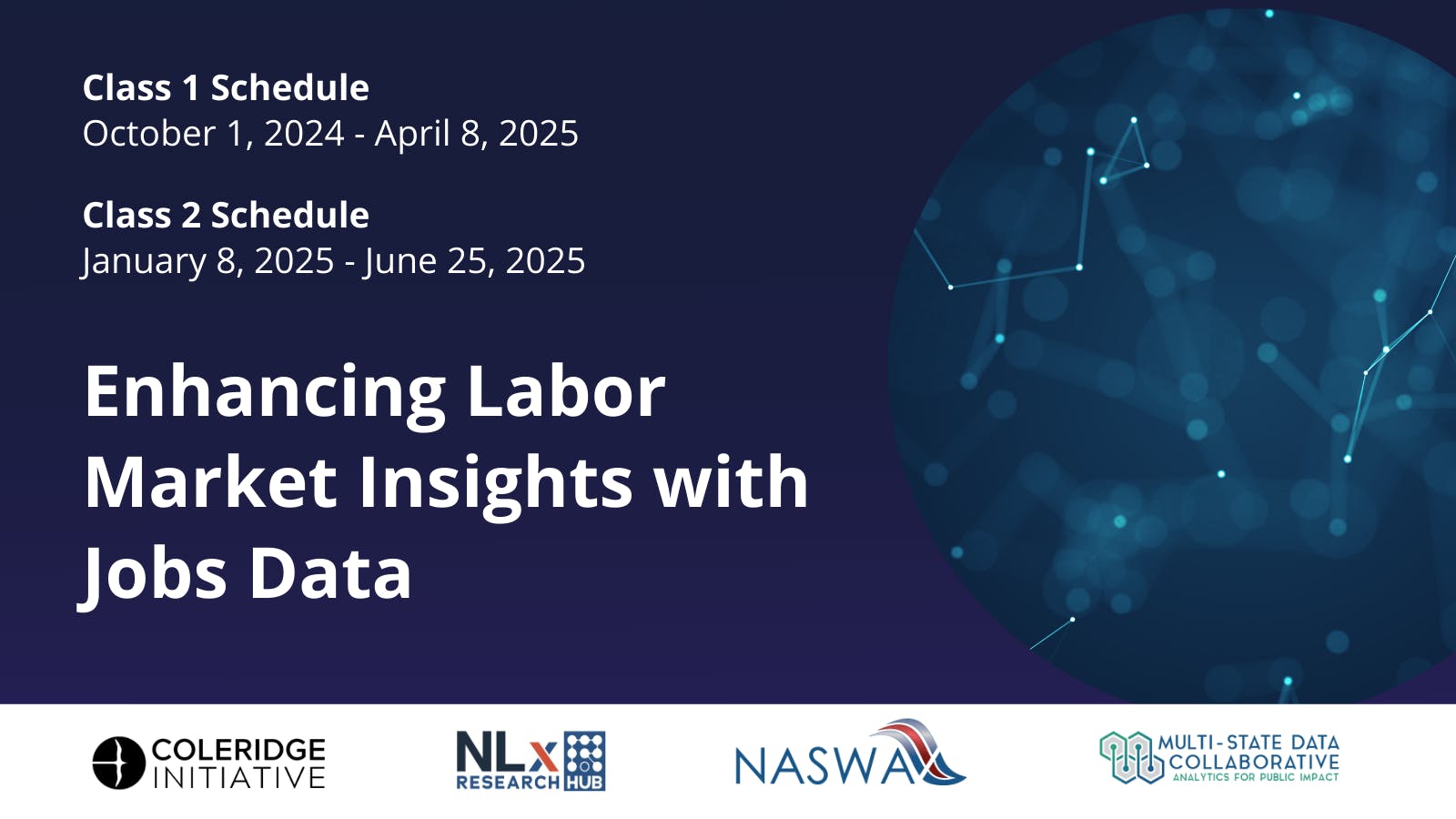
Enhancing Labor Market Insights with Jobs Data
Join one of Coleridge Initiative's upcoming fully-funded Applied Data Analytics Training Program. Participants will work with the NLx Research Hub jobs data and a synthetic dataset based on linked state postsecondary and workforce administrative data inside the Coleridge Initiative’s Administrative Data Research Facility (ADRF).
Overview In partnership with the National Association of State Workforce Agencies (NASWA) and the National Labor Exchange (NLx) Research Hub, the Coleridge Initiative will be delivering a training program focused on job demand data use and how to align it to skills and credentials in state administrative data. The course will be offered in October 2024 and January 2025. By the end of the course, participants will have the tools and experience necessary to create data products and actionable insights that: Enhance existing LMI efforts such as occupational forecasts through supplements to traditional sources of labor market data. Better communicate the changing needs of labor markets across the nation. More effectively examine how skills and credential attainment align to job demand by industry, geography—such as subregion, metro classification, and state—and worker characteristics. The Coleridge Initiative, NASWA, NLx Research Hub, and Multi-State Data Collaborative teams will host a webinar about this training opportunity and the application process on August 26, 2024 at 1 PM EST. The recording and slide deck from the webinar session will be uploaded to this webpage once they are available. Participants in the training program will have the opportunity to work with the NLx Research Hub jobs data and a synthetic dataset based on linked state postsecondary and workforce administrative data inside the Coleridge Initiative’s Administrative Data Research Facility (ADRF). The first class will begin on October 1, 2024, and the second class will begin on January 8, 2025. The program is designed with the understanding that it is difficult for state agency staff to make time for professional development, and participants are expected to devote no more than 2 to 4 hours a week to the endeavor. Application Information Teams from states new to ADA training, the ADRF, or NLx data, as well as those with experience are both encouraged to apply. State teams should consist of 2-3 participants, with at least one member from a state agency who is part of the workforce system, and others from state education and economic development agencies or local workforce boards. At least one participant should have strong programming skills. Priority will be given to teams that satisfy these requirements. As part of the application, the team lead will need to provide the following for each applicant: A recent resume or CV. A statement describing how their participation will increase the amount of actionable labor market information in the U.S. to support the recruitment, hiring, and training opportunities of all workers to good jobs. A statement from their supervisor describing how participation will support their agency in the near and long-term future. The team lead will also be asked to indicate a preference for the class they would like the team to attend, and can respond with “no preference.” Schedule Class sessions will occur at most once a week, with breaks for federal holidays. Class 1 Schedule: October 1, 2024 - April 8, 2025 1:00 PM EST, Tuesdays Kickoff: 10/1/24 (1 hour) Module 1 (Foundations): 10/8, 10/15, 10/22, 10/29 (1 hour each) Module 2: 11/5, 11/12, 11/19, 12/3, 12/10, 12/17, 1/7, 1/14, 1/21, 1/28, 2/4, 2/18 (2 hours each) Self-Paced Project Work w/ Team: 2/19 - 4/7/2025 Final Presentations: 4/8/25 (approximately 3.5 hours) Class 2 Schedule: January 8, 2025 - June 25, 2025 1:00 PM EST, Wednesdays Kickoff: 1/8/25 (1 hour) Module 1 (Foundations): 1/15, 1/22, 1/29, 2/5 (1 hour each) Module 2: 2/19, 2/26, 3/5, 3/12, 3/19, 4/2, 4/9, 4/16, 4/23, 4/30, 5/7, 5/14 (2 hours each) Self-Paced Project Work w/ Team: 5/15 - 6/24/2025 Final Presentations: 6/25/25 (approximately 3.5 hours)
13 Sep 2024
Python for Data Analysis
The Python for Data Analysis course will provide participants with an understanding of Python packages for applied data analysis.
Participants in the course will have the opportunity to explore confidential microdata using the Rstudio development environment and tools from the pandas and polars Python packages within the ADRF secure data environment. Topics include data access, manipulation, and summarization as well as coverage of data visualization using the matplotlib and seaborn packages. Upon completion of this short course, participants will have introductory exposure to tools that are applicable to a wide variety of research settings and that will prepare them for more advanced coursework in applied data analytics. Tuition for this course is $1,000. This course is only available to applicants in the United States. This course has no prerequisites and is offered 3-4 times per year. The next session will be held from September 13 to October 11, 2024, with classes meeting on Fridays from 12:00 PM to 2:00 PM EST and optional office hours on Mondays from 1:00 PM to 2:00 PM EST.
26 Aug 2024
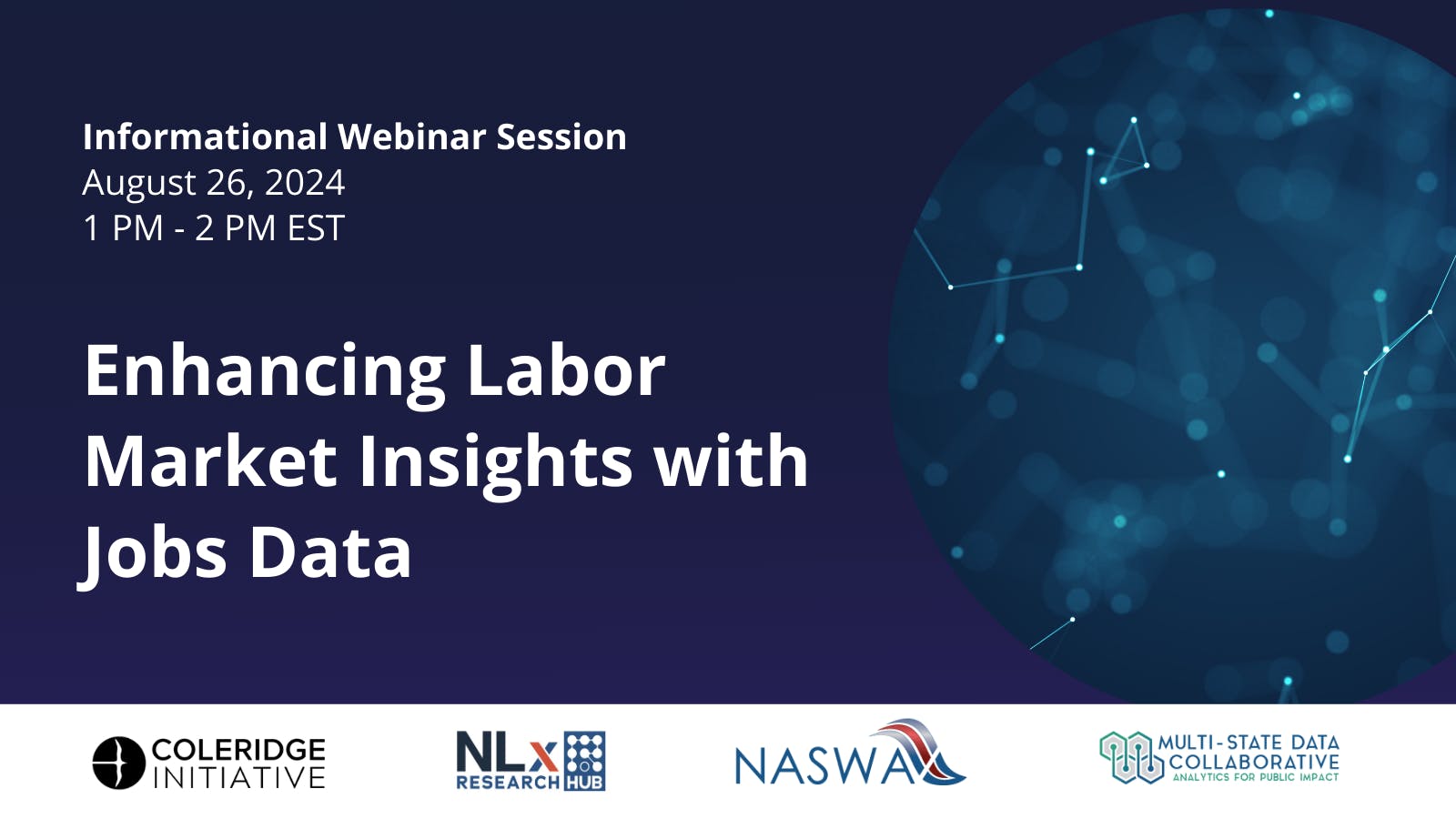
Informational Webinar: Enhancing Labor Market Insights with Jobs Data
Join the Coleridge Initiative, the National Association of State Workforce Agencies (NASWA), the National Labor Exchange (NLx) Research Hub, and the Multi-State Data Collaborative (MSDC) to learn more about the two upcoming fully-funded Applied Data Analytics training programs.
We are excited to announce a fully-funded training program, developed in collaboration with the National Association of State Workforce Agencies (NASWA), the National Labor Exchange (NLx) Research Hub, and the Multi-State Data Collaborative (MSDC), focusing on job demand data use and aligning it with skills and credentials in state administrative data. The training will be offered in both October 2024 and January 2025. Participants will have the opportunity to work with the NLx Research Hub jobs data and a synthetic dataset based on linked state postsecondary and workforce administrative data inside the Coleridge Initiative’s Administrative Data Research Facility (ADRF). Join us for this webinar to learn more about this unique training opportunity and the application process.
19 Jul 2024
Exploratory Data Analysis and Data Visualization
The Exploratory Data Analysis (EDA) and Data Visualization course will introduce participants to applied data analysis and data visualization using R Programming language.
This course is a modern introduction to applied data analysis and data visualization using the R programming language. Participants in the course will have the opportunity to explore confidential microdata using the Rstudio development environment and tools from the tidyverse suite of R packages within the ADRF secure data environment. Topics include data access, manipulation, and summarization as well as coverage of data visualization using the ggplot2 package. Upon completion of this short course, participants will have introductory exposure to tools that are applicable to a wide variety of research settings and that will prepare them for more advanced coursework in applied data analytics. Tuition for this course is $1,000. This course is only available to applicants in the United States. This course has no prerequisites and is offered 3-4 times per year. The next class will be held in 2025, with classes meeting on Fridays from 12:00 PM to 2:00 PM EST and optional office hours on Mondays from 12:00 PM to 2:00 PM EST.
17 Jul 2024
State IMPACT Collaborative Informational Webinar
Join the Coleridge Initiative and MDRC for this informational webinar to learn more about the new State IMPACT Collaborative and how to submit a Letter of Intent (LOI) to participate in the program.
MDRC and the Coleridge Initiative are excited to announce an opportunity for state agencies to conduct a rigorous evaluation of a program or policy modification using their administrative data. We are looking to collaborate with state agencies interested in testing variations in program services such as enhancing a program by adding a new component or enhancing existing services. Tests must be programmatically feasible within a short time frame and have readily available data for measuring outcomes. State agencies will be expected to test variations in economic mobility program services. Proposed tests must target systems, operations, or policies in one of the following domains: workforce development, higher education, income support, housing, and justice programs. This opportunity includes direct funding as well as technical assistance. We are prepared to work with state agency teams across a range of levels of knowledge, skills, and competencies. Some state agency teams may have internal staff capacity to do much of the required data work on their own. Other state agency teams may need more hands-on teaching to complete the data analytics work. Regardless of the state agency’s evaluation and data analytics capacity, we welcome you to apply by August 7th.
06 Jun 2024
Exploring the Impact of the Value Data Collaborative
Join the Coleridge Initiative, the Institute for Higher Education Policy (IHEP), and representatives from multiple state and higher education agencies to learn more about the Postsecondary Value Framework and how it can inform more equitable and effective higher education policies.
The Value Data Collaborative (VDC) is a data-driven approach to understanding the return on investment in higher education. The VDC uses the Postsecondary Value Framework, developed by the Postsecondary Value Commission, which provides a basis for understanding the return on investment in postsecondary education, particularly by race, ethnicity, income, and gender. In this webinar, participants will learn from state administrators who have implemented the framework within their policymaking processes and gain insights into the challenges they’ve overcome. Speakers from Coleridge and IHEP will also dive deeper to explore the nuances of the framework and discover how it can inform more equitable and effective higher education policies.
22 Apr 2024
Breaking Data Barriers through the Democratizing our Data Challenge
Join Coleridge Initiative's Director of Data Enclave Programs, Jon Mills, and VP of State Programs, Jessica Cunningham, to discuss invaluable insights and experience gained through the Democratizing our Data Challenge in data-sharing agreements, multi-partner collaboration, secure technology, data governance and compliance, and data infrastructures.
The successful design of government policies and practices relies heavily on strategic collaboration between data partners. The Coleridge Initiative’s Democratizing our Data Challenge has enabled the collaboration of multi-partner teams from across the United States to expand existing data products developed in the Administrative Data Research Facility (ADRF) and develop new data linkages, dashboards, portals, APIs, data models, and code repositories. Through the Challenge, we have gained invaluable insights and experience in data-sharing agreements, multi-partner collaboration, secure technology, data governance and compliance, and data infrastructures. In this webinar session, we will provide an overview of the Democratizing our Data Challenge and discuss Round 3 of the Challenge.
19 Mar 2024
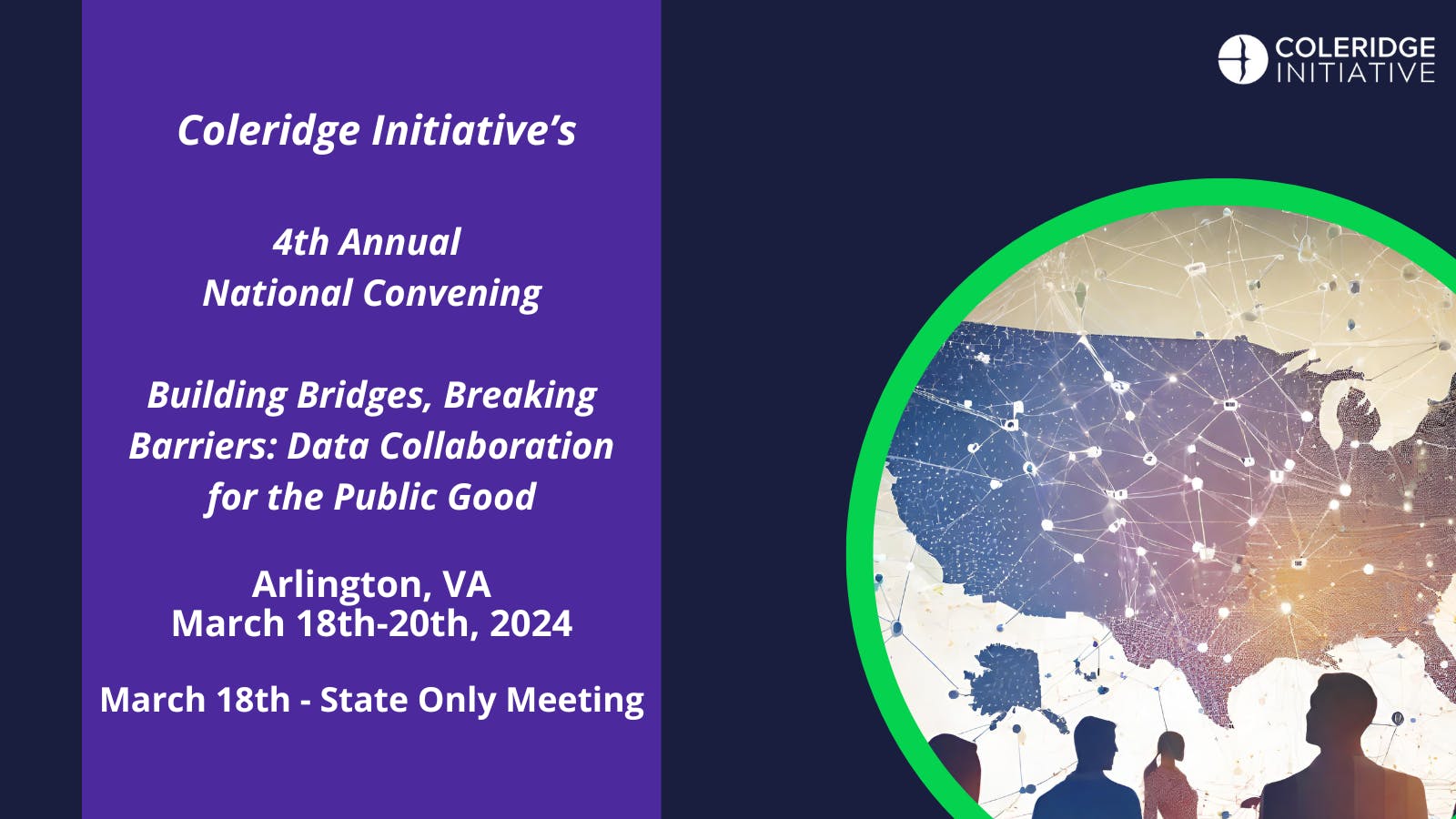
4th Annual National Convening - Building Bridges, Breaking Barriers: Data Collaboration for the Public Good
Join us for the Coleridge Initiative’s 4th Annual National Convening - Building Bridges, Breaking Barriers: Data Collaboration for the Public Good. The Convening will be held from March 18th - 20th, 2024, at the Crystal Gateway Marriott in Arlington, Virginia. Please note that March 18th is reserved for meetings of state agencies, institutions, and entities supporting the Multi-State Data Collaboratives in partnership with NASWA and SHEEO. General registration is closed. If you are a partner and would still like to register, please contact us at info@coleridgeinitiative.org.
In today’s data-driven world, the successful design of government policies and practices relies heavily on strategic collaboration between data partners. Coleridge Initiative’s Annual Convenings are designed to showcase the transformative potential of leveraging administrative data through state, federal, and private collaborations. In this year’s program, we will explore how leaders in the field are pushing the boundaries of traditional governance, forging data partnerships, and reshaping the future of public policy and administration. Attendees can expect to gain insights into how data collaboration can lead to better outcomes in public policy and administration, as well as learn about innovative projects, products, and practices that are driving change in the field. The Convening will feature sessions designed to provide attendees with valuable knowledge and networking opportunities. Some of the highly anticipated sessions include: Fireside Chat - Building Bridges from Data to Public Impact Philanthropic Funding Impacts on Data Innovation and Collaboration Democratizing Data Challenge Gallery Walk Poster Session Employing Strategies for Effective Code Modernization Breaking Barriers through Technology What’s Next with AI? Collaboration for the Future: What’s Next with Upcoming Projects? We invite you to join us for this exciting event and discover how we can work together to leverage data for the public good.
22 Jan 2024
Complex Data Systems and Analytical Approaches: Facilitating Evidence-Based Decision-Making
Join Coleridge Initiative VP of Product and Development, Nathan Barrett, Senior Manager of Training and Data Analytics, Benjamin Feder, and Senior Research Scientist, Corey Sparks to discuss the complex data systems and analytical approaches required to facilitate evidence-based decision-making. 12: 00 PM - 1:00 PM (EST)
Today’s policy questions require increasingly complex data systems and analytic approaches to facilitate evidence-based decision-making. The Coleridge Initiative’s Applied Data Analytics (ADA) training programs are centered around these questions and designed to both build new data infrastructure and the analytic capacity of agency staff. Coleridge's full training program topics are collaboratively developed with partner states and the curriculum is designed to demonstrate concepts through a project-based learning approach. By working hands-on with micro-level data, participants can explore the art of the possible by developing, interpreting, and communicating value-based outcomes. Coleridge is also excited to announce our short course series which takes a deeper dive into core data analytic concepts through the use of micro-level data. In this webinar session, we will provide an overview of our ADA programs, products and insights developed through the training, and an outlook on innovations that can be achieved through our programs.
19 Sep 2023
Access and Discovery of Data for the Public Good
Join Coleridge Initiative CEO, Ahu Yildirmaz, and CTO/CISO, Mahesh Sahore, to discuss the Administrative Data Research Facility (ADRF). 12 PM - 1 PM EST
The Administrative Data Research Facility (ADRF) is an award-winning, secure, cloud-based data hosting platform that enables collaboration between agencies across jurisdictions. With a focus on safe access and use of administrative data, the ADRF provides agency researchers with secure data enclaves that promote collaboration and innovation. During this webinar session, we will explain the pipeline from data ingestion to safe exports while providing a walkthrough of the ADRF including Coleridge's project isolation model and demonstrating how researchers can access their data with R or through DBeaver. We will also present a live demo of the newly launched ADRF Management Portal.

28 Mar 2023
3rd Annual National Convening: Cross-Agency Collaboration for Evidence-Building
The Coleridge Initiative's 3rd Annual National Convening highlighted the transformative potential of collaborations among government agencies and researchers that use linked administrative data to produce actionable insights to improve government programs. The first day of the conference, March 27th, was reserved for an invitation-only meeting beginning at 1:30 PM ET for the Multi-State Data Collaboratives.
States play a critical role in building evidence to improve the impact of federal programs administered at the state and local levels, and should be partners in creating the evidence-building ecosystems needed to leverage federal and state data in ways that benefit constituents, improve programs, and inform policy. This year's conference was intended to spark interest and continue to build upon the interest of federal, state, and private sector organizations to work together to harness the rich government administrative and statistical data as well as private sector data to answer important policy questions. The three-day event featured sessions developed in partnership with the National Association of State Workforce Agencies (NASWA), the National Governors Association (NGA), and the State Higher Education Executive Officers Association (SHEEO). Sessions highlighted state and federal projects working with linked data, state data products being used to inform policy, and the impact of the Democratizing our Data Challenge. Funded by philanthropic organizations, the Democratizing our Data Challenge gave states an opportunity to develop data products and collaborate across jurisdictions through the Multi-State Data Collaboratives. The convening also featured a panel session with leading members in the data community focused on the unique position of states to leverage their data while also collaborating with federal, private, and academic data.

30 Mar 2022
The Multi-State Data Collaboratives: from Projects to Products to Practice Convening
Join leaders from across the country for the Multi-state Data Collaboratives: From Projects to Products to Practice. This year’s convening is a response to the success of the First Annual National Convening in March 2021, the overwhelmingly positive response to the Democratizing our Data Challenge, and the rapid expansion of multi-state data collaboratives.
There is an urgent need for timely, locally relevant, data and evidence that can be used to respond to the changes in the pandemic economy, particularly for low-income learners and workers, at-risk youth, underrepresented minorities, immigrants, and formerly incarcerated individuals. New information can inform policies about investments in education and training, student debt, as well as welfare and corrections programs. Federal, philanthropic, and state partnerships have led to new projects, products, and practice for evidence building. The results are being used by many state Departments of Labor, Education and Human Services. At the National Convening, attendees will both learn about current and proposed projects and products and help set priorities for the future. In partnership with the National Association of State Workforce Agencies and State Higher Education Executive Officers Association, the Multi-state Data Collaboratives: From Projects to Products to Practice convening will introduce the regional collaboratives that are creating networks with national reach across agency and state lines. The convening will showcase the value of new products that have recently been made possible through philanthropic foundations, federal investment, and state agencies including state Departments of Labor, Education, and Human Services, and highlight new and potential partnerships, projects and products that are moving to national scale this year. The convening will also allow us to demonstrate how new approaches can be used to inform equitable decision-making.
03 Mar 2021
National Convening: Jobs Data for Evidence-Based Policy
Join leaders from across the country, representing state and federal governments, as well as philanthropic foundations and professional associations, for a dynamic two-day workshop celebrating success and mapping a strategy to grow data access, stewardship, and analysis for evidence-based policymaking.
The convening will highlight the demonstrated success of a collaboration of state workforce agencies and universities across the country, as well as tangible evidence about the value of state and federal data, and build sustainable state data infrastructure through partnerships and national support. The current COVID-19 outbreak and the resulting employment crisis have made it clear: state and local data are key to understanding and responding to local social and economic challenges. While state data systems end at state borders, there is massive potential to develop the cross-state infrastructure needed to collect, mine and use administrative data; share evidence-based practices; and establish common measures and research tools. LEARN how states have worked together to develop regional collaboratives around a framework of training, shared products, data standards and governance. SHARE your expertise and insights to the development of a national agenda and a sustainable, locally driven, national data infrastructure. GROW the community of data-oriented, evidence-based policymakers and program administrators. ACCELERATE data-driven research and policies supporting program management, policy development, and scholarly research.